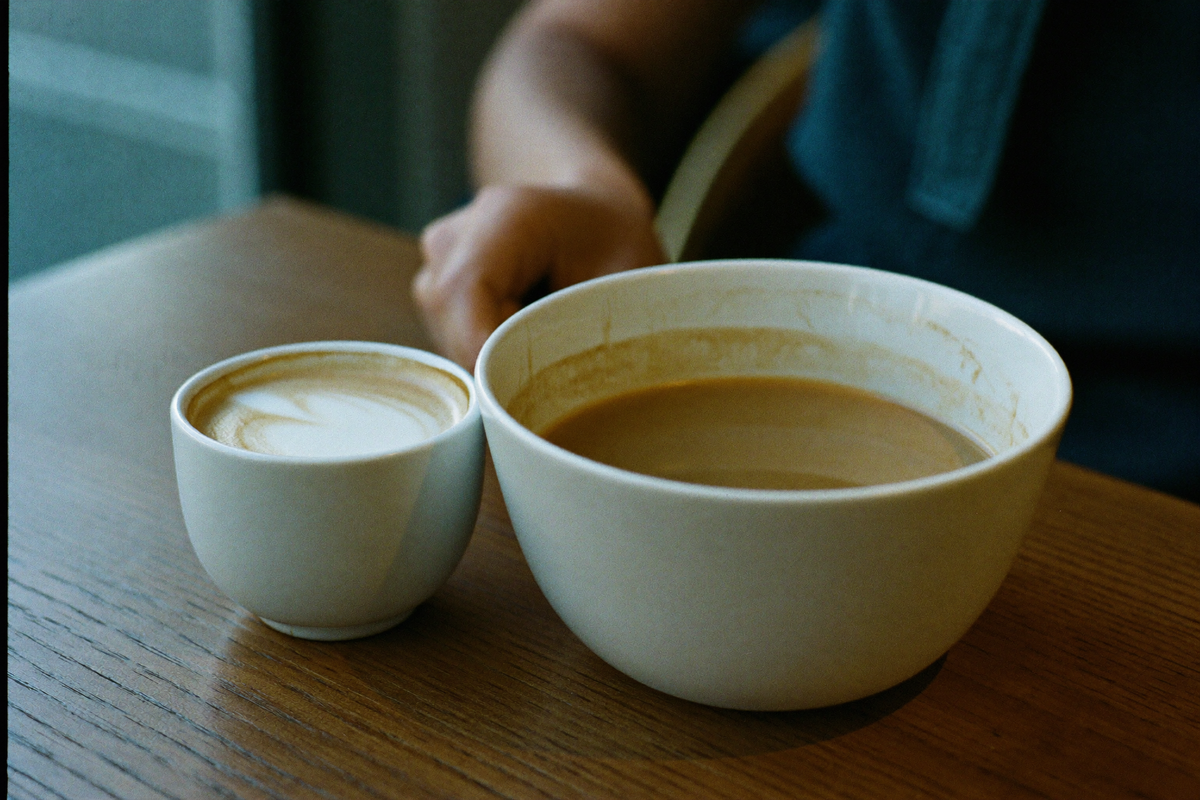
Order a large cappuccino and you get more milk. You do not get more coffee. The shot stays exactly where it was, sized by the basket in the portafilter, and the only number on the menu that moved was the price. Whatever ratio defined the drink when it was small has moved by roughly a factor of three by the time it reaches half a litre, and no menu anywhere describes that as the upgrade it is being sold as.
Size changes quality, because almost nothing in a cappuccino scales with the cup. Espresso volume is fixed. Foam depth is fixed by how the milk was textured, and it is a depth, not a percentage. Only the milk grows. A cappuccino at 150 to 180 ml is finished while it is still one integrated fluid and still inside the temperature band where you can taste it properly. One at 470 ml is not, and skill at the machine does not change that.
That is an argument about arithmetic and heat, not about tradition. The tradition argument is weaker than most people who make it realise, and we will get to why.
The arithmetic is most of the case
Anette Moldvaer's specification in Coffee Obsession is a single 25 ml shot into 130 to 150 ml of milk. Call that one part coffee to five or six parts milk. Contemporary specialty practice in most English-speaking markets builds the same drink on a double shot in a cup of 150 to 180 ml, which lands nearer one part coffee to three parts milk. Same cup size, twice the coffee. The drink has already drifted stronger since the book was published, which is worth saying out loud before anyone claims a fixed standard exists.
Now put that same double shot into a 470 ml cup. Roughly 50 ml of coffee. Roughly 400 ml of milk and foam. One part to eight.
Against the modern small cappuccino, that is about a third of the coffee concentration in every mouthful. The barista did not make a worse drink. The cup made a different one, and then the menu called both of them cappuccino. There is an honest version, and the cafés that do it well already charge for a third shot in the large size so the ratio holds. Most do not, because the margin on milk is very good and the margin on coffee is not.
Foam is a depth, not a proportion
Moldvaer separates cappuccino from flat white and latte by foam depth rather than by size: roughly 10 mm against roughly 5 mm. Depth is the definition. That matters the moment the cup gets bigger, because 10 mm of foam sitting on a 130 ml column of milk looks and drinks like a cappuccino, and 10 mm sitting on a 400 ml column looks like somebody forgot.
The usual response behind the bar is to texture more air into the pitcher so the foam layer reads correctly in a taller cup. That has a cost, and the cost is structural. Milk foam is held up by protein at the air and water interface, not by fat. Fat globules actively destabilise bubble walls, which is why skim milk throws up more foam volume while whole milk throws up less foam with a denser, smoother structure. Push extra air into the same milk and you buy volume by giving up bubble size. Bigger bubbles are what people mean when they say a cappuccino tasted dry and looked like washing-up suds.
Foam and milk also separate on standing. Continuous swirling right up to the moment of pouring is what keeps them a single glossy fluid, and a dry foam island floating in the pitcher means the drink has already failed before it reaches the cup. A larger drink takes longer to steam, longer to pour, and longer to drink. Every one of those is more time for the two phases to come apart.
There is a second casualty at the rim. Moldvaer's own cappuccino instruction leaves a ring of bare crema visible at the edge of the cup so the first mouthful is coffee-forward rather than milk-forward. A wide cup finished with full-surface latte art has no ring left, which means a presentation convention quietly overrode a taste principle stated in the same book. Worth knowing before you judge a café by its leaf, and related to why crema is a freshness signal rather than a quality one.
The temperature curve of a large cup is worse at both ends
Start with the physics. A vessel loses heat across its surface and stores it in its volume. Scale a cup up and volume grows faster than surface area, so a bigger drink cools more slowly. That sounds like a feature. It stops being one once you know what temperature does to tasting.
Jessica Easto is direct about it in her account of the sensory work: heat gets in the way of tasting, and the studies she cites put peak detection of sucrose and other tastants somewhere around 72 to 91°F, which is 22 to 33°C. The SCA's cupping protocol is built on the same fact. No first taste until the sample has fallen to 160°F (71°C). Acidity, body and balance are judged between 160 and 140°F (71 to 60°C). Sweetness, uniformity and cleanliness are held back until the cup approaches 100°F (38°C), and tasting stops at 70°F (21°C). Easto also notes Steen's recommendation to let coffee cool to about 130°F (54°C) before tasting it at all.
So the first sips of any hot drink land in a low-perception zone. The difference is what happens next. A 150 ml cappuccino falls through the useful band and is finished inside it. A 470 ml one holds above the band for longer, and by the time it arrives there you are twenty minutes in, the foam has drained back into the milk, and the coffee itself has kept changing chemically in the cup, which Easto notes usually goes in the wrong direction.
Put plainly: a large cappuccino is hottest when you can taste it least, and most drinkable at the point where it has stopped being the drink that was served. The small one has no such gap, because it does not last long enough to open one.
Cup material and wall thickness move this curve too, in the same direction as volume. A preheated cup buys you a slower start rather than a hotter one, and a heavy stoneware wall holds the drink in the band longer than thin porcelain does. Neither can rescue 400 ml of milk from taking a quarter of an hour to drink.
Milk has a ceiling and a bigger pitcher makes it easier to hit
Moldvaer puts the target milk temperature at about 60 to 65°C, and Racineux and Tran agree, with a hard ceiling near 70°C above which the sweetness people are actually paying for is gone and the milk starts tasting cooked. More milk means a longer steaming run, judged by hand on the side of a pitcher, with more time spent near the top of that range. Large drinks are not condemned to be overheated. The margin for error just gets thinner as the volume grows, and the failure is invisible until the first sip.
The heritage argument is not the strong one
People who defend the small cappuccino usually reach for the rule of thirds: one third espresso, one third milk, one third foam. That rule has no traceable historical basis. James Hoffmann traces the earliest phrasing to a 1950s text that is ambiguous enough to mean one part coffee to two of milk and two of foam, which is a different drink entirely.
The name is not evidence either. Cappuccino descends from the Viennese Kapuziner, named for the colour of a Capuchin monk's habit, and Jonathan Morris records that Vienna's licensed coffeemakers let customers pick the shade of their coffee off a colour chart from 1697 onward. The drink was named after a paint sample. Nothing about that fixes a volume.
Which is why the argument here is made on the cup instead. Ratio, foam depth, and the time it takes you to drink it are measurable. Heritage is a story, and this one does not survive being checked.
What a small cup will not do
A 150 ml cup will not rescue a bad shot. If the espresso underneath is sour, burnt, or pulled from beans that were ground an hour ago, concentrating it makes the fault easier to taste, not harder. It will not fix milk that was textured into bubbles rather than microfoam. It will not make you enjoy a cappuccino if what you actually wanted was a large, warm, milky drink to hold at a desk for an hour, and that is a completely legitimate thing to want. If it is what you want, order a latte in a big cup. That drink was designed for the job, its foam layer is thinner, and it does not pretend the ratio held. Buying a small cup as a corrective for a drink you did not want is just a smaller portion of the wrong thing.
If you are buying one cup for milk drinks
Buy 150 to 180 ml, with a rounded interior base. The round base is not decoration. It supports the roll of milk entering the cup and returns the stream to the surface as a coherent white column, which is why classic cappuccino cups have that shape and why flat-bottomed cups fight you.
We sell cups in both sizes and we will not pretend the larger ones are a compromise, because for latte and for practising pours they are the right object. Dhan Tamang teaches latte art on a 300 ml cup for a straightforward reason: a bigger canvas is easier and holds more design elements. The cup that makes the best photograph is not the cup that makes the best drink. A store can sell both honestly as long as it labels them by what they are for, which is the same reason we argue for keeping two vessels rather than one that does everything badly.
The test is cheap if you would rather not take our word for it. Steam one pitcher, pull two shots, and build the same drink at 150 ml and at 400 ml. Drink them side by side and pay attention to the last third of each. That is the method in why a single cup teaches you almost nothing, applied to a question you can settle in five minutes.
Sources. Anette Moldvaer, Coffee Obsession (foam depths, cappuccino specification, the bare crema ring). Jessica Easto, How to Taste Coffee (temperature and taste detection, SCA cupping protocol temperatures, flavour change as coffee cools). James Hoffmann, The World Atlas of Coffee (the rule of thirds and its missing provenance). Jonathan Morris, Coffee: A Global History (the Kapuziner, the Vienna colour chart, 1697). Dhan Tamang, Coffee Art (the 300 ml teaching cup). Sébastien Racineux and Chung-Leng Tran, Coffee Isn't Rocket Science (the milk temperature target and ceiling, with Moldvaer). Milk foam protein and fat behaviour, and milk and foam separation on standing, from the craft and vessel source analysis.