Every product page for a cup, mug, tumbler or flask claims the same virtue, in the same words: it keeps your coffee hot. It is the only property the entire category has agreed to compete on, and it is the reason most people own the wrong vessel for the thing they are actually doing.
Heat retention is not a universal good. It is the right feature for one job and the wrong feature for the other. A vessel you sit down with and a vessel you carry somewhere are two different products solving two different problems, and a shop that ranks them against each other on a single axis is selling you the wrong one about half the time.
The physics, briefly
Coffee cools because heat leaves it by four routes at once. It evaporates from the open surface, which for an uncovered cup is usually the largest single loss. It conducts into the wall of the vessel and onward into the table and your hand. It convects off the outer surface into the room. And it radiates.
Two consequences follow, and they run in opposite directions.
The first minutes are where most of the loss happens. The rate of heat loss is proportional to the difference in temperature between the drink and the room, which means it is steepest at the start and flattens as the drink approaches room temperature. Whatever happens in the first two or three minutes largely determines your drinking window. Everything after that is a long tail.
The vessel itself is a heat sink before it is an insulator. This is the part almost nobody accounts for. A single espresso is about 25 grams of liquid. A thick stoneware demitasse can weigh 150 grams or more. Pour a 90-degree liquid into a cold object with six times its mass and comparable specific heat, and a large share of the drink's heat goes straight into the ceramic before it ever reaches you. The smaller the drink and the thicker the cup, the more brutal this is, which makes an espresso in an unheated heavy cup close to the worst case in the entire beverage world.
Which is why preheating is the highest-leverage thing you can do to any hot drink, and it costs nothing. Rinse the cup with hot water and dump it. That single habit does more for a small drink than most equipment upgrades, and almost nobody sells it because there is nothing to sell.
Where "keeps it hot" stops being a virtue
Here is the tradeoff the category never mentions.
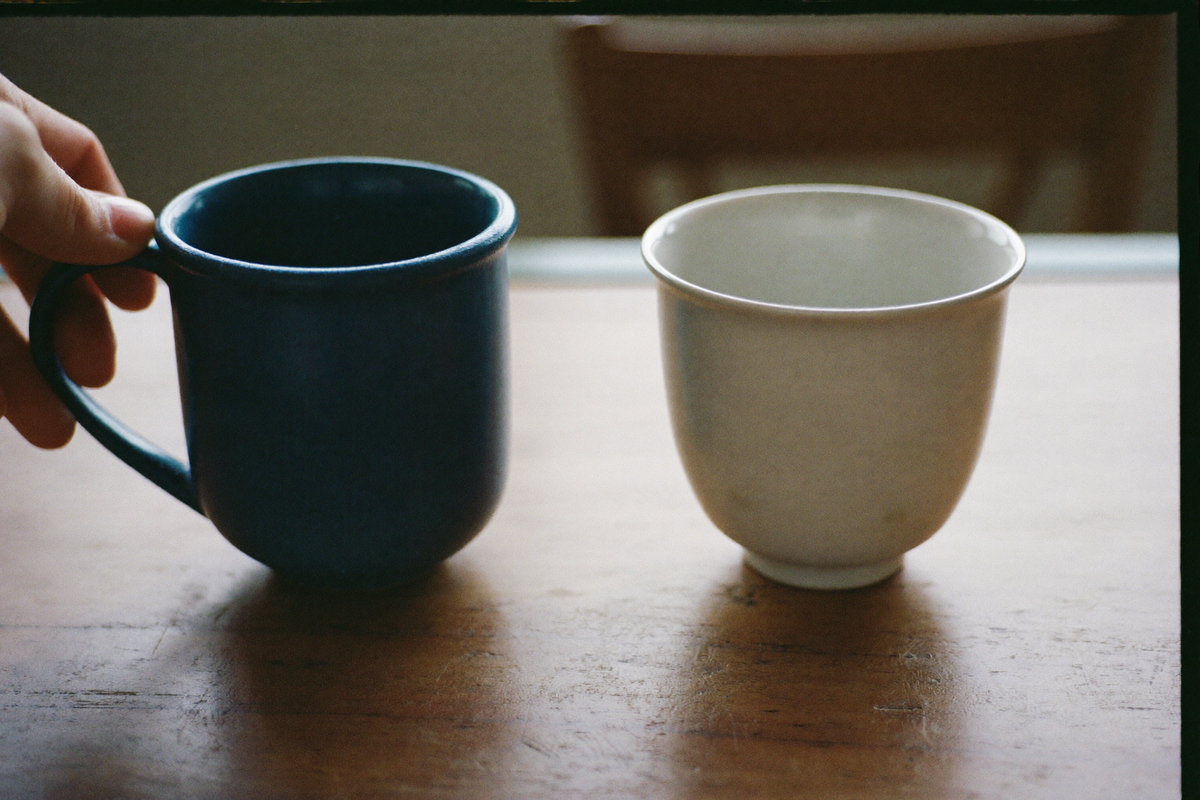
If you are sitting down with a coffee, you are not only drinking it. You are, without noticing, reading it. You put a hand on the cup wall and you know roughly how long you have left. Hot means plenty of time. Warm means finish soon. Cold means the moment has passed. Nobody consults a clock for this. The vessel wall is the display, and you read it by touch without ever deciding to.
A cup that never cools has disabled that display. It is not giving you more time, it is removing the signal that tells you when your time is up. If you have ever sat with a vacuum tumbler for forty minutes and found the coffee still uncomfortably hot at the bottom, you have experienced a product working exactly as designed and producing an experience nobody wanted.
There is also a flavour cost, and it runs the same way. Coffee reveals different things as it cools. A cup held at serving temperature for an hour is a cup you never taste properly, because the range where most of its character is legible sits below where the insulation is holding it.
None of this is an argument against insulation. It is an argument that insulation is a feature of one product and a defect in another, and the way to shop is to work out which one you are buying.
The split
| Sitting vessels | Carrying vessels | |
|---|---|---|
| The job | Meter an interval you are present for | Move the drink somewhere else |
| Construction | Single-walled ceramic, readable by hand, ideally saucered, preheated | Vacuum-walled steel, lidded, sealed |
| Heat retention | A liability past a point | The entire purpose |
| What it fails at | Keeping coffee hot on a commute | Telling you anything by touch |
| Failure it prevents | Sitting down and then not actually stopping | Arriving somewhere with nothing good |
Two products. Not a good one and a compromise. A mug is a clock and a flask is a pause button, and a shop that pretends they are the same product is going to sell you the wrong one.
The one honest correction about double-walled glass
Double-walled borosilicate glass is sold on insulation and is not very good at it. The gap between the walls is air, not vacuum, and air conducts. It performs better than a single-walled glass and nowhere near a vacuum-walled steel flask, which is a genuinely different category of object and will hold a drink for hours.
That does not make double-walled glass a bad product. It is light, it looks like almost nothing on a table, it will not scald your hand, and it shows the drink, which matters for anything layered. Buy it for those reasons. Just do not buy it expecting flask performance, because it will not deliver that, and we would rather tell you now than have you conclude we oversold it.
We should also say plainly that we have not measured the retention gap ourselves. The direction is not in doubt, the magnitude is something we intend to test and publish rather than repeat from a manufacturer's page.
The other variable nobody mentions: the mouth
Width of the opening is a real tradeoff, not a style choice.
Wide mouth: more surface area, so more evaporation and faster cooling into the drinkable band, and much more aroma reaching you. Good for a coffee you want to smell and finish within a reasonable window.
Narrow, inward-tapering mouth: less evaporative loss, so it holds heat longer, and it traps aroma above the liquid instead of releasing it into the room. This is the classic espresso shape and it is why it looks the way it does.
You can test this in one sitting with the same coffee in two cups, which makes it one of the few claims in this whole category you do not have to take anyone's word for.
What neither vessel will do
Neither one will improve the coffee. Nothing about the material adds flavour, and any product page implying a cup makes coffee taste better by some unstated mechanism is describing magic. What a vessel changes is temperature over time, aroma delivery, how the rim meets your mouth, and how you feel about the object in your hand. Those are real and they are worth paying for. They are not the same as better coffee.
A vessel also will not fix a drink that was wrong when it was poured, and it will not extend a drinking window indefinitely without costing you the very thing the window was for.
What we would actually buy
If you are starting from nothing and want to stop owning the wrong thing:
- One single-walled ceramic mug you like looking at. Enough wall to hold heat for the twenty minutes you will actually sit there, thin enough at the rim to be pleasant. Preheat it. This is the everyday object and the one worth caring about.
- One vacuum-walled steel flask. Not for the desk. For the car, the walk, the site visit, the flight. Buy on seal quality and lid design, because that is what fails.
- A small heavy demitasse if you drink espresso, and the discipline to rinse it with hot water first.
Three things. The flask we do not sell, because vacuum-walled steel is a manufacturing problem rather than a materials one and the people who do it well have been doing it for decades. Buy theirs. We will happily sell you the other two, and the reason to buy ours is that you want to look at them every morning for ten years, which is a real reason. It is just a different one.