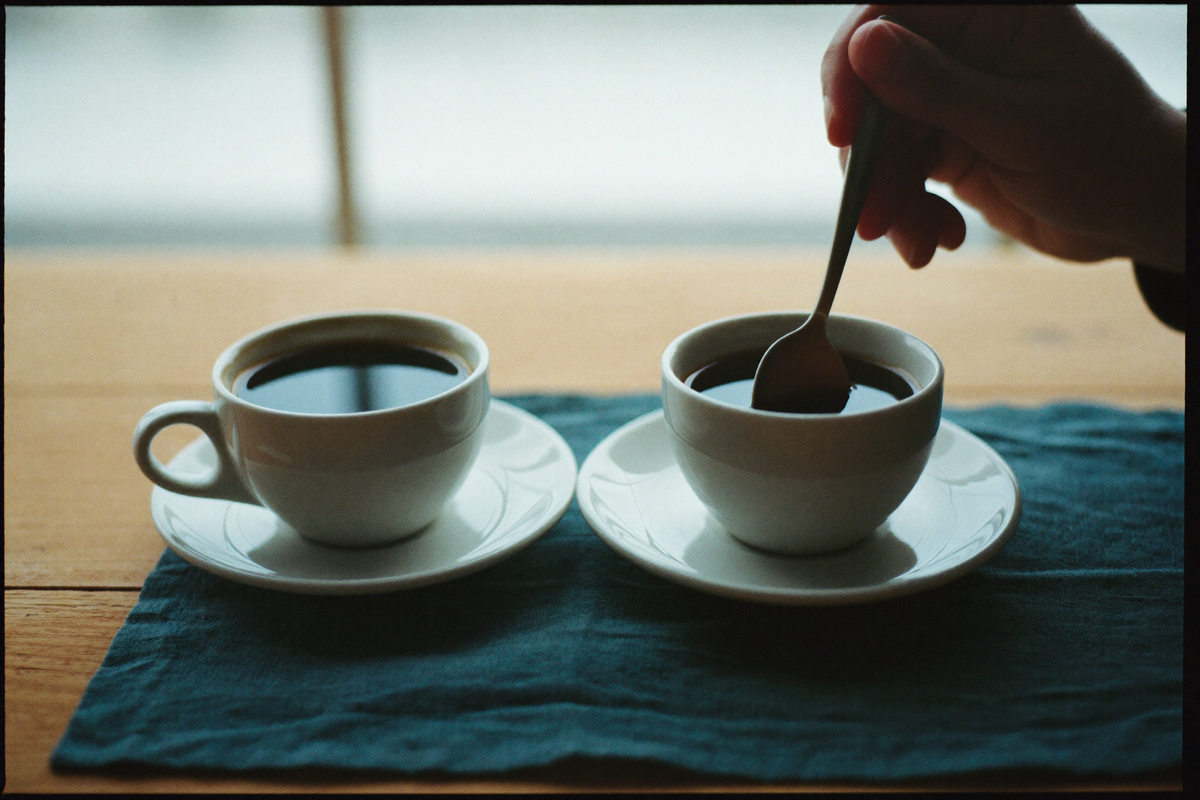
Drinking one coffee attentively teaches you almost nothing about it. That is an uncomfortable thing to say to somebody who has just spent twenty pounds on a bag and sat down to concentrate, but it is how human senses work, and knowing it saves years of wasted effort.
Taste is comparative. You cannot reliably describe a coffee in isolation, only relative to another one. Brew two coffees side by side and you will learn more in ten minutes than in a month of careful solo drinking. The skill everyone is trying to build is not sensitivity. It is discrimination, and discrimination requires two things to sit between.
Why one cup fails
Your senses are built to report change, not absolute values. This is why you stop noticing a smell in a room after a few minutes, and why a room that felt cold becomes unremarkable once you have been in it a while. The system adapts to a steady signal and starts reporting only what differs from it.
Applied to a single cup of coffee, that means the first sip resets your reference point, and every sip afterwards is measured against the coffee itself. You end up calibrating the thing against a copy of itself, which produces an impression rather than an observation.
There is a second problem, and it is the one that actually stops people. You have no vocabulary anchor. "Fruity" means nothing until you have tasted the same coffee next to one that is not fruity. The word arrives attached to a difference, and without the difference it stays a word you are repeating rather than a thing you have noticed.
This is why tasting notes on bags so often feel like a test you are failing. You are being handed the conclusion of a comparison you were not present for.
What professionals actually do
Coffee professionals almost never assess a coffee alone. The standard tool is cupping, a method designed specifically to get several coffees onto a table prepared identically, at the same time, at the same temperature, so that the only variable left is the coffee.
That last clause is the whole point. Everything cupping does that looks fussy, the fixed dose, the identical grind, the same water, the same steep, exists to remove the differences you are not interested in so that the one you are interested in becomes visible.
Jessica Easto's How to Taste Coffee makes the case plainly and, more usefully, gives a way to test whether it is working. The exercise is called triangulation. You prepare three cups, two of the same coffee and one different, and you try to pick out the odd one. You do not have to say what the difference is. You only have to find it.
The statistic attached to it is the part worth carrying. Get five right out of six consecutive triads and the odds of having fluked it are about 1.8 percent, near enough two in a hundred. So if you can do it, that is not confidence, it is evidence. Q graders must pass triangulation tests for certification, and the World Cup Tasters Championship is built on them.
Most home tasting has no way of telling you whether you are improving. This one does, and it needs nothing you do not already own.
The practical version
You do not need a cupping table. You need two coffees and one decision about what you are comparing.
Pick a pair that differs on exactly one axis you care about. Easto's suggested pairings are the useful ones: a traditional roast against a modern one, or a dark roast against a light, an African coffee against a South American, a blend against a single origin, or the same beans brewed as espresso and as filter.
Brew both the same way. Same dose, same grind, same water, same time. If the two coffees were brewed differently you have not compared coffees, you have compared brews.
Taste them alternately rather than finishing one and starting the other. Go back and forth. The difference shows up in the switch, not in the dwelling.
Write down what you notice before you discuss it with anyone else. Easto is firm on this and the reason is not politeness. In a group, the first person to speak anchors everyone else, and facial expressions do it almost as effectively as words. Keep a straight face and keep your notes to yourself until the end.
Easto is also honest about the one real obstacle at home, which is heat. Keeping the first coffee hot while you brew the second is genuinely awkward. An insulated flask and some patience is the answer she offers, and there is not a better one.
Building the vocabulary properly
The comparative principle extends past coffee. The reason the World Coffee Research Sensory Lexicon exists, and the reason it is free on their website, is that flavour language only works when everybody is pointing at the same reference.
You can build the basic taste references at home with things from a supermarket. The point of preparing a bitter reference or a sour one and tasting it blind is not that you will encounter that exact compound in a cup. It is that you learn what the category feels like in your own mouth, with your own name attached to it, so the word stops being borrowed.
That is the whole progression. Two coffees teach you difference. A reference teaches you what to call it. Neither works alone.
What this will not do
Comparative tasting will not make you enjoy coffee more, and for a while it may do the opposite. Attention has a cost, and there is a stage where you notice a flaw in something you used to be perfectly happy with. That is a real loss and it is worth saying out loud.
It will not tell you which coffee is better, either. Triangulation tests discrimination, not preference. You can reliably tell two coffees apart and still have no opinion worth acting on about which one you want on a Tuesday morning, and there is nothing wrong with that.
And it will not turn tasting notes into predictions. Knowing a coffee is more acidic than another one does not tell you it will taste of blackcurrant, because those descriptors are one person's association reported through a shared vocabulary, not a measurement. Two coffees at identical extraction percentages can taste completely different, which is exactly why sensory evaluation still uses people as the instrument.
Where to start this week
Buy two bags that differ on one axis. A light roast and a dark roast is the easiest pair to begin with, because the difference is large enough that you will definitely find it, and finding it is the thing that convinces you the method works.
Brew them the same way, taste them alternately, and write two sentences about each before you say anything out loud.
Then do it again next week with a smaller difference. That is the entire curriculum, and it is the only one that compounds.