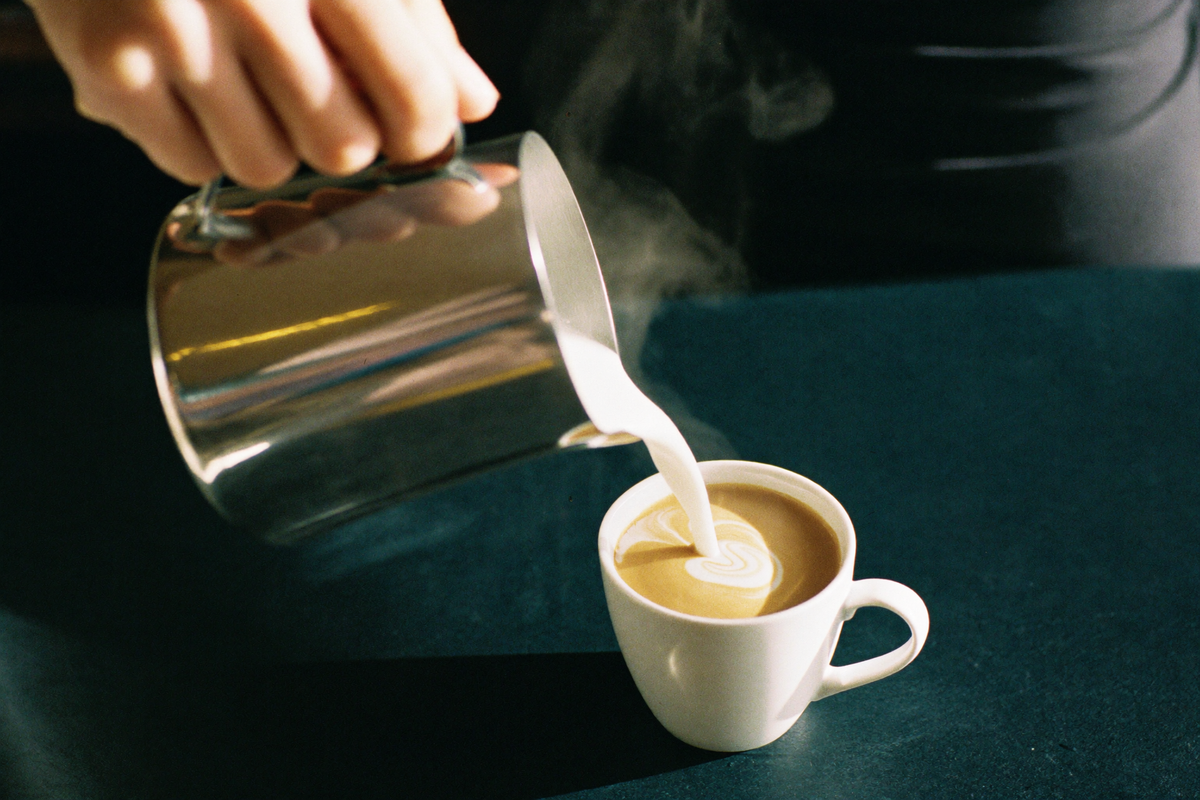
The argument in most kitchens is about foam volume, and it has been settled in the wrong direction for years. Whole milk does not foam more than skimmed. It foams less. What you are choosing when you pick up one carton instead of the other is not how much foam sits on the drink, it is how sharp the coffee arrives and how long it stays in your mouth afterwards.
Protein builds the foam. Fat changes what the foam does to the coffee. Skimmed and whole milk both foam, and they foam for the same reason, because their protein content is close to identical and it is protein that holds a bubble together. Skimmed gives more foam, drier and stiffer to the tongue, with the coffee flavour arriving sharper and finishing sooner. Whole gives less foam, smoother and heavier, with the coffee flavour less intense at its peak and longer in the tail. Neither one is the right answer. Choose by finish, not by volume.
Why protein is the thing that foams
Foam is air trapped inside a liquid film. Milk proteins move to the surface of every bubble, unfold there, and hold the film together long enough for the bubble to survive. That is the mechanism, and it does not care about fat.
Fat interferes with it. Fat globules disrupt the protein film, so a milk with more fat produces less total foam and a finer, softer one. This is the point that sounds backwards and is not: the milk people associate with richness makes the smaller head, and the milk people write off makes the bigger one.
The reference books disagree on this openly, which is worth knowing before you take advice from either. Racineux and Tran, in Coffee Isn't Rocket Science, hold that whole or unpasteurized milk at 3.5 per cent fat is the standard and that skimmed and semi-skimmed do not produce a creamy enough foam. Anette Moldvaer holds that any milk steams, including soy, almond, hazelnut and lactose-free, with low fat producing more foam but a drier texture and full fat producing less foam but a creamier one. Moldvaer's framing is the better one, and not only because it matches what happens at the pitcher. It predicts what you will taste. The other position forbids a category and leaves you with nothing to do if the only carton in the fridge is semi-skimmed.
Why fat is the thing that carries
Jessica Easto's sensory work gives the second half of the mechanism, and it is the half that explains why a whole-milk flat white tastes less of coffee and more of coffee for longer.
Butterfat is the lipid doing the work, and lipids are most of what a liquid's weight in the mouth is made of. US labelling standards set skimmed at 0 to 0.5 per cent butterfat, 1 per cent milk at 1 per cent, whole at 3.25 per cent, and half and half anywhere from 10.5 to 18 per cent. Other countries draw those lines in other places, so read the carton rather than this article. Easto points out that the industry's own Sensory Lexicon uses 1 per cent milk and half and half as its physical references for the oily mouthfeel attribute, which is a small fact with a large implication: the coffee industry calibrates its vocabulary for oiliness against milk.
Two findings she reports then do the work. The first is that a thicker liquid needs more sour, sweet or bitter in it before you register any of them, so all three land softer, while umami runs the other way and lands harder. The second is that aftertaste often comes from the part of a drink that never dissolved, lipids included. Whatever was soluble leaves with the swallow. What is left stays on the tongue and around it, still giving something off.
Put those together and whole milk stops being mysterious. It damps the peak and extends the tail. Skimmed does the opposite: less to get through, so the coffee lands harder and leaves sooner.
| Milk | Foam volume | Foam texture | How the coffee reads |
|---|---|---|---|
| Skimmed | most | stiff, dry, holds a peak | sharper, more intense, shorter finish |
| Semi-skimmed | middle | middle | middle, and genuinely fine |
| Whole | least | smooth, dense, pours well | softer, less intense, longer finish |
| Half and half | least of all | barely a foam | thick, coating, coffee flavour muted |
The variable that beats the one you are arguing about
Fat percentage decides the character of the drink. Temperature decides whether the drink is any good, and it is the larger effect by some distance.
Air can only be added to milk while it is still cold. Bubbles created above roughly 37 degrees C will not fold back into a smooth foam, they sit on top as visible bubbles, and no amount of swirling repairs it. So the stretching phase is the first few seconds and nothing after that. Once the base of the pitcher reaches body heat, the job changes from adding air to spinning what you already have into the milk.
The finish line is 60 to 65 degrees C, and the tactile cue Moldvaer and Racineux both give beats any thermometer: stop when the pitcher becomes just too hot to hold. A deep rumbling from the pitcher means you are already past it. Beyond about 65 degrees the milk starts tasting eggy, or like boiled oatmeal, and by about 68 the change is irreversible. Boiled milk cannot make microfoam at all, no matter what you do to it next.
That number is why "extra hot" is a real conflict rather than a barista being difficult. James Hoffmann puts it plainly: you can have milk very hot or very good, not both. If your drink goes cold too fast, the fix is a smaller drink or a cup that is not stealing the heat before you start, not a hotter pitcher.
One more test, and it costs nothing. Milk close to its use-by date still foams, but the foam collapses audibly, fizzing like a soft drink as it goes. If you hear that, the milk is on its way out and the drink will taste faintly of it.
Plant milks, and what we are not going to claim
Both of the books above predate barista formulations, so their positions on plant milks are dated in a way their dairy chemistry is not. Moldvaer's dismissal of rice milk was fair about the product in front of her. It says nothing useful about a 2026 barista oat.
What is honest to say: a barista edition is a different formulation from the standard carton of the same brand, adjusted so it behaves more like dairy in a pitcher, and swapping between the two changes the result enough to notice. What we are not going to publish is a temperature ceiling or a foam-stability figure for any specific plant milk, because we have not tested them side by side and the numbers circulating online do not carry a source we could check. When we have run that test with a thermometer and a pitcher, we will publish what we measured, including the ones that did badly.
What this will not do
Changing your milk will not fix a bad espresso. Milk sits on top of the coffee and modifies it. It dilutes what you taste and changes nothing about how much was pulled out of the grounds, which is the difference between strength and extraction. If the shot underneath is sour because the puck channelled or the beans are four months old, whole milk will round the edge slightly and leave the fault exactly where it was. Diagnose the coffee first, using the sour-or-bitter split that resolves most bad cups in one taste.
Whole milk will not give you more foam, so if you are getting almost no foam at all, the fat percentage is not your problem. That is either air added too late, a pitcher filled past halfway, or a machine whose steam pressure cannot break the surface, which announces itself with a loud screech and no bubbles.
Skimmed will not flatter every coffee either. On a light-roast espresso with high acidity, the sharper, shorter delivery can push a bright cup over into plainly sour, because there is less body damping it. The same milk on a darker, chocolatey roast is often the better choice for exactly the same reason.
And none of this is a nutrition argument. We are describing texture and flavour release. Choose the milk your body and your household actually want, and read the rest of this as what to expect from it.
How to settle it in one morning
Make the same drink twice, one with each milk, at the same time, and taste them side by side rather than on consecutive mornings. Memory for texture is poor and a single cup on its own teaches you almost nothing.
Pay attention to two moments specifically. The first second, where skimmed will hit harder. And ten seconds after you swallow, where whole will still be there and skimmed will have gone. That gap is the entire decision, and once you have felt it you will stop reading milk advice, including this.