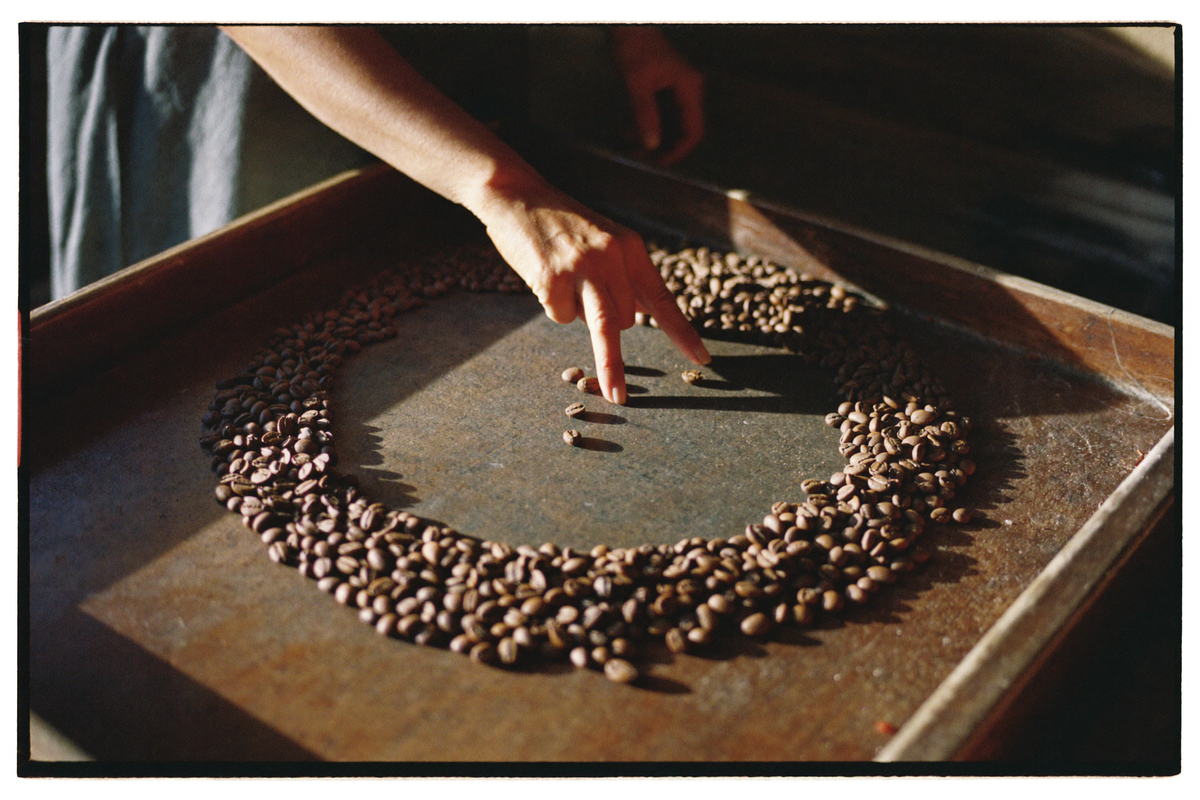
The peaberry premium is one of the few things in coffee that everybody in the chain has a reason to keep. The producer gets a higher price for beans that would otherwise disappear into the main crop. The exporter gets a lot that grades on its own and sells on its own. The roaster gets a story with a physical object attached to it, which is rare and useful. The customer gets a bag that feels like a small piece of inside knowledge. Nobody in that sequence is being dishonest. It is just that none of them is describing a quality standard, because there is not one.
A peaberry is a single round seed growing where a cherry normally makes two flat ones. It is a shape. It gets sorted out and sold separately, and it does sometimes taste different from the flat beans of the same coffee, but there is no reliable evidence that it tastes better. Where a peaberry lot is genuinely good, the most defensible explanation is the sorting it took to make the lot, not the roundness of the bean.
Where the shape comes from
A coffee cherry normally contains two seeds that grow pressed against each other, which is why a coffee bean has one flat face with a crease down it. When only one of the two ovules is fertilised, the surviving seed has nothing to flatten against and develops close to spherical. That is all a peaberry is. James Hoffmann puts it at around five percent of the crop, and Maxwell Colonna-Dashwood makes the point that gets lost most often: it is not a variety. Every variety produces peaberries. There is no peaberry tree.
What varies between origins is whether anyone bothers to separate them. Kenya and Tanzania sort peaberries out and sell them as their own lots, which is why almost every peaberry bag on a shelf comes from a short list of countries. Plenty of origins do not sort them at all, and their peaberries simply go through with everything else. The absence of Ethiopian peaberry on shelves is not evidence that Ethiopian cherries behave differently. It is a sorting decision.
Why PB sits in a grading table at all
This is where the word "grade" gets its foothold, and it is worth being precise about it.
Several producing countries grade green coffee by screen size, meaning the beans are passed over perforated plates and sorted by whether they fall through. The tables below are Hoffmann's, from the country entries in the Atlas. Kenya's system runs E for elephant beans, AA for anything above screen 18 at about 7.22 mm, AB for a mix of screens 15 and 16 which is roughly thirty percent of annual production, then PB, then C, TT and T. India runs AAA down through AA and A to PB. Hawaii separates Kona peaberry into a type of its own, with Kona Number 1 Peaberry above the smaller Kona Peaberry Prime.
PB appears in those tables because a round bean does not behave in a screen the way a flat one does, so it needs its own bucket. Hoffmann puts PB at the small end of the whole-bean range, separate from the broken pieces, and he is equally clear elsewhere that a size system will imply a quality ranking it has not actually measured. Screen size is a sorting fact. It tells you the beans in the bag are consistent in size. It does not tell you they are good, and any grading table that ranks by dimension will produce a hierarchy that reads like quality without measuring it.
The three explanations, and what each would require
Colonna-Dashwood lists the competing theories for why peaberry might taste different and endorses none of them. That is the correct posture and it is worth showing the work.
| Theory | What would have to be true | What we can actually check |
|---|---|---|
| The single seed receives more of the cherry's nutrients | Per-gram composition of a peaberry differs measurably from a flat bean of the same cherry | No published comparison we can point to. Jonathan Morris reports the sceptical reading: one peaberry comes in under the weight of the two flat beans it replaced, so part of what the premium buys back is the yield the grower lost |
| The round, dense shape roasts more evenly | Heat enters a sphere more uniformly than a flat bean with an edge and a fold | Physically sound, and it is the strongest of the three, but see below for why it cuts both ways |
| Careful sorting removes defects | Peaberry lots carry fewer defects than the main lot they came from | Plausible and testable at the mill, and it is the explanation that would survive if the other two failed |
The nutrient theory is the one most often stated as fact on a bag, and it is the one with the least behind it. The weight argument does not disprove it, since concentration per gram and total seed mass are different questions. But nobody has shown us the per-gram numbers, and a claim printed on packaging for a century without a measurement attached is a marketing habit rather than a finding.
The roasting argument is real, and it is not the argument people think
Heat enters a coffee bean through its surface and travels inward. A sphere has the least surface area for its volume of any shape and no thin edge to scorch, so on its own terms the even-roast claim has a mechanism, which is more than the nutrient claim has.
The thing is that evenness inside one bean is not what a roaster is fighting. What decides whether a batch roasts well is uniformity across the batch, meaning every bean reaching the same internal temperature at the same moment. Davids puts the roaster's variables plainly: moisture content and density of the beans set how fast they take heat, which is why professionals measure density and adjust chamber temperature to match. A peaberry lot is a uniform lot of small, dense, round beans. That is a genuine advantage, and it is an advantage of the sorting, not of the geometry.
It also runs the other way, which nobody mentions. Because peaberries are smaller and denser than the flat beans from the same farm, they need their own roast profile. A roaster who buys a peaberry lot and runs their standard curve on it will scorch the outside before the inside develops, and the bag will be worse than the AB lot sitting next to it. The peaberry premium buys you a coffee that is easier to roast well and easier to roast badly at the same time. This is the same principle that makes grind consistency matter more than grind setting, which we have written about in the context of why a blade grinder produces dust and boulders in the same batch. Uniform inputs, predictable output.
How to settle it for yourself, properly
Hoffmann's own suggestion is the right one: buy the peaberry lot and the ordinary lot of the same coffee, and taste them against each other. Most people who try this do it badly, taste a difference, and believe it, because knowing which cup is which is enough to manufacture a difference.
Jessica Easto's book on tasting sets out the professional version, and it is not difficult to run at a kitchen table. The test is called triangulation. You prepare three samples, two of them the same coffee and one different, and you try to pick the odd cup out. You do not have to say what the difference is. You only have to find it. The controls matter: use opaque cups so brew colour cannot give it away, have someone else mark and arrange them so the tasting is genuinely blind, weigh the doses rather than scooping them, and randomise the position of the odd cup, because a sample sitting in the middle position is easier to spot for reasons that have nothing to do with the coffee.
Then repeat it. A single correct answer means nothing, since guessing gets you there one time in three. Easto cites the statistic that matters: passing five of six triangulations by chance has a probability of about 1.8 percent. Clear that bar on peaberry against AB from the same roaster and the same harvest, and you have your own answer, which is worth more than ours. If you cannot clear it, you have learned something more useful still, and it cost you two bags. Dose accuracy is the part people skip, and it is the reason we argued against the volumetric scoop in the first place. For the general case of why comparison beats contemplation, one cup on its own teaches you almost nothing.
What buying peaberry will not do
It will not fix a roast. A peaberry lot roasted past its window tastes like any other coffee roasted past its window, and the shape offers no protection.
It will not tell you anything about the farm, the picking, the processing or what the producer was paid. Peaberry is a sorting outcome that happens after all the decisions that determine whether a coffee is any good. A carelessly grown coffee produces peaberries at the same rate as a carefully grown one.
And it will not reliably taste better than the main lot from the same harvest. It will very often taste different, and different in a direction some people prefer. That is a real thing to buy, and it is not the thing the premium is usually sold as.
Worth knowing that the premium is old enough to have been worth counterfeiting. William Ukers records that in the early twentieth century, re-bagging coffees in New York under more valuable market names was routine, and that peaberry was one of the labels most often applied to coffee that was not peaberry. The Pure Food Act of 1906 made the practice criminal. Ukers then describes a conspiracy prosecution that followed, though the lot at the centre of that particular case was Caracas coffee sold under a Colombian mark rather than a peaberry claim. A shape people will pay extra for has been an opportunity for as long as it has been a category.
If you have a small amount of money set aside for making your coffee better, and peaberry is on the shortlist, it is the weakest option on that list. The same money moved toward a grinder that holds its setting will change every cup you make rather than one bag, which is the whole argument behind buying the grinder before anything else. Buy the peaberry because you are curious about it and want to run the comparison. Curiosity is a good enough reason to spend money. It is just not the same reason as quality.