A blade grinder does not grind. It chops, repeatedly, at whatever happens to be in the path of the blade at the moment it passes.
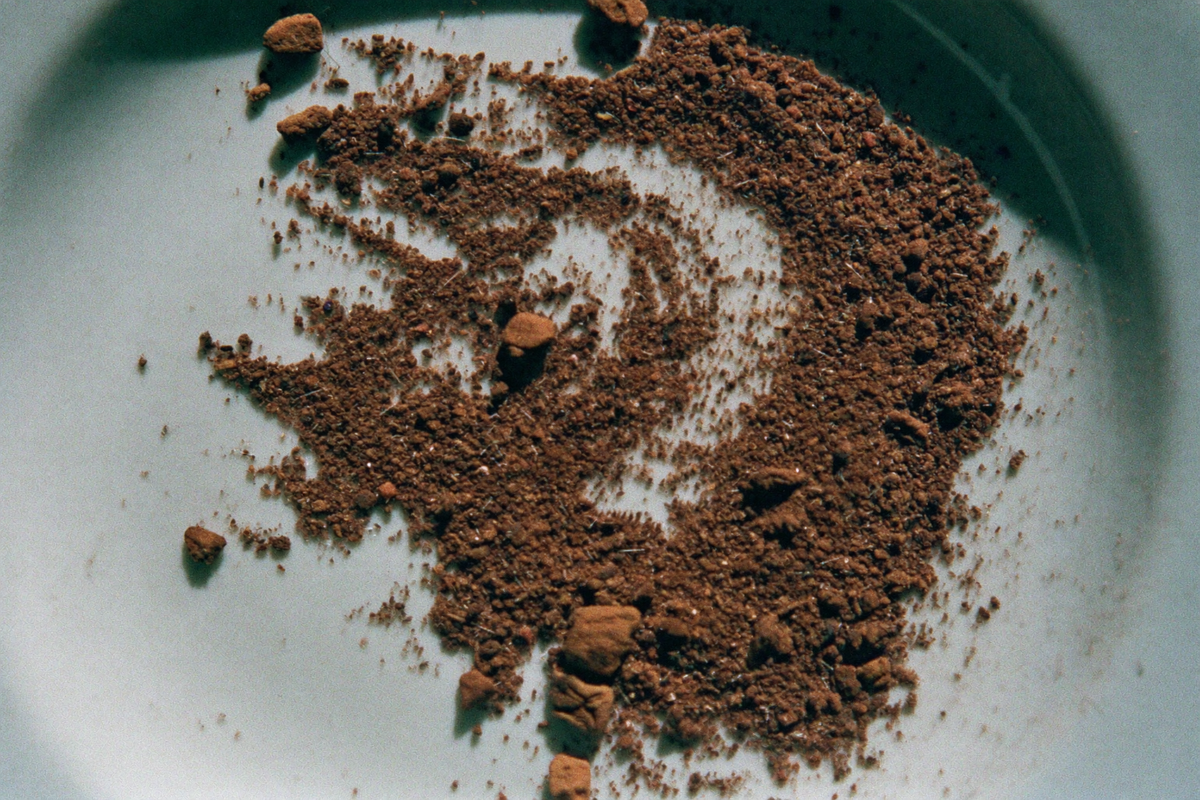
That distinction sounds pedantic until you look at what comes out. A blade grinder produces dust and boulders in the same batch, and the two extract in opposite directions. The dust gives up everything it has within seconds and then keeps giving up the bitter fraction. The boulders barely dissolve at all. You brew both together and drink the average, which is a cup that is over-extracted and under-extracted at once.
That is the reason good beans cannot rescue a blade grinder, and it is worth knowing before you spend another twenty pounds a bag trying.
What burrs do differently
A burr grinder passes beans between two abrasive surfaces set a fixed distance apart. A particle cannot leave until it is small enough to fit through the gap. The gap is the specification, so the output clusters around one size, and moving the gap moves the whole distribution.
Blades have no gap. The chamber is a container and the blade is a propeller. Whether any given fragment gets hit again depends on where it happens to be sitting, which is why the output is a wide spread rather than a distribution around a target. Running it longer does not narrow the spread. It grinds the dust into finer dust while some boulders remain untouched, because they have migrated to a corner the blade does not reach.
Shaking the grinder while it runs helps a little. It does not change the mechanism.
Why an uneven grind is worse than a wrong grind
This is the part that gets missed, and it is the reason the fault is not fixable by adjustment.
A uniformly wrong grind is correctable. Too coarse and the cup is sour, so you go finer and it improves. The whole diagnostic loop of sour or bitter depends on the grounds behaving as a population that moves together when you change the setting.
A mixed grind cannot be corrected, because the two halves need opposite corrections. The dust needs a coarser setting. The boulders need a finer one. There is no adjustment that satisfies both, so every change makes half the cup better and half worse. That is why people with blade grinders describe their coffee as inconsistent and unimprovable at the same time, which sounds like a contradiction and is not.
Anette Moldvaer puts it plainly in Coffee Obsession: blade grinders produce an imbalance that good beans and correct brewing cannot fix. She is right, and it is the strongest single equipment claim in either of the two manuals we work from.
A disagreement worth naming
Racineux and Tran, in Coffee Isn't Rocket Science, say the opposite. Their line is that blade grinders "are not expensive and give a uniform grind," and they suggest them as useful for achieving a balanced coffee.
We think that is simply wrong, and we are naming it rather than quietly citing the other book, because their manual is otherwise good and a reader may well own it. It may be a translation artefact. It may be an editorial slip. Either way, it is the clearest example in our whole reference shelf of a mass-market book giving advice that will actively degrade a buyer's coffee, and the buyer has no way of knowing which of two respectable sources to believe.
The mechanism decides it. A blade has no dimension that sets particle size. Uniformity would require one.
What this will not do
Replacing the grinder will not fix stale beans. Grind quality and freshness are separate faults, and a burr grinder full of month-old supermarket coffee will produce an even grind of dull coffee.
It will not fix water. Water is around 98 percent of a filter cup.
A cheap burr grinder is not automatically better at everything, either. Entry-level burr grinders drift, retain grounds between doses, and struggle at espresso fineness. What they do reliably is produce a narrower particle spread than any blade, which is the specific problem under discussion. For filter coffee that is enough. For espresso it often is not, and the gap between "even enough for a press" and "even enough for a 25-second shot" is where most of the money in grinders lives.
And it will not make you like your coffee. It removes a fault. Preference is downstream of that.
The honest exception
If you drink pre-ground coffee, or you drink one cup of a dark roast in the morning and think about it no further, a blade grinder is not costing you much. Dark roasts are more soluble and more forgiving, milk covers a multitude of extraction sins, and a small inconsistency inside a large tolerance is invisible.
The blade becomes a real problem at the exact point you start caring: when you buy a bag with a farm name on it, when you start adjusting anything, when you want the same cup twice. That is when an uncontrollable variable sitting upstream of every other decision stops being tolerable.
So the honest version is not that blade grinders are worthless. It is that a blade grinder sets a ceiling, and the ceiling is low enough that nothing you buy afterwards can lift it. Better beans hit it. Better water hits it. A better brewer hits it hardest of all, because a precise brewing method applied to an imprecise grind is precision spent on the wrong step.
What to do instead
Buy the cheapest burr grinder you can find with a metal burr set and a stable adjustment, and buy it before you buy anything else. A hand grinder at a modest price will out-grind an electric blade grinder at three times the money, at the cost of two minutes of effort every morning, which is a real cost and the reason many people abandon them by spring.
This is the whole content of the upgrade order almost nobody follows: the grinder is not an accessory to the brewer. It is the first machine, and everything downstream inherits its errors.
We sell cups and servers, not grinders, so there is nothing for us at the end of this recommendation. That is rather the point. If the grinder is the constraint and we cannot sell you one, the useful thing we can do is tell you to spend the money elsewhere before you spend it here.