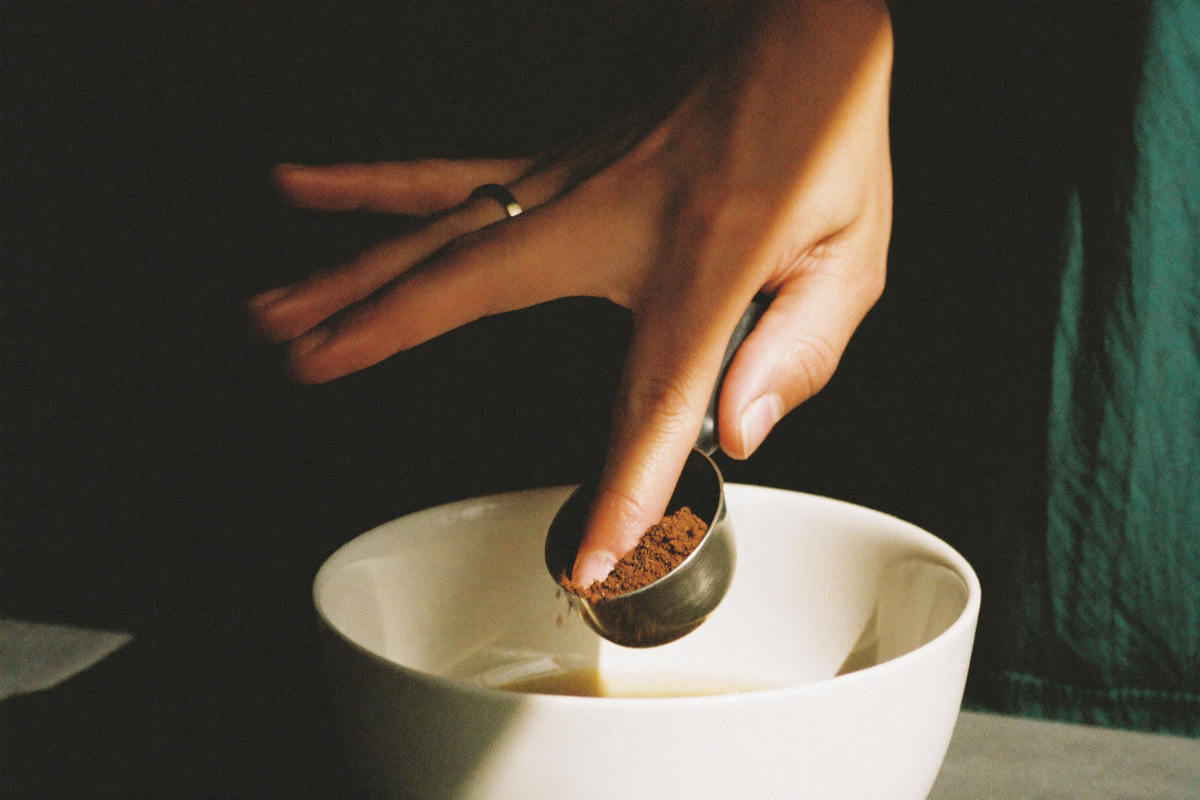
The scoop that came free with your brewer is the only piece of coffee equipment that gets less accurate the better your coffee gets. That is a strange sentence, and it is the whole argument.
A scoop measures volume. Every brewing recipe worth following is written in mass. Those two things track each other only when the coffee never changes, and the moment you switch beans, roast level or grind setting, the scoop quietly starts lying to you by a margin large enough to taste.
This is not an argument for precision. It is an argument against a hidden variable.
What the scoop is actually measuring
A level tablespoon of coffee holds a fixed amount of space. What ends up in that space depends on three things that move constantly.
Grind size. Fine grounds pack more densely than coarse ones, because the smaller particles fill the gaps between the larger ones. The same scoop of espresso-fine coffee carries meaningfully more mass than the same scoop ground for a French press. So the moment you adjust your grinder to fix a sour cup, you have also changed your dose without deciding to.
Roast level. Roasting drives water off and puffs the bean's structure. Both books in our reference shelf put the mass loss at roughly 11 to 22 percent depending on how far the roast goes. A dark-roasted bean is physically larger and lighter than the same green bean roasted lightly. Scoop by scoop, a dark roast delivers less coffee.
Bean density. Coffee grown at higher altitude is denser than coffee grown low. Different species differ too. This is smaller than the first two effects, and it is not nothing.
Put them together and the scoop is a measurement instrument whose calibration changes every time you buy a different bag or turn the grinder collar. You are not brewing inconsistently. You are brewing consistently to a number that keeps moving.
The specific way it wastes your morning
Here is the failure that sends people to the internet.
You brew a sour cup. You correctly grind finer, which is the right response to sourness. You scoop the same two scoops. But finer grounds pack denser, so you have also increased your dose, which raises strength and slightly lowers extraction, partially cancelling the fix you just made.
The cup comes out stronger and still a little sour. You conclude that grinding finer did not work, when it did work and was masked. So you change something else, usually the water, and now two variables have moved and you have learned nothing about either.
That is the real cost. Not the inaccuracy, but the fact that the inaccuracy is correlated with the exact adjustment you are trying to evaluate. A random error would average out. This one moves against you every single time.
Weigh, do not scoop. That is the whole instruction
Set a scale on the counter, put the empty brewer or a cup on it, zero it, and add coffee until the number is right. It takes about four seconds and it removes the variable permanently.
Once you weigh, one number covers most of your shelf. Moldvaer standardises nearly every filter method to roughly 60 grams of coffee per litre of water, and the arithmetic works out the same whether you are using a press, a cone, a cloth or an electric drip machine. One ratio for every filter brewer you own is only possible if you are measuring in the unit the ratio is written in.
The precision claim we are not going to repeat
Racineux and Tran state that an espresso dose "needs to be accurate to a tenth of a gram." We think that is wrong, and it is worth saying so rather than passing it along because it appeared in a good book.
On an 18 gram dose, a tenth of a gram is about half a percent. Meanwhile the grind is drifting, the tamp pressure varies, the beans are ageing by the day, and the group temperature is moving between shots by more than that half percent is worth. Chasing a tenth of a gram while those four run free is measuring the smallest thing in the room.
The same page of that book gives the correct reason to weigh, and it is not precision: a scoop does not account for grind size, roast level or density. That is the honest claim. Weigh, do not scoop, is right. Resolve to a tenth of a gram is theatre.
Which means a scale accurate to a gram, or half a gram, is genuinely enough for filter coffee. If you buy a more precise one because you enjoy it, that is a fine reason. It is not a taste reason.
What a scale will not do
It will not make your coffee consistent on its own. Dose is one of four variables, and the other three are grind, water and time. Fixing dose removes the hidden one, which makes the other three legible. That is its actual job.
It will not help if it times out. The specific irritation of cheap kitchen scales is auto-shutoff at 30 or 60 seconds, which fires in the middle of a pour-over and takes your reading with it. Look for a scale that stays awake for at least three minutes, or one with a timer built in that keeps it alive. This is the single spec worth checking and it is rarely on the box.
It will not survive being splashed forever. Brewing happens next to hot water, and cheap scales are not sealed against it.
And it will not do anything at all for espresso if the grinder is the weak link. A perfectly weighed dose through a grinder that cannot hold a setting is a precise input to an imprecise process.
The one honest defence of the scoop
Consistency is only worth having if you want to repeat the result.
If you drink the same supermarket blend every day, ground the same way, and you like it, the scoop's error is stable and effectively invisible. Nothing is moving, so nothing is drifting. You have a working system and there is no reason to change it.
The scoop becomes a liability at the exact moment you start caring: when you buy a bag of something different, when you start adjusting the grinder, when you want yesterday's good cup back today. That is when a fixed volume stops approximating a fixed mass.
So the honest version is not "throw the scoop away." It is: the scoop is fine until you start trying to improve, and useless from that moment on.
What we sell here, which is nothing
We do not sell scales, scoops, grinders or brewers, and we have no plans to. This piece exists because a reader who buys a beautiful cup from us and then brews mediocre coffee into it has been sold something that does not work.
A kitchen scale that reads to one gram and stays awake for three minutes costs very little and is the cheapest real improvement available in coffee, cheaper than better beans and far cheaper than better machinery. Buy the plain one.
If you want the fuller argument about where money actually earns its keep in a coffee setup, it is in the upgrade order almost nobody follows.