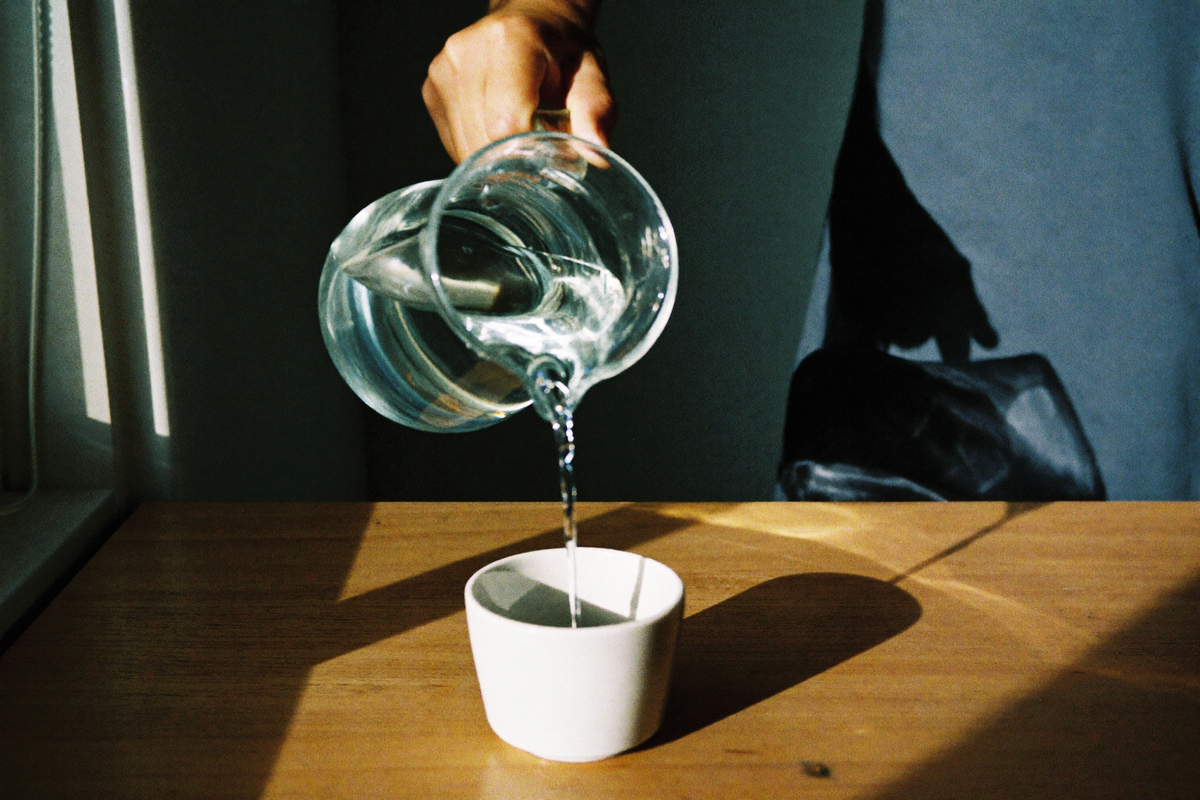
A scale asks for two things you may not want to give it. It takes up counter space next to a kettle that is already there, and it turns a morning you liked precisely because it was thoughtless into a small arithmetic problem. That is the honest cost, and for some people it is enough of a cost to stop reading here. The reason to pay it is not accuracy for its own sake. It is that a scale is the only instrument in the kitchen that can read both halves of a coffee recipe in the same unit.
Buy the scale. One millilitre of water weighs one gram, so a set of scales replaces the measuring jug, the marked kettle, the cup you fill to the chip on the rim, and the scoop, all at once. It is the cheapest thing that reliably improves coffee, and the cheapest version of it works.
That last clause matters more than the first. This is not an argument for a $325 scale. Every price in this piece, that one included, was checked on 27 July 2026.
The identity, and the exact point where it stops being true
Water at its densest, just above freezing, weighs almost exactly one gram per millilitre. That is not a coincidence. The gram was originally defined against it.
At the temperatures you actually live at, the identity holds well enough to ignore. At 20 °C a millilitre of water weighs about 0.998 grams, so half a litre measured cold is under a gram off. Nobody can taste that.
At brewing temperature it stops holding. Water expands as it heats, and at 93 °C a millilitre weighs roughly 0.963 grams. Pour 500 millilitres of just-off-the-boil water into a jug and read the markings and you have about 482 grams of water in the pot, not 500. Against a 30 gram dose that is a brew ratio of roughly 62 grams per litre rather than the 60 you thought you were making.
Two things follow. The first is that measuring hot water by volume introduces an error of about four percent that always runs in the same direction, which is worse than a random error because it never averages out. The second, and this is the useful part, is that weighing makes the temperature irrelevant. A scale reads mass. Mass does not care how hot the water is, what altitude you are at, or whether your jug's markings were moulded accurately. The millilitre-to-gram identity is a convenience for reading recipes, not a thing your scale has to rely on.
So the physics gives you a small correction. The instrument gives you the correction for free, permanently, without your having to know about it.
What one instrument replaces
Look at what a coffee recipe requires you to measure. A quantity of ground coffee, a quantity of water, and often a quantity of finished drink. Traditionally those needed a drawer of separate tools, each with its own failure mode: a scoop that measures volume for something whose density moves with grind and roast, a jug that measures volume for something whose density moves with heat, a kettle whose window was moulded to a tolerance nobody published, and a cup with a line on it.
A scale reads all of them in grams. Coffee in grams, water in grams, output in grams, on one display, to one resolution.
This is the real argument and it is a boring one. The scale is not more accurate in some abstract sense. It removes the translation step between units, and translation steps are where domestic recipes go wrong. Every serious brewing recipe published in the last fifteen years is written in mass for exactly this reason, which means that without a scale you are permanently converting someone else's numbers into your own approximate ones.
The coffee side of that argument has its own piece, because the ways a scoop drifts are specific and worth naming. Grind size, roast level and bean density each change what fits in a fixed volume, and a scoop is a measuring instrument whose calibration moves every time you change bags. The water side is simpler and almost nobody talks about it: hot water is lighter than cold water and your jug does not know.
Both halves, or the number means nothing
Here is where the scale stops being a convenience and becomes the thing that makes the rest of coffee legible.
Extraction is defined as a proportion: how much of the dry coffee's mass ended up dissolved in the drink. The target range for filter coffee, in Colonna-Dashwood's account, is 18 to 22 percent of the coffee's weight dissolved, with 20 percent as the working shorthand. Industrial soluble coffee production pushes that as high as 60 percent, which is why instant coffee tastes the way it does and not because of anything mysterious.
You cannot hold that idea at all without mass on both sides. There is no volumetric version of it. The same is true of brew ratio, which is a mass of coffee against a mass of water, and of espresso yield, which is a mass out against a mass in.
Once you have both halves, one number covers your whole shelf. Moldvaer standardises nearly every filter method to roughly 60 grams of coffee per litre of water, and that single ratio does the job across a press, a cone, a cloth and an electric drip machine. Without a scale it is not a ratio, it is a suggestion.
It also separates the two complaints people conflate constantly. Strength is how much dissolved material is in the cup. Extraction is what proportion of the coffee gave it up. They move independently and treating them as the same thing is the reason a lot of coffee keeps tasting wrong. Both are ratios. Both need mass.
The reference dose is not a constant of nature
A small piece of evidence that measuring matters, drawn from two books on the same shelf written about twenty years apart.
Kenneth Davids, writing on home roasting, records the meticulous professional cupping dose of his time as 7 grams of coffee per 150 millilitres of water. Jessica Easto, writing on sensory evaluation, gives the current cupping dose as 8.25 grams per 150 grams of water. That is a rise of nearly 18 percent in what the profession treats as its neutral reference point.
Neither figure is wrong. The standard moved. That is the point: the number you are aiming at is a convention, and conventions drift, so the only way to know what you actually did is to have measured it in a unit that does not drift.
Worth noting too that the cupping dose of 8.25 grams per 150 grams works out to 55 grams per litre, which is weaker than the 60 grams per litre most home recipes use. That is deliberate. Cupping is a comparison protocol designed to expose defects across many coffees at once, not a recipe for a drink you want. Do not adopt it as your breakfast ratio because a professional uses it.
Where volume genuinely is good enough
Long-form arguments should carry the counter-case honestly rather than gesture at it, so here is the strongest version.
Plenty of people made excellent coffee for decades without weighing anything. They did it by holding every other variable still: one coffee, bought in the same tin, ground at the same setting or bought pre-ground, in the same pot, at the same fill line, every day. Under those conditions a volumetric measure has a stable error, and a stable error is invisible. You calibrated yourself against it years ago.
Davids says as much about green beans and he is a roasting authority with every incentive to say the opposite. Density varies from bean to bean, so a scale beats a scoop on green coffee. He also says the scoop is usually fine anyway for someone roasting at home. Both halves of that are true at once.
The scale earns its place at the exact moment something starts moving. A different bag. A new grinder setting. A recipe from someone else. A cup you liked on Tuesday that you would like again on Thursday. Repeatability is the product, not precision.
Espresso is where volume fails hardest
The category that clung longest to volumetric measurement is the one it suits least.
Espresso output was specified in millilitres for most of its commercial history, crema included. Racineux and Tran note the resulting problem without resolving it: with crema in the glass, one gram of espresso occupies about 1.5 millilitres. Crema is a foam, its volume depends on how fresh and how degassed the coffee is, and it collapses while you look at it. A 30 millilitre shot is therefore a measurement of something that is partly air and partly still changing.
Current practice is brew ratio by output mass: roughly 1:2 to 1:2.5 for a modern shot, 1:1 for a ristretto, 1:3 and longer for the fast, coarse, high-flow shots that became common after 2020. All of those numbers are unusable without a scale under the cup.
What a scale will not do
It will not make your coffee better on its own. It removes one variable from four. Grind, water and time are still yours to get wrong, and a perfectly weighed dose through a grinder that cannot hold its setting is a precise input to an imprecise process. If you have limited money, the grinder comes before nearly everything else, and that includes the scale.
It will not tell you the coffee is good. A scale measures repeatability. Whether the repeatable thing is worth repeating is a question only tasting answers, and tasting one cup on its own teaches you very little.
It will not stay awake for you. The specific irritation of cheap kitchen scales is auto-shutoff, which fires partway through a slow pour and takes the reading with it. Look for one that stays on for at least three minutes, or one with a built-in timer that keeps it alive. This spec is rarely on the box and it is the one that determines whether you keep using the thing.
It will not survive a wet counter forever. Brewing happens next to boiling water and inexpensive scales are not sealed.
And it will not tell you how much drink you are going to get. Wet grounds keep a meaningful share of the water you pour, which is why a recipe written for a litre of water does not fill a litre carafe. We are not going to print a retention figure, because the reference books we work from do not give a consistent one and we have not measured it ourselves. Brew a little more than you think you need and stop guessing.
What to actually buy, with the prices dated
The scale market in 2026 is unusually easy to read, because the gap between the cheap end and the expensive end is not accuracy. It is response speed, build, and software.
As of 27 July 2026, prices taken from the manufacturers' own stores: Acaia's Umbra lists at $135, the Lunar at $250 and the Pyxis Black at $325. The Timemore Black Mirror Basic 2 sits around $56 and is the value benchmark, credited with flow-rate display and auto-timing.
One finding from that same check is worth passing on. Acaia's Pearl and Pearl Model S, the two scales that defined the brand for a decade, were both showing as sold out on Acaia's own store, with the line now led by names most people have not heard of. That could be a planned generational replacement or a supply problem, and we could not tell which. Either reading has the same practical consequence: any guide still telling you to buy a Pearl is recommending something the manufacturer was not selling.
Now the part that costs us nothing to say, because we do not sell scales. We could not find independent measured accuracy or response-time data for any of these. Every comparative ranking we read, including the ones we found persuasive, was reviewer preference rather than measurement. So we are not going to tell you the $325 scale is more accurate than the $56 one. We do not know that, and neither do the people who wrote it.
For filter coffee, a plain kitchen scale that reads to one gram and stays awake for three minutes does the whole job. Doses in filter brewing run from about 12 to 60 grams, and one gram of resolution against a 30 gram dose is finer than any of the other errors in the process. Buy the plain one, and if you later find yourself wanting a faster display for espresso, you will know precisely why.
The escape hatch nobody mentions
Here is the version of this argument that ends with the scale in a drawer.
Easto, setting up a home cupping, gives an instruction that generalises further than she uses it. Weigh the capacity of your cup once, then mark the fill line on it with a piece of tape, and you never have to weigh water into that cup again. The measurement is done. The cup now remembers it.
The same works for a kettle, a carafe, a press, or the mug you use every morning. Spend two weeks weighing everything and writing the numbers down. Learn what your kettle actually pours in four seconds. Learn what your press holds to the fill line. After that the scale becomes an instrument you reach for when something changes, not a thing you touch daily.
Most people who quit weighing quit because it felt like an obligation. It is not an obligation. It is a calibration you do once per object.
The station this belongs to
The complete setup for filter coffee at home is a grinder that holds its setting, a kettle you can aim, a scale that stays awake, a brewer, a vessel to decant into so the coffee stops extracting, and something to drink from that you want to look at.
We sell the last two categories. We do not sell the first three and have no plan to, which is why we are comfortable telling you that if you can only buy one thing this month, it should be the grinder, and if you can only buy one cheap thing this week, it should be a one-gram kitchen scale from a supermarket.
A reader who buys a good cup from us and then brews indifferent coffee into it has been sold something that does not work. That is a bad outcome for both of us and it is the reason this piece has no product in it.