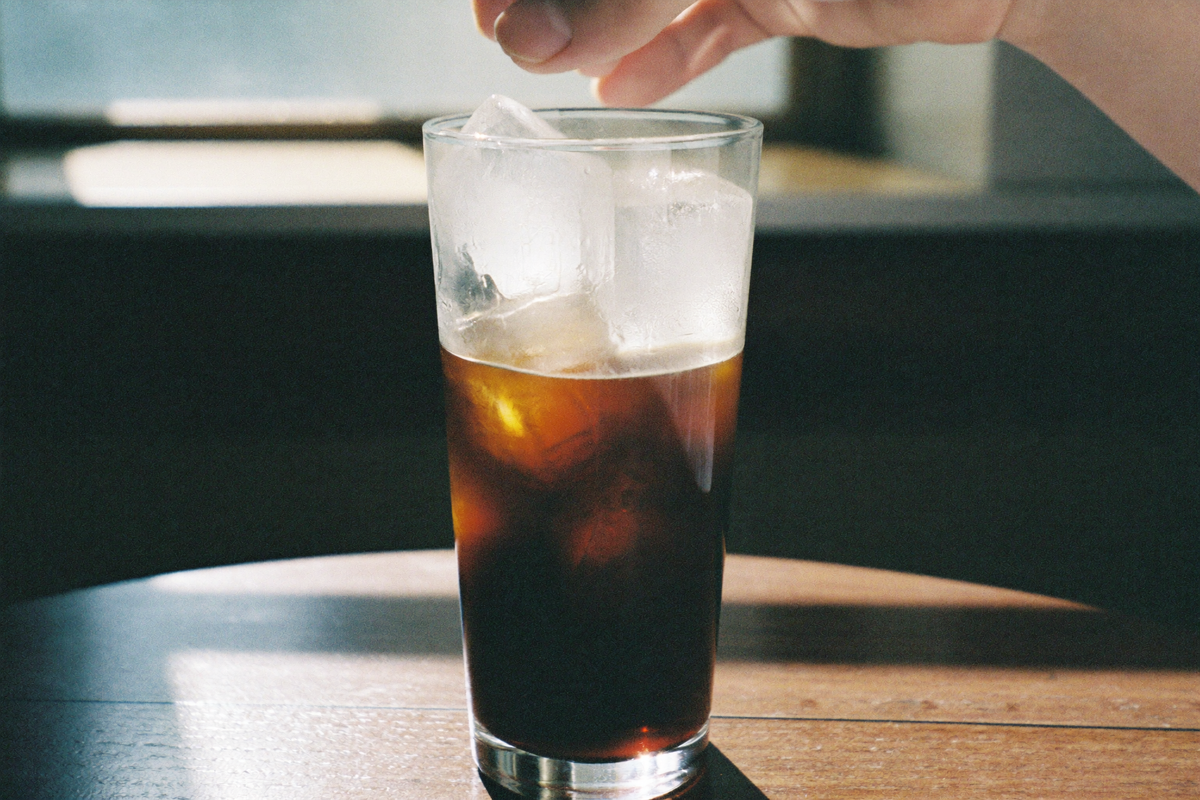
The usual way this gets explained is that cold water pulls the same things out of coffee, only slower and more gently. That is a comfortable picture and it is wrong in a way that matters, because it implies you could get a hot cup's flavour out of a cold brew if you simply waited long enough. You cannot. Sixteen hours does not buy back what 94°C (201°F) does.
Cold water does not extract the same coffee slowly. It extracts a narrower and different set of compounds, and it delivers them to a palate that is working at reduced sensitivity. Two separate things are being given up. The first is chemical: at low temperature, solubility drops and reaction rates slow, so the same beans brewed hot and brewed cold end up with genuinely different chemical compositions. The second is physical: aroma reaches your nose because heat pushes volatile compounds into the air, and a cold drink barely does that at all.
What you get in exchange is real, and worth the trade for some drinks. It is just not the same drink with the edges filed off.
The chemistry, briefly
Water temperature does two jobs at once, and Jessica Easto separates them cleanly in How to Taste Coffee: hot water increases how much of certain compounds will dissolve, and it speeds up the chemical reactions that happen during brewing. Drop the temperature and both slow down together. This is why cold brewing is measured in hours rather than minutes.
The important part is what follows. Time does not simply substitute for heat. Easto's point is that the same coffee, hot brewed and cold brewed, arrives with a different chemical composition and therefore a different sensory profile. Not a muted version of the same profile. A different one.
That single fact settles most of the arguments people have about cold brew. Asking which is better is like asking whether a stock is better than a broth. They came from the same ingredients through different processes and they are not competing for the same job.
If you want the underlying mechanism at a level that transfers to every other brewing decision you make, it sits in the order things come out of coffee and what governs that order.
The aroma you are not getting
Here is the part almost nobody names, and it is the reason cold brew can taste flat even when it is technically well made.
Easto's distinction between fragrance and aroma is useful here. Fragrance is what you smell from dry grounds. Aroma is what you smell from the brewed coffee, and the reason those two smell different is that hot water transfers energy into the coffee and pushes heavier volatile compounds into the air, where your nose can reach them. Heat is doing mechanical work on the smell.
Then there is the second, larger route. When you swallow, volatile compounds travel from your mouth up into the nasal cavity, and that retronasal smelling is where most of what you call flavour actually comes from. Take away the basic tastes and you still have coffee. Take away the smell and you have bitter, sour, faintly sweet water.
Cold liquid volatilises far less of anything. So a cold brew is quiet in the nose on the way in and quiet in the nose on the way out. That is the single biggest thing you are trading, and it is structural. No steep time fixes it, because the loss is happening in the glass and in your throat rather than in the brewer.
The palate is also colder
There is a third effect, and it compounds the other two.
Easto sets out the temperature ranges involved in professional tasting. Very hot coffee impedes tasting outright. Sensitivity to sucrose and other tastants is best in the region of 72 to 91°F, and the Specialty Coffee Association's cupping protocols reflect this by staging what gets evaluated as the cup cools, with the first taste held until 160°F and sweetness and cleanliness not judged until the coffee approaches room temperature. Below 70°F, professional tasters are not supposed to be judging coffee at all.
A cold brew over ice is served well below that floor. So the drink is arriving with fewer aromatic compounds airborne, and it is arriving at a temperature where your equipment for detecting the rest is running below its best. This is our reading rather than a claim any of these authors makes directly, and it is offered as an explanation for something people report constantly: cold brew needs to be noticeably stronger than hot coffee before it registers as coffee at all.
Which is exactly why the ratios are what they are.
Cold brew is a concentrate, and the dilution step is the one that goes missing
The workable numbers, and they are functional facts rather than anybody's recipe:
| Method | Coffee to water | Time | Then |
|---|---|---|---|
| Immersion concentrate | 1:4 to 1:8 by weight | 12 to 24 hours | Dilute 1:1 to 1:3 to serve |
| Fridge steep, ready to drink | around 1:15 | 12 to 16 hours | Strain and drink |
| Cold drip tower | 60 g per 500 ml, about 120 g per litre | 5 to 6 hours at 30 to 40 drops per minute | Dilute to taste |
Note that the tower runs at double the 60 grams per litre that governs essentially every hot filter method you own. That is not a stronger version of filter coffee. It is a different product category, and the dilution is part of the recipe rather than an optional adjustment.
Two failure modes account for most bad home cold brew. Following a hot-coffee ratio produces brown water, because the extraction at low temperature is not efficient enough to fill out a 1:15 in the way hot water would. Following a concentrate ratio and then drinking it undiluted produces something harsh that gets blamed on the beans. Recipe collections routinely publish the second version with no dilution instruction attached, which is how the mistake spreads.
Grind coarse. Long contact time and fine grounds together over-extract and clog whatever you strain through. If your cold brew tastes woody or vegetal, shorten the steep toward 14 to 16 hours and go coarser before you change anything else.
Strain through cloth rather than paper. Racineux and Tran specify cloth in a sieve for the fridge steep, and the reason is volume: a coarse overnight steep sheds more fines than a paper filter will pass before it blocks. If you have not chosen a filter medium deliberately, the three media do genuinely different things and the choice matters more here than most places.
What cold brew will not do
It will not make stale coffee taste fresh. The long steep masks some faults, which is why the idea got started that cold brew does not need good beans. Stale beans give stale cold brew. What you lose is the aromatic top end, and stale coffee has already lost that, so you are subtracting from a smaller number.
It will not give you a low-acid coffee in the sense the marketing implies. Cold brew does taste less sour, and the reason is that fewer of the perceptually sharp acids are extracted at low temperature over long contact. Measured pH, though, is often close to hot-brewed coffee, within a few tenths of a point in the figures our reference sources quote, and we flag those figures as ones we have not independently verified. The category labelled low-acid is loosely defined and largely unregulated. We are not going to tell you cold brew is easier on your stomach, because we have not found controlled evidence that supports it, and a shop selling cups is the wrong source for a claim about anybody's digestion. Take it to a doctor if it matters, and mention what you drink and how much.
It will not keep indefinitely because it is cold. Cold brew is not heat treated, and its shelf life is a food-safety question rather than only a flavour one. You will find confident numbers online. We have not verified them against current guidance and so we are not repeating them. Refrigerate it as soon as it is strained, and make batches you will actually finish within days rather than weeks.
And it will not be smoother by default. Badly made cold brew is flat and woody. The marketing has made the words cold brew and smooth into synonyms, and the effect is that people stop diagnosing a bad batch, because the category name has already told them what it tastes like.
The thing to make instead, some of the time
If what you want is cold coffee that still smells like coffee, brew it hot straight onto ice.
Japanese iced coffee, sometimes called flash brew, uses the normal hot method with a portion of the brew water replaced by ice in the server. The coffee is extracted at full temperature, which does all the aromatic work described above, and then chilled within seconds, which locks the volatiles into the liquid instead of letting them escape as the cup cools slowly. Acidity survives. The nose survives. It takes four minutes rather than sixteen hours.
The two drinks are not interchangeable and neither is a substitute for the other. Cold brew gives you a low-acid, quiet concentrate that keeps for a few days and dilutes well with milk. Flash brew gives you a bright, aromatic cold cup that must be drunk more or less immediately. Make both on the same beans on the same afternoon and taste them side by side, because a single cup on its own teaches you very little, and this particular pair makes the difference impossible to miss.
Then choose per occasion instead of per season. That is the whole skill.