People shop for brewers and inherit filters. It is the wrong way round. The brewer sets the shape of the process, but the thing the coffee passes through on the way out decides more about what lands in the cup than the cone above it does.
Paper, cloth and metal are not three grades of the same product. They are three different answers to one question: how much of the coffee do you want to keep? Paper holds back the oils and the fine particles, giving the clearest cup. Metal passes both, giving the heaviest. Cloth holds the fines and passes the oils, which is why it is the one people describe as having both body and clarity, and also the one almost nobody keeps up with.
Pick the filter for the cup you want, then buy a brewer that takes it.
What each one actually stops
Two things are trying to get through: dissolved compounds, which are the coffee, and undissolved material, which is oil and fine sediment. The dissolved part passes through everything. The undissolved part is what the filter is arguing about.
Paper stops oils and fines. It is the finest barrier of the three, and the result is a transparent cup with a light body, articulate acidity and a clean finish. Flavours read separated rather than blended. What you lose is texture and some of the aromatic compounds that ride in the oil.
Metal stops almost nothing but the grounds. Oils pass, fines pass, and the cup is opaque, heavier, rounder and less distinct. Sediment settles at the bottom of the mug. What you gain is body and a sense of fullness. What you lose is clarity, and the last inch of a metal-filtered coffee is often gritty.
Cloth sits in between and it is not a compromise. The weave holds fines back while letting oil through, so you get the texture of metal with much of the transparency of paper. Both of our reference manuals treat it as the richest-textured filter method available, with no papery taste at all.
That is the entire dial, and it runs body at one end and clarity at the other.
The part people are actually deciding
If you say you want a "smoother" coffee, you have said nothing, because half the people who use that word mean less bitterness and the other half mean more body.
The useful version of the question is this: when you drink coffee you like, are you noticing what it tastes like, or how it feels?
If flavour separation is the pleasure, if you like being able to name what is in there, paper is your filter and you should stop fighting it. If you want the cup to feel like something in the mouth, weighty and rounded, you want metal or cloth, and no amount of grind adjustment on a paper brewer will get you there. The filter is a hard ceiling on body.
Paper: two arguments worth knowing
Bleached tastes cleaner than unbleached. This surprises people, because the eco instinct runs the other way. Racineux and Tran prefer bleached paper on the grounds that unbleached carries a more noticeable papery taste, and Moldvaer agrees while noting that rinsing reduces it. Modern bleaching is oxygen-based rather than chlorine-based, so the environmental gap is narrower than the brown colour suggests.
Rinse either kind, and know what the rinse is for. It washes out some of the paper taste, but the larger benefit is thermal: it warms the brewer and the carafe so your brew water does not lose heat on contact. If you only ever do one, do it for the heat.
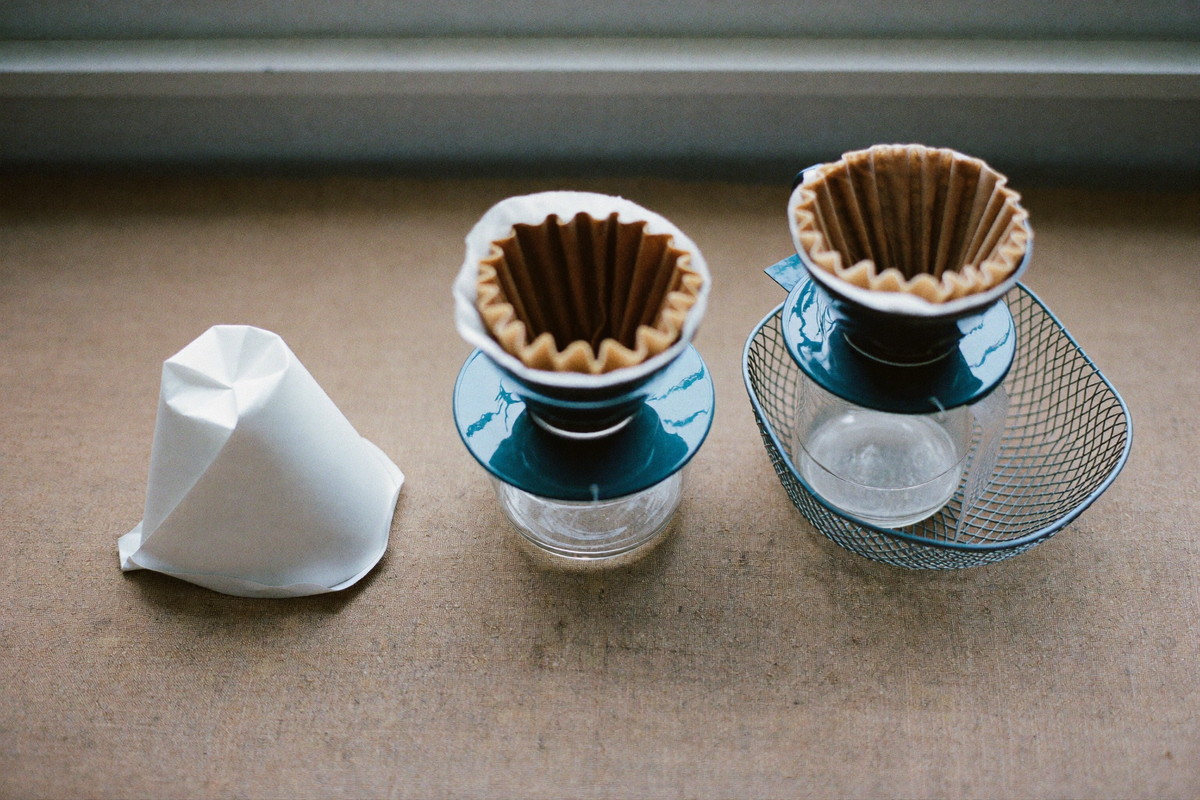
Chemex sits apart here. Its paper is heavier than standard, folded so that three layers sit against the spout and one against the other side. That thickness is why the drawdown is slow and the cup is the cleanest and thinnest of the pour-over family. It is also why a grind that works in a V60 can stall a Chemex completely.
Metal: honest about the sediment
A metal filter is permanent, needs nothing, and never runs out at the wrong moment. Those are real advantages and they are the reason presses and reusable cone filters sell.
The sediment is not a defect to be engineered away. It is the same property that gives you the body. If you want the texture without the grit at the bottom of the mug, the fix is technique rather than hardware: skim the crust off a French press before plunging, plunge gently, and let it stand for two minutes before pouring. Moldvaer specifies exactly that sequence, and it removes most of what people complain about.
Grind coarseness matters more here than with any other filter, because there is no medium fine enough to catch your mistakes.
Cloth: the best cup and the highest maintenance
Cloth is the one we would recommend if the care instructions were not real.
They are real. A cloth filter must be rinsed before first use, never washed with soap, and stored wet, sealed in the fridge or frozen, between uses. Dry storage makes the cloth smell and taints every subsequent brew. Soap is worse, because the residue is not rinsable and the cloth carries it into the coffee.
That is a genuine ongoing obligation, roughly like keeping a sourdough starter. Most people who buy a cloth filter abandon it inside two months, and they abandon it because nobody told them the protocol at the point of sale.
So the honest recommendation: buy cloth if the ritual appeals to you as a ritual. If you are buying it because you read that it makes the best cup, which it might, be aware you are buying a small daily duty along with it.
What this will not do
The filter will not fix extraction. A sour cup through a cloth filter is a sour cup with better texture. Balance is grind and time, and it is a separate diagnostic that has to be run first.
Switching filters will not make a stale bag taste fresh. Body is not flavour.
Paper will not remove bitterness. It removes oils and fines. People expect a cleaner filter to solve over-extraction, and it does not, because the bitter compounds are dissolved and dissolved things pass through everything.
And we are not going to give you the health argument. You will find claims online that paper filtering matters for cholesterol, because paper retains oil-borne compounds that metal passes. There is published work in that area. We have not verified it to the standard we hold ourselves to for anything health-adjacent, and a store selling you a cup is the wrong source for a claim about your blood. If it matters to you, take the question to a doctor, and mention what you brew with when you do. What we will stand behind is the mechanism: paper holds oils back, metal does not. What that means for a body is not ours to say.
Matching filter to brewer
You have less freedom than the shops imply, and knowing the constraints saves money.
| You want | Filter | Practical route |
|---|---|---|
| Clarity, separation, light body | Paper | Cone or flat-bottom dripper, or Chemex for the extreme version |
| Body, texture, no consumables | Metal | French press, or a reusable cone insert |
| Both, plus a daily duty | Cloth | Nel brewer, or cloth in a siphon |
One warning worth having. A metal insert dropped into a cone dripper does not turn it into a press. The bed geometry and contact time are still the cone's, so you get a percolation brew with sediment in it rather than the fuller immersion cup people are usually chasing. If body is the goal, change the brewing category rather than the filter.
What we sell, and what we do not
We sell cups, servers and the things a coffee lands in. We do not sell filters, brewers or grinders, and this piece would read differently if we did.
Where we do have a stake is the vessel at the end, and it interacts with this choice more than people expect. A heavy, opaque, oily metal-filtered coffee shows nothing in a glass and gains nothing from being seen. A transparent paper-filtered cup genuinely does read differently in glass, where the colour tells you something about the roast, and where the cup's own material is changing what you taste.
Buy the filter for the cup you want. The rest of the setup follows from it rather than the other way round.