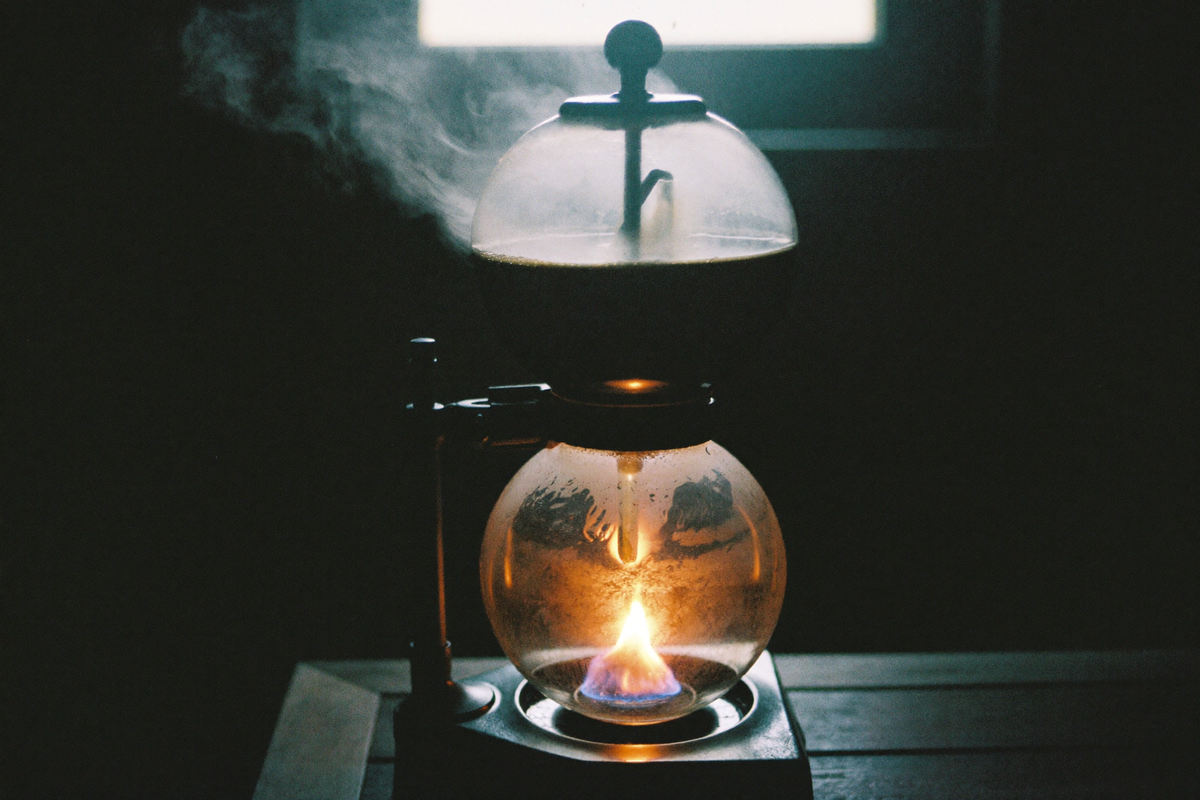
A syphon takes about fifteen minutes of your attention to produce roughly one minute of brewing, and it does it over an open flame in two pieces of glass joined by a rubber gasket. That is the price. Everyone who sells one talks about the moment the water climbs the tube, and nobody mentions that you will be washing a wet cloth filter afterwards and finding somewhere cold to store it until Thursday. Both halves are true. The question is which half you will still care about in a year.
Buy a syphon if you brew for other people often and you enjoy the performance, and buy the adjustable heat source at the same time or do not bother. As a way to make yourself a cup on a weekday morning it is the least practical filter brewer available, and the cup it makes is clean and distinctive rather than better. The clarity is real and it comes from the filter and the short contact time, not from the drama. If nobody is watching, a pour-over of the same coffee gets you most of the way there in a quarter of the time.
What the machine is actually doing
The lower bowl is sealed, so heating the water in it raises the vapour pressure above the water line, and that pressure pushes the water up a tube into the upper chamber where the grounds are waiting. The water does not boil its way upstairs. It is pushed. Cut the heat and the lower bowl cools, the vapour condenses, the pressure drops below atmospheric, and the partial vacuum pulls the brewed coffee back down through the filter. The vacuum in "vacuum pot" is the drawdown, not the brewing. Syphon and vacuum pot are two names for one device, which is worth saying because several coffee books present them as separate methods.
That mechanism decides everything else about the brew. The water sits in the upper chamber at close to its boiling point, held there by the flame underneath, for the whole of the steep. Anette Moldvaer puts that steep at about one minute, with a stir as the water arrives and a second stir before the heat comes off. One minute is the shortest contact time of any filter method, and it has to be, because the temperature is at the top of the range the entire time. Jessica Easto groups vacuum coffee with the decoction methods in How to Taste Coffee, alongside boiled coffee and the cezve, on the grounds that the coffee and water stay in continuous contact at high heat. Those methods extract fast and can drive off aromatics if they run long.
So the syphon is not gentle. It is quick, hot, and stopped early, and then it is filtered through cloth or paper, which is where the clarity comes from. Understanding the order in which compounds leave the grounds explains why the timing is so unforgiving here: the acids come out first and the heavy bitter compounds come out last. At this temperature that whole sequence runs in about sixty seconds.
The heat source is the purchase, not the brewer
Most syphons ship with a small alcohol burner. Sébastien Racineux and Chung-Leng Tran are blunt about it: the burner offers no control at all, and they recommend replacing it with a gas burner. This is the single most important thing to know before buying, and it is buried in the accessories tab on every retailer that sells one.
An uncontrolled flame produces a runaway boil in the upper chamber. The bubbles agitate the bed unevenly, the temperature climbs past where you wanted it, and the coffee reads scorched. The other half of the same fault is leaving the flame on after the water has finished rising, which keeps cooking coffee that has already given you what it has. A beam heater or an adjustable gas burner lets you drop the heat to a holding level once the water is up, and then kill it cleanly to trigger the drawdown. As of August 2026, a glass syphon typically runs $80 to $130 and a beam heater can cost as much again, which means the honest budget for this brewer is roughly double its shelf price.
Two other failures are worth naming because both look like a defective device and neither is. Grounds in the finished cup mean the filter is not seated: on a cloth filter the beaded chain has to hang so it touches the glass of the lower bowl, and the hook must be fastened at the funnel opening. And a stale, laundry-like taste in a syphon you have owned for a month means the cloth was dried out between uses. Cloth filters are rinsed immediately and stored wet, either submerged in water in the fridge or frozen in a sealed bag. That care requirement is not optional and it is the reason a lot of syphons end up in cupboards.
Where the object came from, briefly
Jonathan Morris places syphon systems among the fashionable equipment of the nineteenth-century European elite, alongside the hydrostatic percolators of the same period. The device's second life is Japanese. Coffee reached Japan through Dejima, the artificial island off Nagasaki that handled the Dutch trade under the Tokugawa shogunate, and the kissaten proprietors of the twentieth century built precise brewing practice around net filters and syphon equipment. That demand is why Hario, a glassware manufacturer, ended up making heat-resistant brewing gear at all. Western third-wave shops then imported the Japanese syphon back the other way in the 2000s, along with the V60.
This matters commercially rather than romantically. The syphon is the one brewer whose value has always been partly performance, in Europe in the 1850s and in Tokyo a century later. Buying it for the show is not a failure of seriousness. It is what the object has always been for.
What a syphon will not do
It will not make better coffee than your grinder allows. Nothing does, and a device this demanding of attention is a particularly expensive way to discover that the grind was the problem the whole time.
It will not be less acidic, and it will not be easier on your stomach. The brewing method has almost no effect on the finished pH of the cup. The cloth filter removes oils and fines, which changes the body and the aftertaste, and that is a texture change rather than a chemistry one.
It will not survive being knocked over, put in a dishwasher, or handed to a guest who wants a look. The glass is thin, the gasket perishes, and replacement upper chambers are a real recurring cost for anyone who uses one weekly.
And it will not read as dramatically different in the cup as it does on the counter. Pour a syphon and a well-made pour-over of the same coffee side by side and most people find them closer than expected, with the syphon a little rounder in the middle and the pour-over a little brighter. If you want to test that honestly, taste them in pairs rather than on separate mornings, because one cup on its own tells you almost nothing.
When the theatre is worth it
Four conditions, and the case gets weak if any one of them is missing.
- You brew for other people more than occasionally. The syphon is a genuinely good host's object. It gives the room something to look at during the four minutes when a host is otherwise silently pouring water, and it does that better than any other brewer.
- You have bought an adjustable heat source. Without it you are not controlling the one variable that decides whether the cup is clean or scorched.
- Your grinder already holds its setting. A syphon wants a medium grind, roughly where a pour-over sits, and it will faithfully transmit every inconsistency your grinder produces.
- You accept the cycle. Setup, brew, decant, wash both chambers, rinse the cloth, store the cloth wet. Call it fifteen minutes.
One more thing that nobody warns you about, and it is the difference between a good syphon cup and a wasted one. The coffee arrives in the lower bowl extremely hot, well above the temperature at which you can taste much of anything. High temperature reduces sensitivity to flavour, which is why the Specialty Coffee Association's cupping protocol starts tasting at around 160°F and why Easto recommends letting a cup fall further before assessing it. Pour the syphon out into a warmed server or a cup you have already rinsed with hot water, then wait. Preheating the vessel is what stops the coffee falling off a cliff on the way down, and the two or three minutes after that are when the clarity you paid for actually becomes perceptible.
We do not sell syphons. If you want one, buy the glass and the heater together, buy a spare upper chamber at the same time, and be honest about whether you are buying a brewing method or an occasion. The occasion is a perfectly good reason. It is just not a flavour reason, and anyone selling it to you as one has skipped the part where you have to wash it.