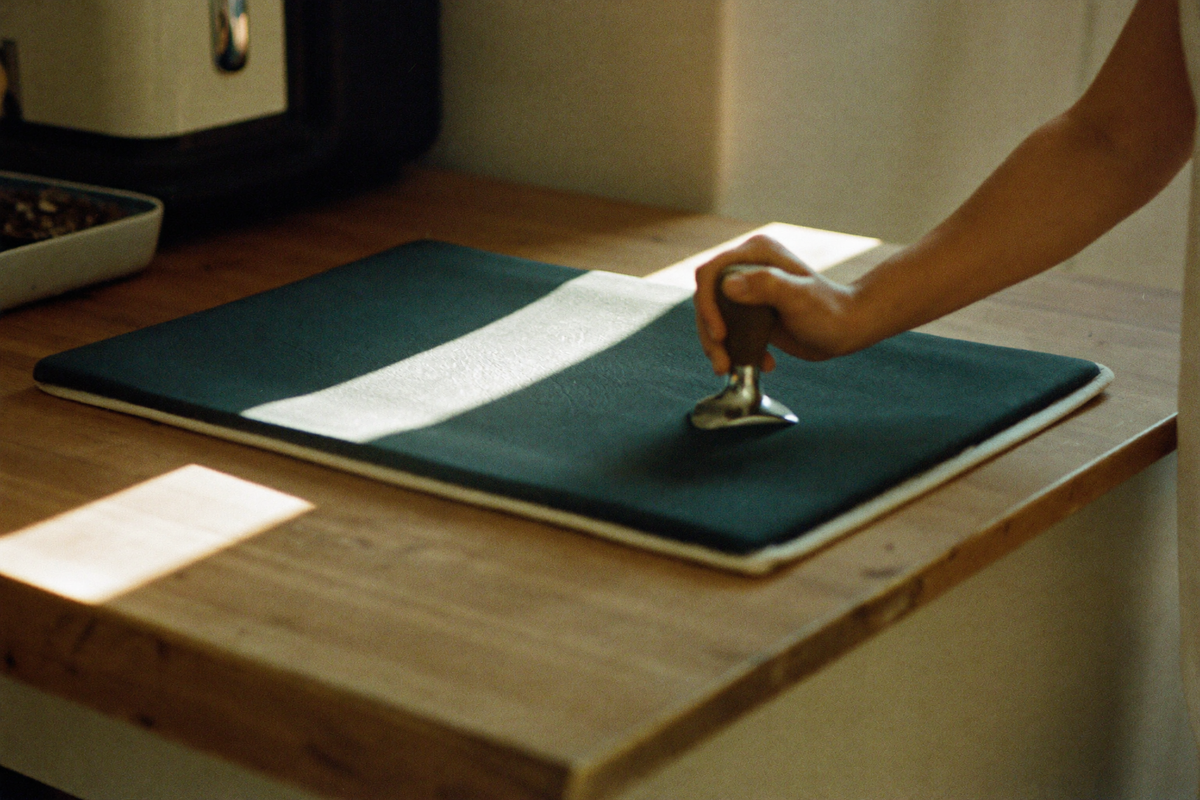
Every espresso accessory page lists the mat somewhere between the tamper and the distribution tool, and that placement does most of the persuading. Things sitting together look like they do the same kind of work. So a reasonable person assumes the mat is one more object acting on the coffee, buys it in the same basket as the tamper, and is mildly disappointed when nothing tastes different. Nothing was ever going to. The mat acts on the granite.
Buy a tamping mat if you press the portafilter down on a surface you would be annoyed to see chipped, scratched or dented. Skip it if you tamp on your machine's drip tray, or over a counter you genuinely do not mind marking. It protects the counter from the portafilter spouts and gives the portafilter something to grip while you press. It does not change extraction, and no mat has ever improved a shot. That is the entire decision. The rest of this piece is why the counter needs protecting at all, which turns out to be a more interesting question than the mat is.
Where the damage actually comes from
Set a loaded portafilter on a bare counter and it does not rest on its rim. It rests on the spouts, because they are the lowest point on the assembly. Two small metal feet carrying a heavy brass or steel body, and then carrying whatever you add on top of it.
What you add is the tamp. The figure that circulates in barista training is roughly 10 to 15 kilograms of downward force, and while the precise number matters much less than most people think, the order of magnitude is right. Call it 15 kg at the top end.
Now compare two areas. A standard 58 mm basket gives the tamper face about 26 square centimetres to press against. The two spout tips underneath, depending on whether they are rounded or flattened, present something in the region of one to two square centimetres to the counter. That is an estimate rather than a measurement, and we will flag it again at the end, but the ratio survives a wide margin of error: the counter is taking somewhere between ten and twenty-five times the pressure the coffee is.
That is the whole mechanism. The same push that feels gentle against a bed of coffee grounds is concentrated, at the other end of the same rigid object, into two contact points the size of a pencil eraser.
Then there is the twist. A lot of people finish a tamp with a small rotation, a habit inherited from the idea of polishing the puck surface. Whether that helps the coffee is arguable at best. What is not arguable is what it does underneath: it drags two loaded metal points sideways across the counter. Dents come from the press. Scratches come from the twist.
Why the counter loses
Which damage you get depends on what your counter is made of, and the answer is not the one most people expect.
Marble and limestone. Calcite sits at 3 on the Mohs hardness scale. It is a soft stone that polishes beautifully and bruises easily. A loaded spout will leave a small crushed spot, and the polish around it will go dull long before anything visibly chips.
Granite and engineered quartz. These contain a lot of quartz, which sits at 7, so they are genuinely hard. Hard is not the same as tough. Hard, brittle surfaces resist scratching and then fail by chipping, and a point load at the edge of a slab is exactly the loading case they are worst at. The chip you eventually get will be small, sharp-edged and permanent.
Laminate. A thin melamine wear layer over particleboard. The wear layer is tough for its thickness and the substrate under it is not, so a point load presses through and leaves a dished mark, and once the surface is broken, water gets into the board.
Wood, oiled or waxed. Dents. Alder and walnut are both soft enough that a metal point under 15 kg will leave a mark you can feel with a fingertip. Some owners want that and some return the board over it, and both positions are honest.
The uncomfortable part: most portafilters are chrome-plated. Hard chrome plating is harder than every surface listed above. In any contact between two materials, the softer one gives, which means that in this particular fight your counter is always the one that loses, whatever it is made of.
The number that puts tamping in proportion
While we are doing arithmetic, it is worth doing the one that reframes the tamper.
Moldvaer gives professional brew pressure at around 9 bar. Across a 58 mm basket, 9 bar works out to roughly 240 kilograms of force pressing down through the puck. Your hardest tamp, that same 15 kg over the same area, is about half a bar.
So the machine pushes something like sixteen times harder than you do, and it does so for the entire shot rather than for a second. This is the mechanical reason behind a point James Hoffmann makes plainly: pressing harder does not meaningfully slow the water down, because the pump is operating in a completely different range of force. Tamping is not compression in any useful sense. It is levelling, and closing the air pockets so that water meets one continuous bed rather than a bed with holes in it.
Moldvaer's version of the same instruction is that the tamp needs to be level and firm enough to close air pockets, and that extra force, repeat tamping and tapping the portafilter add nothing. Hoffmann adds a specific warning about tapping: it can crack the puck away from the wall of the basket, which is an invitation to channelling and therefore actively harmful.
Two consequences follow, and neither is about the mat. First, if you are buying accessories in order of effect on the cup, a tamper sized correctly to your basket comes a long way before anything else, because a mismatched tamper leaves an unsealed ring of grounds around the edge that no technique can fix. Second, if you are buying in order of effect on your morning, the answer is further upstream still, and the honest ranking of that spend is why the grinder comes before nearly everything else you could buy.
The one place a mat touches the coffee
Having said the mat does nothing to the cup, here is the honest qualification, because there is one and pretending otherwise would be a small lie.
A mat has grip. Bare stone does not. If a portafilter can slide even slightly while you press, your wrist follows it, and the tamp ends up a degree or two off level. Off-level tamps are one of the ordinary causes of channelling, where water finds the shallow side of the bed and runs through it while barely touching the rest.
So the mat removes one route to a tilted puck. That effect is real and it is small, and it only exists if your current surface actually lets the portafilter move. If you tamp in the corner of a machine's drip tray, or on a rubber-footed knock box, or with the portafilter held in a stand, you already have the friction and the mat adds nothing at all.
What it definitely does not do is make your tamp level. Levelness is a wrist and eye problem, or a hardware problem solved by a self-levelling tamper, and no amount of grip underneath addresses it.
Materials, and what each one does after five years
This is where the category gets interesting, because the material choices behave very differently over time and almost nobody writes about it.
Silicone. Heat tolerant, chemically inert, wipes clean, will not harden or perish. Also the slipperiest of the options once it is wet, and it carries a static charge that collects dry coffee grounds like a magnet. A silicone mat looks filthy faster than any other kind while being the easiest to actually clean. In five years it will look exactly as it does now, which is either the point or the objection.
Rubber, natural or nitrile. The best grip of the group, wet or dry. It also absorbs coffee oils, which over a couple of years turns the surface slightly tacky and holds a coffee smell that washing does not fully remove. Worth knowing: rubber compounds can leave a mark on light, porous stone and on some finished timbers where a mat sits undisturbed for months. If your counter is pale marble or an oiled light-coloured timber, put a sheet of paper under the mat for the first few weeks and then look at what is underneath. That takes five minutes and prevents a permanent rectangle.
Vegetable-tanned leather, 3 to 4 mm. Grips well dry, poorly wet. It takes a permanent impression rather than rebounding, so within a year you will have two shallow dimples where the spouts land, which is honest wear and looks like it. It cannot be washed, it stains, and new veg-tan will transfer colour to a pale porous surface if it gets wet. This is the material we like most and it is also the one that asks the most of you, and both of those things are true at once.
Cork. Cheap, quiet, compresses permanently and starts shedding at the edges inside two years. Fine as a stopgap, not a five-year object.
Wood. Does not work. The mat's job is to be softer than the counter, and a wooden pad simply becomes the thing that gets dented instead. There is a version of this that is actually reasonable, which is a sacrificial board you have decided to let mark, but that is a different decision made deliberately.
The tradeoff nobody states: thickness against stability
A mat protects a counter by deflecting. Load lands on a small point, the material squashes, and the load spreads out across a wider patch of counter before it reaches the stone. That spreading is the entire protective function.
Which means thickness and softness are what protect you. A thin, hard pad transmits most of the point load straight through and is close to decorative. A thick, soft one distributes the load properly.
And here is the cost. The softer and thicker the mat, the more the portafilter can rock during the press, and rocking is precisely the lateral instability that tilts a tamp. Counter protection and tamp stability pull in opposite directions, and the middle of that range is where the good mats sit. Somewhere around 6 to 10 mm of a fairly firm compound protects a stone counter while still feeling solid under the hand.
You cannot check this from a product page, because manufacturers in this category almost never publish a durometer figure, the Shore A number that would tell you exactly how firm the material is. Thickness is usually listed. Hardness almost never is. If you are choosing between two mats and one publishes both, that is a real signal about the supplier, independent of the rubber.
What a tamping mat will not do
It will not improve your coffee. Not the extraction, not the body, not the crema, not the consistency of the shot beyond the small levelling effect described above. If your espresso is sour, or harsh, or different every morning, the mat is not in the causal chain, and the first question to ask is whether you are tasting a sour cup or a bitter one, because that single answer routes you to grind and time rather than to hardware.
It will not fix channelling. Uneven distribution of the dry grounds is the dominant cause and a needle distribution tool addresses that directly. If your grinder is producing dust and boulders in the same dose, you have two problems in one basket and no mat participates in either.
It will not protect your counter from a knock box impact, or from the drip that runs off the spouts onto the surface beside it. The mat covers the area it covers.
It will not stop staining. Coffee oils migrate, and a mat that sits in one place for a year will have a counter under it in a slightly different condition to the counter around it. On light stone, that difference is visible.
It will not survive being treated as a trivet. Silicone is heat tolerant, rubber is much less so and will take a permanent impression from a hot pan, and leather will scorch.
And it will not make you tamp better. A level tamp is a repeatable body movement. The object under your hand is not the variable.
Who should skip it entirely
Some people should not buy one at all, and we would rather say so here than at the foot where nobody reads it.
If you own a machine with a decent drip tray, look at the tray corner. Many are moulded with a ridged flat area intended exactly for this, and it is usually the most stable tamping surface in the kitchen because it is attached to a heavy machine. Use it and buy nothing.
If you brew on the hob rather than with a pump, none of this applies to you, and the reason matters: a moka pot is not an espresso machine, its basket is filled level and never compressed, and there is no tamp to protect a counter from. Buying a tamping mat for a moka pot is buying a solution to a problem the design does not have.
And if your counter is stainless steel, or a butcher block you already treat as a working surface, the object is optional. A five-year owner of a scarred beech worktop nods at the scars. That is a legitimate position and it costs nothing.
What accessories cost, and what that tells you
One calibration on price, all figures as of 27 July 2026 and checked against Fellow's own product pages on that date. Mainstream coffee accessories from an established brand cluster between about $30 and $50: the Atmos vacuum canister at $29.95, the Shimmy coffee sieve at $39.95, the Carter lid system at $49.95 on offer against a $57.00 list.
Mats generally sit below that band, and we are not going to quote a figure for them, because we have not price-checked the category and an undated price is a lie waiting to happen. The useful part of the comparison is the ranking. A tamping mat is the cheapest object on the espresso shelf and its cheapness is appropriate, because it is doing the least to the coffee. When one is priced like a tamper, you are paying for the material and the look. That is a real reason to buy something. It is not a performance reason.
The station, and what we do not sell
A working tamping station, in the order we would actually buy it.
Things we do not sell and would buy first: a tamper whose base matches your basket diameter, which for most home machines means 58 mm and is a purchase-blocking detail people usually discover after buying the wrong one; a needle distribution tool to break up clumps before you tamp; a self-levelling tamper if your press keeps coming out tilted; and a knock box with a rubber-covered bar, because knocking the portafilter on anything else damages both the portafilter and the surface. That is the part of the station that changes what happens in the cup, and none of it comes from us.
The pieces from our side of the shelf are the ones you touch and look at for a decade: a heavy leather mat that will dimple where the spouts land, and a thick stoneware demitasse. Only the second of those changes the drink, and it changes it by holding heat so the final third of a small cup does not arrive cold. The mat is an object you will own for ten years. That is a real reason. It is just not a performance reason.
What this analysis cannot see
We have not run a dent test. Nobody has published one that we can find, which means the contact-area figures above are geometric estimates from looking at portafilters rather than measurements from a load cell and a witness plate. The ratio between tamper face and spout tip holds across a wide error band. The absolute pressures do not, and we would not defend them to a materials engineer.
We have also not tested mats. No accelerated wear, no five-year sample, no measured coefficient of friction wet and dry. The material behaviours described above come from how these materials behave generally rather than from a rack of mats we have abused for a year, and until we have done that, this is reasoning rather than evidence.
The counter question has an answer we cannot give you either. Whether a specific engineered-stone surface chips under a specific point load depends on the resin content, the slab thickness, the substrate underneath it and how close to an edge you are working, and manufacturers publish almost none of that. If your worktop is under warranty, the terms are worth reading before you decide the risk is theoretical.
Last, a bias worth naming. We sell objects in natural materials, so the recommendation that flatters us is the leather one, and we have tried to price that in by saying plainly that leather is the highest-maintenance choice here and that silicone will outlast it while looking identical in a decade. If your only goal is a protected counter and no thought spent on it, buy the silicone. We will survive the lost sale.