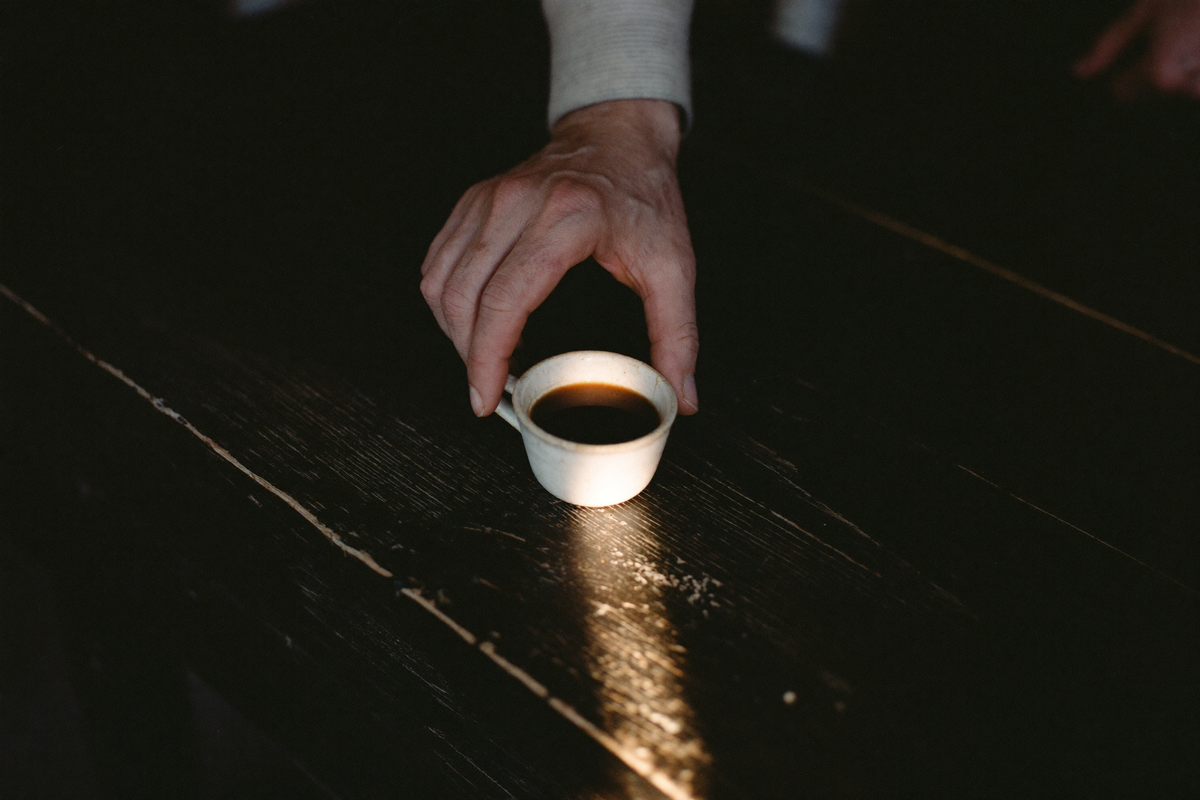
The earliest person in a history is rarely the person who invented the thing. They are usually the earliest person somebody happened to write down, which is a fact about paperwork rather than about events. Coffee has an unusually clean example of this, and it is not the goatherd on the café wall.
The earliest individual the surviving documents attach both a name and a date to is Muhammad al-Dhabani, a Sufi mufti of Aden who died in 1470. He did not discover coffee. What the record credits him with is a substitution. The Sufi devotional drink qahwa was being made from kafta, the leaves of the khat shrub, and when khat could not be got reliably in Aden he used the coffee bean instead. That is the founding act at the top of coffee's documented history. A supply problem, solved with a cheaper local alternative.
Why the death date is the entire claim
A legend has no dates. That is close to a definition. What separates al-Dhabani from every origin story you have heard is that he arrives with a year attached, and the year is a death year, recorded in all likelihood because he held a religious and legal office in a society that kept track of its scholars.
That is worth sitting with, because it means coffee's first named person is named for a reason that has nothing to do with coffee. He shows up in the record the way a district judge shows up in a court register. The drink is a detail beside the name, and the detail survived because the name did.
Kenneth Davids puts the general position plainly in his roasting book: everything known about early coffee rests on inferences drawn from a handful of scattered references in fifteenth and sixteenth century Middle Eastern documents. That is the whole evidential base. Not a thin one for the period, but small enough that a single named man with a single date does a great deal of load-bearing.
The source, and why it argues with itself
The principal surviving account of coffee's spread through the Islamic world is a manuscript written around 1556 by Abd al-Qadir al-Jaziri. Al-Dhabani had been dead for roughly eighty-five years when it was written. Al-Jaziri is not a witness. He is a scholar assembling what was already, by his own time, a contested question.
And it is visibly contested inside his own text. One account has al-Dhabani encountering the drink in Ethiopia and taking it up after an illness. Another says Ali ibn 'Umar al-Shadhili is honoured in Mocha as the father of qahwa, but that al-Shadhili's version was the khat drink, and that al-Dhabani made the swap to the bean afterwards.
Two accounts, one manuscript, no resolution. Jonathan Morris presents this with the disagreement intact rather than picking a winner, and the disagreement is the informative part. By 1556 the practice was widespread enough that its origin had already become something people argued about. A tradition only acquires competing founders once it is big enough to be worth founding.
All of this sits at medium confidence and deserves to be labelled that way. The date is good. The story attached to the date reaches us through one later manuscript and through modern historians reading it.
What he almost certainly never drank
Here is the part that gets left out, and it is the most interesting thing about the man.
Al-Dhabani probably never drank roasted coffee. Davids dates the definite roasting of coffee seeds, in the full sense of the word, to Syria and Turkey by around 1550. That is roughly eighty years after al-Dhabani's death. Before that, the likeliest hot coffee drink was qishr: the husks of the coffee fruit, toasted lightly and then simmered. Yemen has never stopped making it. Dried husk is sugary, so the cup lands sweet and still carries caffeine, which puts it closer to a spiced fruit infusion than to anything sold as coffee now.
Ian Bersten, whose history Davids summarises, argues that true bean roasting was an escalation of the light toasting already applied to husks, and that the Ottomans pushed the roasted bean partly to make use of a by-product that qishr production had been throwing away. He also proposes Syria as the likely birthplace, on the grounds that Damascus had the metalworking to produce cookware, and a metal pan reaches temperatures an earthenware bowl cannot. Davids labels this speculation. It should be read as speculation. It is still a good mechanism, because it says the roast was gated by the vessel, and a tradition working in fired clay simply could not get there.
So the founding figure of the drink was working with the seed of a fruit whose husk was the more valuable part, in a form nobody today would recognise, for a purpose that was not pleasure. Sufi orders used qahwa for dhikr, night-long devotions performed by men with daytime jobs who needed to stay awake through them. The word itself points at a lessening of desire, which in that setting means desire for sleep.
What a "no later than" date is good for
The 1470 date does not mark an event. It marks a boundary. Somebody was drinking coffee as a beverage in Aden before 1470, and everything after that is downstream.
That boundary is useful because it cleanly separates two facts that get merged constantly. The plant is old. Coffea arabica came out of the forested highlands of Ethiopia's centre, something Western science only settled around the middle of the twentieth century, and Davids reports a well-argued case that it was first deliberately cultivated in Ethiopia and carried across to South Arabia as an already domesticated crop, possibly as early as around AD 575. The drink is young. Roasted coffee is younger still.
Anyone selling you an ancient tradition owes you an answer to which of those three they mean, because they are separated by nearly a thousand years.
The same boundary logic explains a European habit nobody thinks about. Coffee reached Europe in the Ottoman style, boiled, unstrained, with the powder still suspended in the cup. Jessica Easto files that as decoction: the grounds are never separated out, so the solids ride into the cup and stay there, doing the work a paper filter would later remove. That is where the weight of the drink came from.
It also explains the sugar. Long contact at high heat takes almost everything the bean has, and the order in which compounds come out of coffee puts the bitter, drying ones last, so a drink boiled that hard needs something to sit against. The roast was black too. A seventeenth century English pamphlet was still telling readers to take their beans to black in an old frying pan.
Straining came later, and Davids makes an observation about where. Map where Europeans strain and where they still drink the powder, and the boundary sits more or less on top of where the Ottoman Empire stopped and Christian Europe began, as that line stood in the seventeenth and eighteenth centuries. Filtration is not a neutral technical upgrade. It is a border, and what paper, cloth and metal each hold back continues a decision made along that line. Before it, every cup in this story was full immersion with nothing taken out at the end, which is the far side of the immersion and percolation split that still sorts every brewer sold today.
What this article will not do
It will not tell you al-Dhabani drank the first cup of coffee. He is the earliest person we can name and date, which is a claim about which documents survived, not about who was first. People were almost certainly drinking it before him, in Yemen and in Ethiopia, and none of them held an office that generated a record.
It will not defend the date as settled either. Ukers, writing the standard English reference in 1922, gives the same figure as Gemaleddin, mufti of Aden, and puts him at about 1454. Morris, working a century later with modern scholarship behind him, gives al-Dhabani and 1470. Same tradition, different transliteration, sixteen years apart. That is what a name looks like after five centuries and two languages, and anybody quoting either number with total confidence has stopped reading too early.
And it will not improve anything in your cup. This changes no variable in any brew you will make this week.
The version worth carrying
Coffee's documented history begins with a jurist in a port city who could not get the plant he wanted and used the one he could. It is a procurement decision. It happened before roasting existed in the form we mean by the word, in a drink that was probably made from fruit husks rather than beans, for men who needed to stay awake to pray.
There is no discovery in it and no moment of wonder. There is a date, a name, an office, and a manuscript written eighty-five years later that does not fully agree with itself. That is what real history usually looks like. It holds without anyone's help. The goat story has to be retold to stay alive.