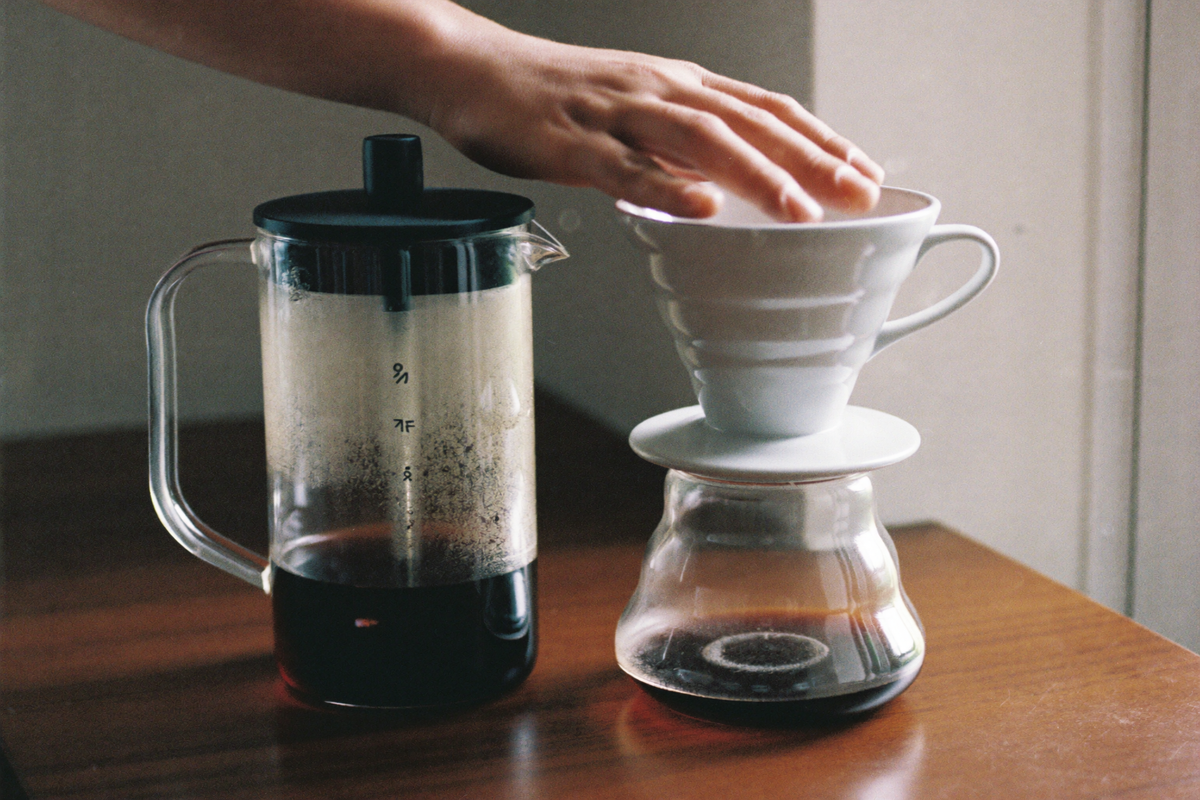
A shop shelf of brewers looks like a shelf of unrelated inventions. A press, a cone, a flat-bottom dripper, a vacuum pot, a plastic plunger, a valved thing that claims to be both. The marketing treats each as its own philosophy.
There are two categories, and everything on that shelf is in one of them.
Either the coffee and the water sit together for a set time and are then separated, or the water passes through a bed of grounds and keeps going. The first is immersion. The second is percolation. Which one you are holding determines what you can control, what you need to buy, and how your coffee will fail.
The difference that actually matters
In an immersion brewer, you set the contact time directly. A French press steeps for four minutes because you decide it does. Every particle sits in the same water for the same duration, which makes extraction unusually even and unusually forgiving. If the grind is a little off, the result shifts, but it shifts uniformly.
In a percolation brewer, contact time is an output, not an input. Water enters at the top and leaves at the bottom under gravity, and how long it takes is decided by the grind, the bed depth and your pour rate acting together. You are not setting a timer. You are setting conditions and reading the clock afterwards to find out what happened.
That single structural difference explains most of the advice that otherwise sounds arbitrary.
What follows from it
It tells you whether you need an expensive kettle. A gooseneck kettle exists to control where and how fast water lands, and in percolation that control is the whole game. In immersion it is close to irrelevant, because the water is going to sit in a pot with the coffee for four minutes regardless of how gracefully it arrived. Anyone selling a gooseneck kettle to a French press owner is selling a solution to a problem that category does not have.
It tells you which failure to expect. Immersion fails by grind, because grind is the only real variable left once time is fixed. Percolation fails by pour, and specifically by channelling: water finds a path of least resistance through the bed, races down it, over-extracts that channel and under-extracts everything else. A cup that is simultaneously bitter and weak in a pour-over is usually a channel, not a recipe error.
It tells you what to change when the cup is wrong. In immersion, adjust grind and steep time, which are independent of each other. In percolation, adjust grind and accept that it will move the brew time too, since they are linked through flow resistance.
And it tells you what the method is for. Immersion gives evenness, forgiveness and body. Percolation gives clarity, articulation and a higher ceiling in trained hands. Neither is better. They are different instruments.
Sorting your own shelf
| Brewer | Category | Consequence |
|---|---|---|
| French press | Immersion | Grind coarseness is the main lever. No kettle skill needed |
| Cupping bowl | Immersion | The purest form: coffee, water, a spoon |
| Siphon | Immersion | Brews about a minute in the upper chamber, then separates |
| Cold brew steep | Immersion | Twelve to sixteen hours, in the fridge |
| V60 and cone drippers | Percolation | Pour rate sets contact time. Most technique-sensitive |
| Chemex | Percolation | Thick paper slows drawdown regardless of your pour |
| Flat-bottom dripper | Percolation | Small holes regulate flow, so it forgives more than a cone |
| Electric drip machine | Percolation | The shower head is pouring for you, well or badly |
| Moka pot | Percolation, under pressure | Steam pushes water through once, no return |
Two brewers deserve their own line.
The AeroPress is an immersion brewer with a pressure finish. You steep, then you press. Most of the extraction happens during the steep, which is why steep time is the variable that matters and why pressing hard and fast mainly forces fines through and adds bitterness.
The valved dripper is a deliberate hybrid. Steep like an immersion, then open a valve and let it drain through paper. It exists to combine immersion's evenness with paper's clarity, and it does that well enough to be slightly boring, which is its virtue.
What this taxonomy will not do
It will not predict body on its own. Immersion tends heavier, but a press with a paper filter placed in it produces a clean cup, and a percolation brew through metal produces a heavy one. The filter medium is a separate dial and it can override the category.
It will not tell you about espresso. Espresso is percolation under nine bars of pressure in twenty-five seconds, which is far enough from gravity brewing that the shared category name stops being useful.
It will not rank the two. Both source manuals cover both without preferring either, and the choice belongs to what you want from the cup and how much attention you want to spend on a Tuesday.
And it will not save a brewer from its own design. A percolator that recirculates already-brewed coffee back through the grounds is a percolation device, correctly classified and still a bad idea.
Why it is worth carrying around
Most brewing advice on the internet arrives without saying which category it applies to, which is why so much of it contradicts itself. "You need a gooseneck kettle." "Stirring is essential." "Time your brew." Each of those is true in one category and irrelevant or wrong in the other.
Once you can classify the brewer in your hand, you can classify the advice before you follow it. That is worth more than any specific recipe, and it stays true when the equipment changes.
If you own several brewers, the taxonomy also tells you what to hold constant when comparing them. Use the same ratio across the shelf, and the difference you taste is the category and the filter doing their work, which is the only way to find out what you actually prefer.