Most words on a coffee bag have no definition behind them. "Specialty" is the odd one out, because for about twenty years it had a number attached, and the number is stranger than the word suggests. It was not invented to tell you which coffee to drink. It was invented so that two people who had never met could agree on the price of sixty kilos of green beans over a telephone.
Specialty, in its technical sense, means green coffee that scores 80 or above out of 100 on the Specialty Coffee Association's cupping form, with no primary defects and no more than five full defects in a 350 gram sample. The score belongs to a lot of unroasted beans at one moment in its life. It does not belong to the bag on your counter, and it says nothing at all about the cup in your hand.
What the scale is actually measuring
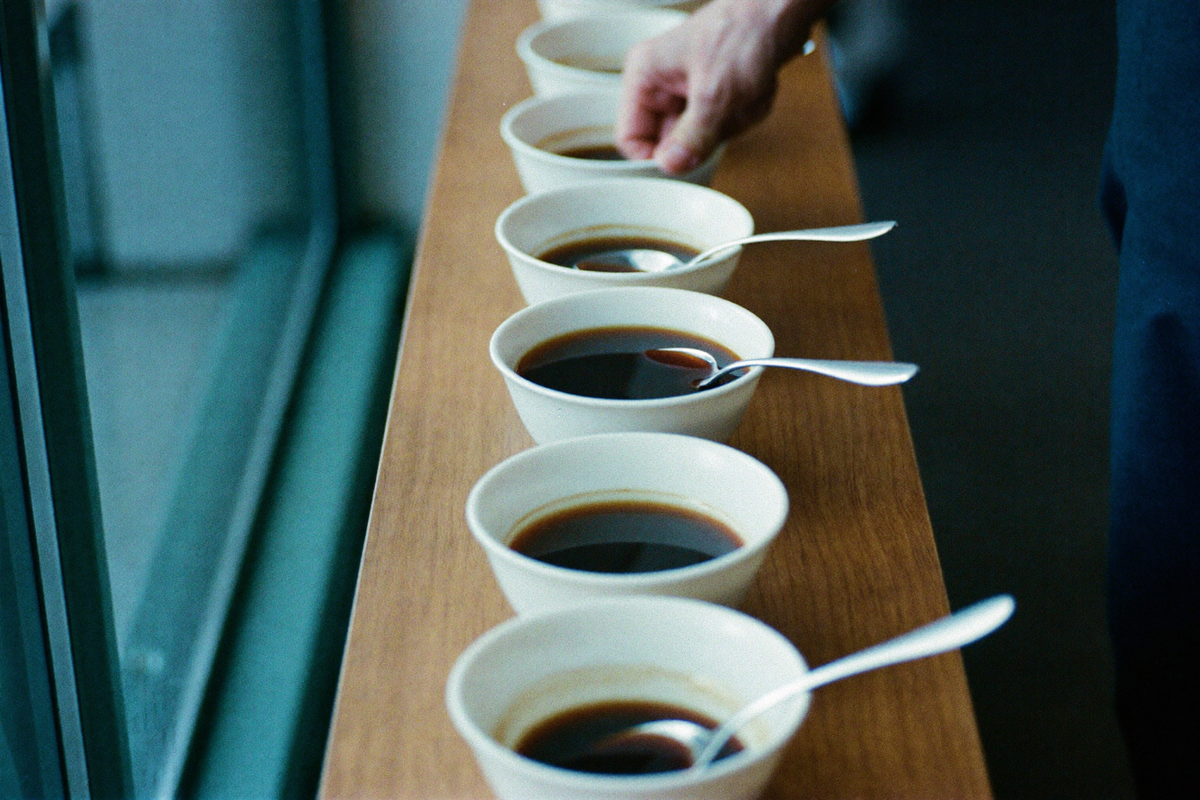
A cupping is a controlled tasting, and control is the whole point of it. Roast level, grind, water temperature, dose and steeping time are all fixed so that the only thing varying between samples is the coffee. Kenneth Davids notes that the procedure was already established in something close to its current form by the middle of the nineteenth century, and the parts of it that look eccentric are functional: the slurping aerates the liquid across the palate, and the spittoon exists because a working cupper tastes dozens of samples in a session.
The scorer fills in categories rather than an overall impression. Fragrance and aroma, flavour, acidity, body, balance, aftertaste, uniformity, sweetness, clean cup, overall, plus deductions for defects. Several of those are not about deliciousness at all. Uniformity and clean cup are tests of whether five cups brewed from the same lot taste the same as each other, which is a question about the consistency of a shipment, not about pleasure.
That is the first thing worth understanding. The form was built to sort green coffee for trade, and the SCA says so plainly: its own handbook describes cupping as an evaluation and quality assessment tool that exists inside the green coffee trade, and distinguishes it from demonstration tastings run for education or promotion. Jessica Easto makes the practical version of the same point for drinkers: by the time coffee reaches you, this assessment has already happened, and there is little reason to reproduce it at your kitchen table.
Why 80, and what the numbers above it mean
The scale runs to 100 and almost none of it gets used. Below 80 is the commercial pile, which is the great majority of coffee grown. Above 80 is the specialty band, and in practice that band is about ten points wide before it runs out of coffee.
Roughly how the range is read by people who buy for a living: 80 is the entry line, 83 is a solid working benchmark for a good single origin, 84 is around where competition and auction lots start, and 90 and above is exceptional and rare. A perfect 100 has essentially never been awarded.
So the resolution is much finer than the number suggests. A single point is a large distance. Two coffees at 82 and 85 are not 3 percent apart in any meaningful sense, they are in different commercial categories, and the price gap between them will not be 3 percent either.
An illustration of how threshold-like the line is. Aaron Davis and colleagues at Kew, writing in Nature Plants in 2021, reported that a panel at Union Hand-Roasted in London had cupped a Sierra Leonean sample of Coffea stenophylla, a wild West African species that is not arabica at all, and scored it 80.25. A quarter of a point over the line, and a different species entirely. That number tells you the coffee cleared a bar. It tells you nothing about whether you would enjoy it.
Four honest problems with the number
It has a taste, and the taste is documented. Traore, Wilson and Fields, writing in the Journal of Agricultural and Applied Economics in 2018 on Cup of Excellence data, found that floral, fruity, sweet, spice and sour-acid attributes had the largest effect on quality scores and on the prices those coffees fetched. That is a defensible finding and it has an uncomfortable implication: the scale rewards a particular flavour direction. A deep, low-acid, chocolatey Sumatra is not being measured against its own ambitions. If you prefer that cup, a high score is not straightforwardly good news for you.
Scores move with what the taster knows. The SCA recommends that a cupper knows as little about a sample as is practical, which is an institution acknowledging its own instrument's sensitivity. Easto's account of professional bias is blunter: knowing a coffee was naturally processed can make a taster expect fruit, look for fruit, and find it.
Order effects are real. Easto describes the carry-over effect, where a defective sample makes the next cup in the line seem better than it is, and cuppers score it higher than they would have in a cleaner line-up. The same coffee, sampled third instead of fourth, can come out with a different number.
Grading systems mostly grade other things. Davids makes the point that national grading standards, the ones that produce names like Kenyan AA or Colombian Supremo, tend to focus on externals: bean size, altitude, how many sticks and broken beans are in the lot. Cup score is one system among several and it does not travel with most of the grade names printed on bags.
What the number will not do for you
An 80-plus score will not tell you the coffee in your kitchen is good. It was awarded to green beans, often a year or more before you opened the bag, and everything that happens afterwards is outside its scope. A roaster can waste an 87-point lot. Time will do it more slowly and just as thoroughly, which is why a roast date is a more useful number on a bag than a cup score, and why the interesting question is usually how long ago the coffee was roasted rather than how it once scored.
It will not tell you whether the coffee suits you. The score compresses eleven categories into one figure, and your preference does not live in that figure. It lives in the categories underneath it, and acidity is where two drinkers most often part company.
It will not tell you the producer was paid well. Score and price correlate, but a score is a quality assessment and not a transaction record. What the grower received is a separate question with a separate paper trail.
And it will not be audited on a retail bag. Nobody checks a "scored 86" claim on a website. Roasters who publish the score alongside the lot, the year, the form used and who did the cupping are doing something real. A bare number with no provenance is a marketing figure, and it belongs in the same category as the crema on top of a shot, which people read as a quality signal and which mostly is not one.
The word is drifting away from the number
Two things are happening at once, and both matter if you are trying to use "specialty" as a filter.
At the industry end, the SCA has been rebuilding the twenty-year-old cupping form into a broader Coffee Value Assessment, on the grounds that a form designed to separate specialty grade from commercial grade is not the right tool for describing what different drinkers actually want. That work is live rather than finished. Treat "80 points equals specialty" as a shorthand on its way out rather than a permanent definition.
At the consumer end, the word has already left. The National Coffee Association's consumer tracking counts as specialty every espresso-based, cold brew and nitro drink on a menu, plus any ordinary coffee the drinker believes was made from premium beans. That last clause is self-reported perception. When you read that some large share of Americans drink specialty coffee, a vanilla latte is inside that number and a cupping score is not.
Kenneth Davids watched the earlier version of this drift happen: specialty started out in the 1960s as small roasters selling loose fresh beans to the streets around them. It went to the malls next, then to the national chains, and the word stretched a little further at each move.
What to do instead
Use the score for what it is, which is a floor. Above 80 means a lot passed a trade screen for defects and consistency. That is genuinely worth something, and it is not a recommendation.
Then look at the things a number cannot carry: the roast date, the process, the variety, and whether the roaster will name the farm or the co-operative and the year. Those tell you what kind of cup you are about to have. The score only tells you it was fit to sell.
And then taste it against something. A single cup drunk alone gives you almost no information, because you have nothing to measure it against and your palate is not calibrated in the abstract. Two coffees side by side teach you more in ten minutes than ten mornings of one. Professional cuppers work in lines of samples for exactly this reason, and it is the one part of their method worth stealing.