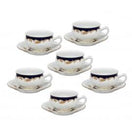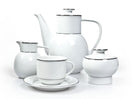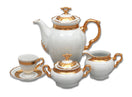
There is a claim moving around specialty coffee that a white cup makes the same coffee taste roughly twice as intense as a black one, and simultaneously less sweet. If it is true it is the most commercially significant fact in the entire drinkware category, because it means the glaze colour we choose is changing the drink rather than decorating it.
We are not going to tell you it is true, because we have not verified it. What we can tell you is where the claim comes from, why it is plausible, and one thing about cup colour that is straightforwardly useful regardless of how the research shakes out.
The claim, stated carefully
The finding is attributed to work associated with Charles Spence at Oxford, who has spent a long career on how the senses interact with context: how the weight of cutlery changes perceived food quality, how the sound a crisp makes changes how fresh it seems, how the colour of a mug changes a hot chocolate.
The coffee version, as it reaches us second-hand through the specialty literature, is that a white cup pushes perceived intensity up sharply relative to a black one, and pushes perceived sweetness down.
Here is our problem with repeating it. We have it from a coffee reference book citing the research, not from the paper. We have not read the study, checked the sample size, checked whether it was coffee or another drink, or checked whether the effect has held up in replication. Cross-modal perception research is a real and serious field, and it is also a field where striking single findings get repeated for a decade after the evidence has moved.
So: plausible, consistent with a large body of work on context effects, and unverified by us. We are flagging it rather than dropping it because it may well be the most useful thing in this article, and pretending we had checked would be worse than admitting we have not.
Why the direction is believable even if the magnitude is not
Colour changes expectation, and expectation measurably changes perception. That much is not seriously contested.
A dark interior makes the liquid disappear into the cup. A white interior throws the colour of the coffee into relief: you see how dark it is, how the crema sits, how the milk was folded in. Your visual system delivers a prediction to your palate before the first sip, and your palate does not evaluate independently of it.
Whether that produces a doubling of perceived intensity, or a modest nudge, is exactly the part we cannot tell you.
The part that needs no research at all
Set the perception question aside. There is a second reason cup colour matters, and it is purely practical.
A white interior is a reference field.
It is the only surface that lets you honestly judge what is in the cup. Crema colour, which tells you something real about roast recency and darkness. Pale broken patches, which tell you the shot channelled. The contrast a poured pattern needs to be visible at all. The colour of a filter coffee, which tracks roast level closely enough to be informative.
A dark or black glazed interior hides every one of those.
That is not a flaw. It is a choice, and it is a perfectly reasonable one if you want an object that looks a particular way on a shelf. But it is a choice to make the drink harder to assess, and almost nobody selling dark-interior cups mentions it.
We sell cups with dark interiors. We are telling you here, and we will tell you again on those product pages, because you would work it out eventually and it is better coming from us.
What a cup colour will not do
It will not change the chemistry of the coffee. Nothing about a glaze alters what is dissolved in the liquid, and any product page implying otherwise is describing magic.
It will not fix a bad shot, and it will not rescue stale beans.
And it will not affect your experience anywhere near as much as temperature does. If you are optimising a cup, the wall thickness, whether you preheat it, and the width of the mouth all have larger and better-understood effects than the colour. Colour is interesting. It is not the main variable, and we would rather you spent your attention on the ones we can defend.
How to test it on yourself
This is one of the few claims in coffee you can check in a single sitting, which is unusual and worth taking advantage of.
Brew one batch of coffee. Divide it between a white-interior cup and a dark-interior cup of similar size and wall thickness. Let both settle to the same temperature, which matters more than people expect, then taste them alternately.
If you want to be slightly more rigorous, have someone else hand them to you, and taste with your eyes closed first to establish that they are in fact the same coffee before you look.
You will get an answer for your palate in about ten minutes. That is worth more to you than our summary of a paper we have not read.
What we are going to do about it
This claim sits in the verification queue for our reference material, and we will update this piece when we have either read the underlying research or run a structured test ourselves with enough tasters to mean something.
Until then it stays labelled as unverified, including in the places where it would be commercially convenient for us if it were true. A shop selling white ceramic has an obvious interest in a finding that white ceramic improves coffee, and that is exactly the kind of claim we should be slowest to repeat.