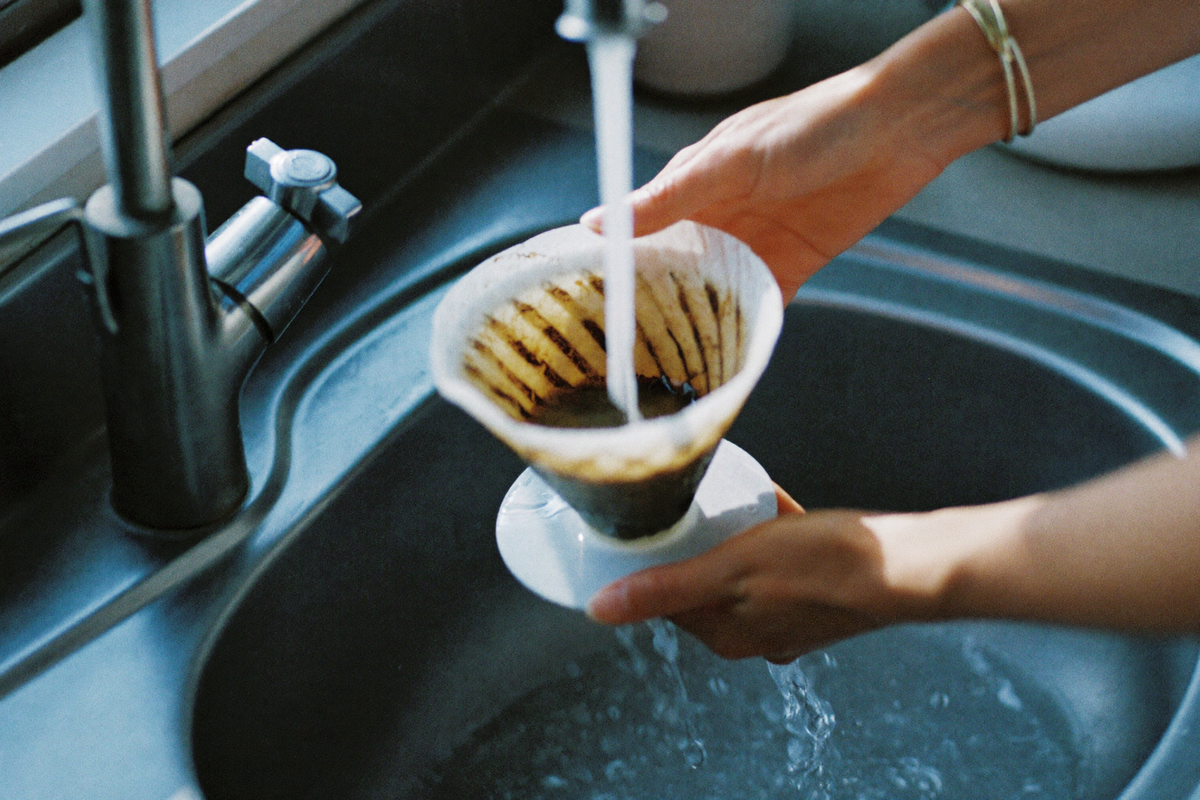
A cloth filter is the only part of a coffee setup that gets worse while you are not using it. Everything else on the counter is inert between brews. The grinder sits there. The kettle sits there. The cloth, meanwhile, is a piece of oil-soaked fabric in a warm room, and what happens to it overnight decides how tomorrow's coffee tastes. Almost every cloth filter that ends up in a drawer got there because of something the owner did after brewing, not during.
Rinse it under hot water the moment you finish brewing, and never let it dry out. Between uses it lives submerged in cold water in a lidded jar in the fridge, or squeezed out and sealed in the freezer. Never wash it with dish soap. Dried out with coffee oil still in the weave, a cloth picks up a stale, damp-laundry smell, and that smell goes straight into the next cup. Once it is in the fibres, rinsing does not take it out.
That is the whole protocol. The rest of this is why it works, what it does not fix, and how to tell when the cloth is finished.
What is actually in the cloth after a brew
Start with what a filter is holding back, because that is what you are cleaning.
Two kinds of material leave a coffee bed. The dissolved compounds are the coffee itself and they pass through any filter. The undissolved material is a different matter, and Jessica Easto's account of body in How to Taste Coffee is the clearest short version of what it consists of: large polysaccharides that cannot dissolve and instead stay suspended in the liquid, visible plant fines from grinding, and lipids, which is to say coffee oil. Green arabica runs roughly 12 to 18 percent lipids by composition in the figures Easto sets out, and roasting drives more of that oil to the surface of the bean, so a darker roast puts more of it into the brew than a lighter one does.
Now place a filter in the path. Paper stops both the oil and the fines. Metal stops neither. Cloth does the useful in-between thing, which is where its reputation comes from: the weave traps fines while letting oil through, so the cup arrives with the texture of a press and much of the transparency of paper. That is the property people buy it for, and Anette Moldvaer sets out the same three-way split in Coffee Obsession, as do Racineux and Tran.
Read that mechanism back and you have the maintenance problem stated exactly. Fines are lodged in the weave. Oil has passed through it and coated it. What you are holding after a brew is a small piece of fabric carrying wet grounds and a film of vegetable oil, and you are about to decide where it spends the next sixteen hours.
Why the smell happens
Two processes are available to a damp, oily cloth left in air, and the honest position is that both are plausible and they are hard to separate at the kitchen sink.
The first is oxidation. Kenneth Davids, writing about why roasted beans go flat, names oxygen as the thing that stales coffee's flavour oils, with moisture and heat destroying them outright. He also notes something more specific and more useful here: beans left sitting in droplets of water after roasting stale unusually fast. Oil, water, warmth and air together are the accelerating combination. A cloth filter drying slowly on a draining board reproduces all four for hours.
The second is biological. Damp fabric held at room temperature for a day grows things, and the musty smell of a towel left in a gym bag is a microbial smell rather than a chemical one. That is not a coffee fact, it is a laundry fact, and it matches the description people actually give of a failed cloth filter far better than "rancid" does. Most owners say old laundry. They say it because that is what it is.
We are not going to pretend to know which of the two dominates in your kitchen, because we have not cultured anything and we are a shop, not a lab. What matters practically is that the same intervention shuts down both. Cold slows chemical reaction rates and slows microbial growth. Submersion cuts off most of the air. Freezing very nearly stops both. Keeping the cloth cold and wet is not a preservation superstition. It is the one move that addresses both candidate mechanisms at once, which is probably why it survived a century of being passed on.
The instruction is older than the fridge
William Ukers wrote All About Coffee in 1922, when cloth was still the ordinary way to filter coffee in much of the world, and he already gave the care rule in full: do not let the cloth dry, keep it immersed in a jar of cold water. No refrigeration in that instruction, because there was no refrigerator to put it in. The jar was the technology.
The thing that displaced cloth was not a better cup. Melitta Bentz patented her paper filter in 1908, and paper won on the single axis where cloth is genuinely terrible, which is that you throw paper away and it never smells of anything. A century later people rediscover cloth for the cup it makes, buy one, get no care card with it, and abandon it by the second month. The failure is in the retail, not in the object.
Worth stating plainly, since we sell objects for a living: an accessory that requires a maintenance routine and ships without instructions is a return waiting to happen. Anyone selling a cloth filter should be selling the jar beside it.
The protocol, in order
Before first use, boil it. New cloth often carries a finishing agent from manufacture, and Moldvaer, Racineux and Tran all specify a rinse before the first brew. Five minutes in plain boiling water, then discard that water. Skip this and the first two brews taste faintly of fabric.
Immediately after brewing, rinse hot. This is the step that matters most and the one people postpone. Knock the spent grounds into the bin, then run hot water through the cloth from the outside in until it runs clear. Do it while the oil is still warm and mobile. Oil that has cooled and set into the weave does not come out with a rinse, and every brew after that is filtering through the residue of the ones before.
Squeeze, do not wring. Press the water out between your palms or against the side of the sink. Twisting distorts the weave, and the weave is the whole instrument. A cloth that has been wrung into a rope filters unevenly at the folds.
Store it submerged and cold. A small lidded glass jar with cold water, in the fridge. The cloth should be under the surface, not floating half in the air. Change the water daily. If the water is brown when you change it, the rinse before storage was not thorough enough, which is useful feedback rather than a disaster.
Going away, freeze it. Squeeze it out, seal it in a bag with the air pressed out, freeze. Thaw it under running cold water when you come back. Do not microwave it and do not thaw it on the counter for hours, which puts you back in the warm damp condition you were avoiding.
Deep clean by boiling, never by soaping. Every couple of weeks, boil the cloth in plain water for around ten minutes. The water will go brown, and that brown is the accumulated oil you could not rinse out. Then back into the jar. If you want more than plain water, use a percarbonate-based coffee equipment cleaner and rinse it very thoroughly, which is the same class of cleaner used on brewing equipment generally.
Never dish soap. This is not fussiness. Detergent is engineered to bind oil and cling to surfaces, and a woven fabric holds it far better than a glass carafe does. The residue is not fully rinsable and it transfers into the coffee as a soapy, chemical edge that most people misdiagnose as a bad bag of beans. The prohibition is stated flatly in Moldvaer and in Racineux and Tran, and it is the same reason nobody puts soap in a moka pot.
Knowing when it is finished
Cloth filters do not announce their retirement. The weave slowly loads with fines and set oil, the flow rate drops, and because the change is gradual you compensate at the grinder without noticing you are doing it.
So use drawdown time as the gauge. Once, early in the life of a new cloth, brew a batch you can repeat: fixed dose, fixed grind setting, fixed water volume, and write down how long the water takes to pass through. That number is your baseline. When the same brew takes noticeably longer, roughly half again as long, the cloth is filtering through its own history rather than through the coffee. Boiling buys back some of it. Eventually it does not.
We are not going to give you a brew count, because we have not run a cloth to failure under controlled conditions and any number we invented would be more precise than the truth. What we will tell you is that the variable is oil volume rather than calendar time. Dark roasts and daily brewing wear a cloth out faster than light roasts twice a week, for the reason set out at the top: darker roasting puts more oil in the cup, and the cloth is what the oil passes through.
What this will not do
Cold storage will not rescue a cloth that has already dried out and gone off. Once the smell is in the fibres, boiling reduces it and does not remove it. We have seen people run four or five boils on a spoiled cloth trying to save an object worth less than a bag of coffee. Buy a new one. Cloths are consumable, they just consume more slowly than paper.
Wet storage will not make your coffee taste better. It stops it tasting worse. Nobody has ever been able to detect a correctly stored cloth in the cup, which is exactly the point. This is hygiene, not a flavour lever.
A cloth filter will not fix extraction. If your coffee is sour or harsh, the filter is not the cause and swapping it will not help. Body and clarity are what the filter medium controls. Balance is grind and contact time, and that is a separate diagnostic you run first, before you go looking at hardware.
And it will not fit your life just because it appeals to you. This is the honest gate. A cloth filter is a daily obligation with a jar in your fridge attached to it, and it is a bad gift for anyone who has not asked for one specifically. If you already skip rinsing the press until the evening, you will not rinse a cloth within thirty seconds of pouring, and the cloth is unforgiving in a way the press is not. There is no shame in that. Paper exists.
Two places cloth turns up that nobody warns you about
Siphons use one, and seating is the failure point. A siphon's cloth filter has to sit flat against the lower rim of the upper chamber with its chain and hook pulled true. When it is off centre or curled at the edge, grounds pass into the finished coffee and the brew reads gritty when the real fault is assembly. Same care rules apply, and the same jar.
Cold brew is strained through cloth rather than paper. Racineux and Tran specify exactly this: steep in the fridge, then strain through cloth set in a sieve. Paper clogs on the volume of fines a coarse-ground overnight steep produces. If you use your brewing cloth for this, be aware you have just pushed several times a normal brew's worth of solids through it, and rinse accordingly. A cheap second cloth kept only for straining is the sane arrangement.
The station this actually needs
There is a real setup behind the cloth, and it is short.
You need the cloth itself, which is typically $6 to $12 as of August 2026, and the ring or handle it stretches over, which usually costs more than the cloth does. You need a small lidded jar that holds the cloth submerged and lives in the fridge, and a second cloth so you are not brewing with a frozen one while it thaws. That is the complete list. There is no cleaner on it, because the correct cleaner is a pot of boiling water.
We do not sell cloth filters or brewers. We sell the vessels at the end of the process, and the honest connection to this piece is the jar, since a small lidded stoneware or glass jar is a thing we do make and a thing that happens to be exactly right for this job. That is not a performance claim. It is a container.
The related habit worth borrowing is the storage logic itself, which runs opposite to the rule for the coffee. Beans should never go in the fridge, because they take on moisture and odour there, while the cloth belongs in the fridge for the same reason inverted: it is already wet and you want it kept that way, cold. The freezer works for both, and for the beans there is a specific method that makes it work.
If you have not yet chosen a filter medium and arrived here out of curiosity, start one step back, with what each of the three media actually changes about the cup. Choose the coffee you want first. The maintenance is downstream of that choice, and it is only worth accepting once you know what it buys.