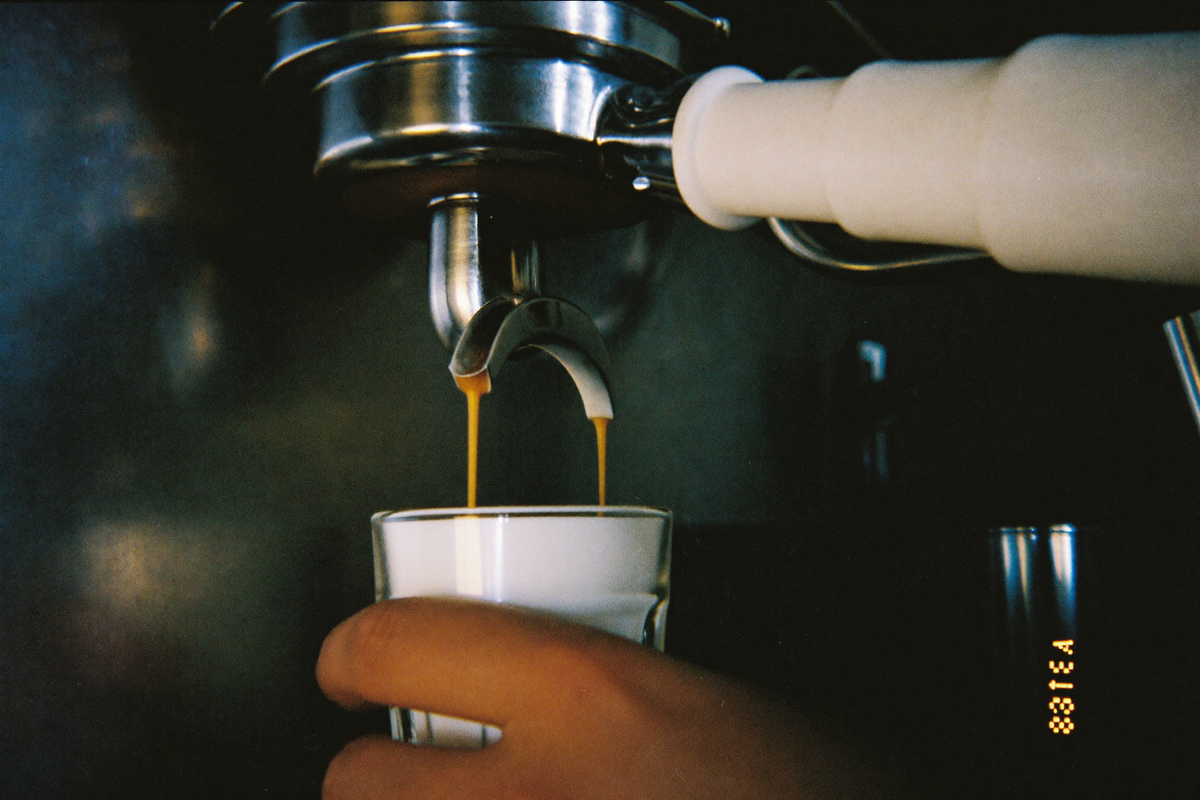
Your recipe says eighteen grams in, thirty six out, twenty eight seconds. You hit all three. The shot is sour. What happens next is usually that the numbers get blamed, and a person spends a fortnight moving the grind back and forth around a setting that was never the problem, ending up with worse coffee and less patience than they started with. The numbers were not lying to you. They were describing something they cannot see.
A bottomless portafilter shows you one thing: how evenly water left the coffee bed. That is the whole function. It measures nothing and it fixes nothing. What it makes visible is channelling, which is water finding a low-resistance path through the puck and pouring down that path instead of spreading through the whole bed. Your recipe cannot detect this, because dose, yield and time are totals. They describe the average shot. Channelling is a problem of distribution, and an average has no opinion about distribution.
How a correct recipe and a sour shot fit together
Espresso runs at around nine bar, roughly 130 psi. Water under that much pressure behaves the way water always behaves. It goes where the resistance is lowest.
A coffee puck is meant to resist evenly across its whole face. Where it does not, because there is a crack, a gap along the basket wall, or a dense clump sitting next to loose grounds, water finds that spot in the first second and commits to it. Two things then happen simultaneously in the same basket. The coffee lining the channel receives far more water than its share and over-extracts. The coffee outside the channel is barely touched and under-extracts. Both go into the same cup.
Under-extraction is the louder of the two. Under-extracted coffee is sour and thin, and it tends to dominate the impression even when there is bitter, over-extracted material sitting beside it. So the cup reads as sour, the timer read twenty eight seconds, and both facts are true.
There is a second signature worth knowing, because it is the one that breaks the standard fix. Jessica Easto, writing about how water moves through a coffee bed, makes the point that chlorogenic acids are relatively large molecules and take some doing for water to extract, so where water lingers too long with the same grounds it has time to pull them out, and astringency rises. She is describing pour-over, where the geometry is gentler and the pressure is nothing like an espresso machine. The chemistry does not change. A channelled shot can therefore taste sour and drying at the same time, which fits neither half of the sour-or-bitter question that sorts most bad cups in a single taste. When you get both at once, stop adjusting and look at the puck.
What you actually see through the bottom
A bottomless portafilter has no spouts and no base. You watch the underside of the basket directly. Here is the reading, in the order it happens.
A shot that is behaving looks like this. Dark spots appear across most of the basket face within a second or two of each other. They join into a single stream near the centre. That stream holds together, runs the colour of dark honey, and thins gradually toward the end.
A shot that is channelling looks like any of these:
- a thin jet firing sideways off the face of the puck, sometimes clean across the drip tray
- a fine spray from one point while the rest of the face is still dry
- pale, watery streaks appearing early and staying pale
- flow that suddenly accelerates halfway through, which means a channel opened mid-shot
Then knock the puck out and look at it. A crater, a visible hole, or one wet quadrant against three dry ones all tell you where the water went. This after-the-fact read is the part people skip and it is free.
The causes, in the order worth checking
Clumping in the grinder. Fine coffee is static-prone and it sticks to itself. A clump is a dense lump surrounded by looser grounds, which is a resistance difference that exists before you have touched the basket. Breaking clumps up with a needle distribution tool is the single highest-yield fix available, and it is absent from the reference books because it became standard practice after most of them were written. If your grinder produces dust and boulders in the same dose, no amount of stirring will save you, because you are not correcting one bed, you are trying to average two.
Distribution, not tamping force. James Hoffmann's position is that tamping only needs to remove air and leave a level bed, because the machine pushes far harder than any person can, so pressing harder does not meaningfully slow the water. A heroic tamp buys nothing. A crooked one costs you the shot, because a bed that is 2 mm higher on one side has a thin side, and the thin side is a channel.
Tapping the portafilter. Knocking the side of the basket to settle the grounds cracks the puck away from the basket wall. That gap is a ready-made channel around the entire circumference. It is the most common well-intentioned habit in home espresso and it should simply stop.
Dose and basket. Too little coffee leaves headspace above the puck, so the puck lifts and breaks when pressure arrives. A worn basket, or one with a damaged hole pattern, produces uneven flow no matter what you do above it. Baskets are consumables and nobody treats them that way.
Pre-infusion. Wetting the bed at low pressure before full pressure gives the grounds time to swell and close small gaps before the machine starts pushing. It reduces channelling, and it is the reason machines with a pre-infusion function forgive a sloppier puck.
The counter-argument, which is a good one
Every shot channels somewhere. Perfect flow across an entire basket face is a laboratory condition, not a Tuesday.
The bottomless portafilter has a well-earned reputation for turning a working home setup into a research project. People start pulling shots to look at them rather than to drink them, and the coffee gets worse while the videos get better. The rule that prevents this is short: the picture is not the score. Taste first, look second, and if a shot that sprayed a little tastes good, it was a good shot.
One trap is worth naming because it wastes money. If your machine came with a pressurized basket, the double-walled kind with a single small hole underneath, a bottomless portafilter shows you nothing useful. The back-pressure in that basket is manufactured downstream of the coffee, so the puck's real behaviour is hidden and the foam that comes out is an artefact of the hole, not of the shot. That foam is also the source of half the confusion about what crema does and does not tell you. Replace the basket first. Then buy the portafilter.
What this will not do
A bottomless portafilter will not tell you whether your shot is under- or over-extracted overall. It has no opinion on extraction. It reports evenness and nothing else, so it can show you a beautiful, even, entirely wrong shot pulled from beans roasted four months ago.
It will not distinguish between causes. A jet at nine o'clock looks the same whether it came from a clump, an unlevel tamp, a damaged basket or a group screen that has not been cleaned since March. You still have to work through them one at a time.
It will not survive an inattentive morning cleanly. There is no spout, so a channelling shot sprays coffee onto the counter, the wall, and you. You also cannot split a shot into two cups with it, which sounds trivial until the second person in the house wants a coffee.
And it will not improve a single thing on its own. It is a window. Fitting a window to a room does not tidy the room.
What to do with it
Buy one only after you own a grinder that holds its setting, because everything above assumes the grind is repeatable, and if it is not then the puck is different every morning and you are diagnosing noise. That ordering is the whole argument for buying the grinder before anything else in the chain.
Then run one morning properly. Pull three shots with the same beans, dose and grind. Do nothing special for the first. For the second, break up the clumps with a needle before tamping. For the third, do that and level the tamp deliberately against the rim. Watch all three, and taste all three.
You will see the flow change before you taste it change, and once you have seen it, sour espresso stops being a mystery about numbers and becomes a question about a surface. That is a much easier problem.