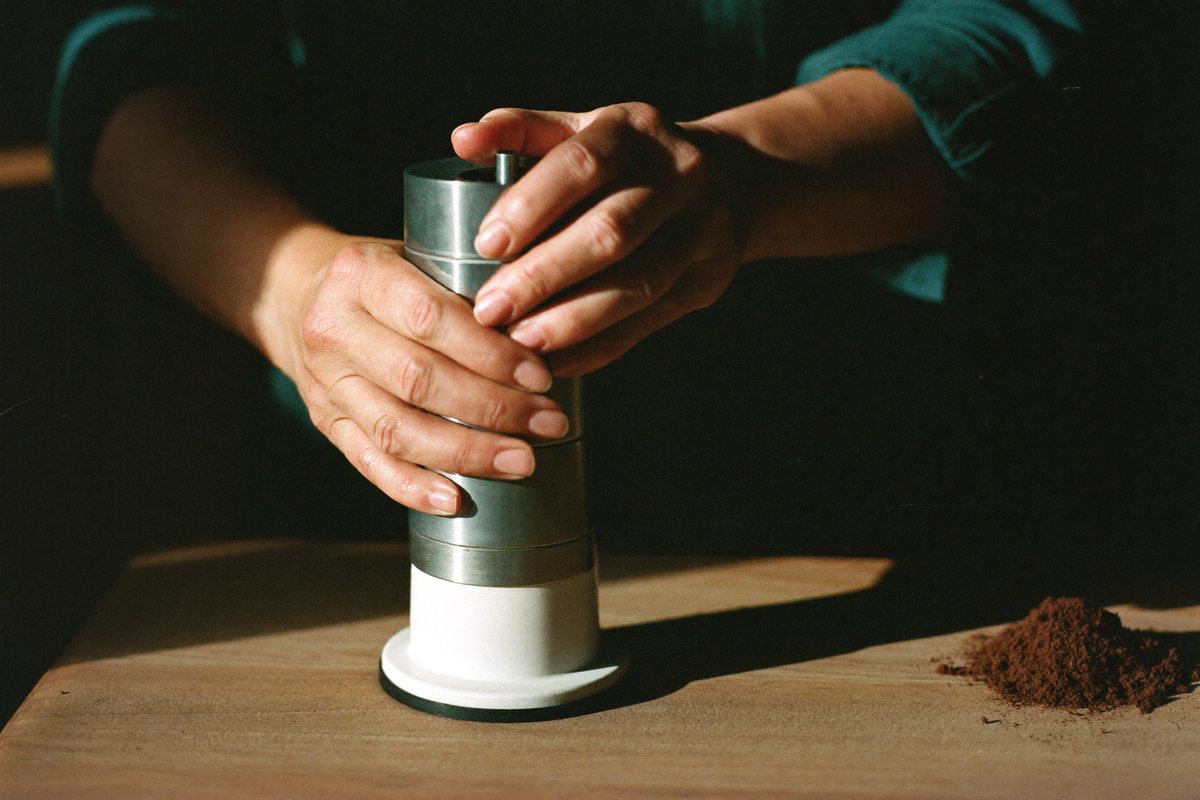
Somebody posts a recipe with a grind setting in it. Twenty on the Encore. Two and a half on the hand grinder. It gets copied into a comment, then into a video description, then into the note on somebody's phone, and by the time it reaches you it has the authority of a measurement. It never was one. It was a description of where one person's adjustment mechanism happened to be sitting on one particular machine, on one particular morning, with one particular bag of coffee in the hopper.
No, you cannot use someone else's grind setting. A number on a grinder is a position on that machine's adjustment mechanism, and nothing about that position is standardised between models, between two units of the same model, or reliably across a year of use on your own. Copy the dose, the water weight, the temperature and the target brew time. Those transfer. The number does not.
A number is a position, not a gap
Start with the physical thing the dial is doing. It moves two burrs closer together or further apart, and the distance between them is what the coffee has to pass through. That distance is measured in microns. The dial is not.
How far one click moves the burrs is a design decision, and manufacturers make it differently. Baratza's Encore ESP Pro, announced in February 2026, shifts roughly 2.2 microns of gap per degree of collar rotation in the espresso range, a figure that comes from the launch reporting at CoffeeGeek and Coffeeness rather than from a published Baratza specification. The Option-O LAGOM 01, named the World Brewers Cup qualified filter grinder for 2026 to 2029, moves about 7.5 microns of burr gap per micro-tick, which is Option-O's own competition figure. Those are both fine adjustments and they are not the same adjustment, so "one step finer" means a different physical change on each. On a coarsely stepped electric grinder built for filter, where the whole usable range is covered in a dozen or so detents, one step is far larger again.
Then there is the zero. Every grinder's numbering starts from a point where the burrs are set to touch, and that point is established when the machine is assembled, within manufacturing tolerance. Two units off the same line can have their scales offset from each other by a meaningful amount before either has ground anything. This is why the advice to ignore other people's numbers holds even between two people who own the identical model. James Hoffmann makes the point in The World Atlas of Coffee and Maxwell Colonna-Dashwood makes it in The Coffee Dictionary, and neither offers a workaround, because there is not one.
Matching the gap would still not match the grind
Suppose you could measure the gap and set yours to match. You would still not have the same coffee, because the gap is not what does the work. The burr geometry is.
The most useful measured evidence on this is Jonathan Gagné's analysis of 300 particle size distributions across 24 espresso grinders, using data collected by the Kaffeemacher team with Marco Wellinger at the ZHAW Coffee Excellence Center on a Camsize X2 imaging device, published in September 2023. Two findings from it matter here. Larger burrs did not systematically produce more uniform or more unimodal grinds within that sample, which retires burr diameter as a shortcut for quality. And flat against conical turned out to be a tendency with large overlap rather than a rule, with conicals averaging slightly less uniform and specific flat burrs underperforming specific conical ones.
What that dataset really shows is that two grinders set to the same gap can produce measurably different populations of particles. Cutting geometry, burr speed and how the grounds exit the chamber all shape the result. A number cannot carry any of that.
Every setting is a distribution, not a size
This is the part that gets left out of most grind advice, and Jessica Easto states it plainly in How to Taste Coffee: even the best burr grinders produce a range of particle sizes rather than one size, and each size in that range extracts on its own clock. Her point is that the goal is not a particular size but a narrow spread, because a narrow spread is what lets a single brew time suit most of the bed.
Follow that through and the arithmetic of copied settings collapses. Two grinders can share the same median particle size and differ substantially in how much of the batch is fines, formally the fraction under 100 microns, which is about the thickness of a sheet of paper. Fines have enormous surface area for their weight, so they give up their solubles almost immediately and they clog the bed, slowing everything else down. A grinder that produces more of them will brew slower and taste more bitter at the same setting as one that produces fewer, and no number on either machine reports this.
The World Brewers Cup drew the obvious conclusion. From the 2026 season the competition standardised on a single grinder across both service rounds, with seasoned burrs cleaned and reset between competitors. That is set out in the World Brewers Cup grinder procedure document, last updated on 28 January 2026. The sport's answer to grinder variance was to remove the variable, not to publish a conversion table. That is worth sitting with before you copy a setting off the internet.
Your own numbers drift too
The number is not even stable against yourself, for four reasons that all operate at once.
Burrs dull. As their cutting edges round over, they begin milling rather than shearing, which produces more fines and a flatter, more bitter cup at the setting that used to work. This happens slowly enough that most people blame the coffee.
Beans change temperature. Particle size varies with how warm the beans and the burr chamber are, which is why an espresso grinder in a café behaves differently at seven in the morning and at eleven. At home the same effect shows up between the first brew and the third.
Beans change density. Higher-grown, denser coffees resist fracture more than softer ones, so the same gap yields a coarser result from a hard Kenyan than from a soft Brazilian.
And roast level changes brittleness. Kenneth Davids makes the point historically in Home Coffee Roasting, observing that lighter-roasted beans are tougher and harder to pulverise than the more brittle dark ones, and arguing this is part of why very fine grinding developed alongside very dark roasting in the Ottoman coffee tradition. The modern version is mundane: switch from a light roast to a dark one and your dial has effectively moved without you.
What knowing this will not do for you
It will not give you the right number. There is no lookup table at the end of this article, because the whole argument is that such a table cannot exist. Anyone selling you one is selling a starting guess with a decimal point on it.
It will not make grind unimportant either, and it would be a bad reading of this piece to conclude that the setting does not matter much. It matters more than almost anything else you touch. It simply is not portable, which is a different claim.
It will not fix the underlying variance in a grinder that is producing a wide spread of particle sizes. Knowing that your numbers are private to your machine is useful. It does not narrow the distribution, and on a blade grinder there is no distribution to narrow in the first place, only dust and boulders arriving in the same batch. If your equipment is the constraint, this article is not the fix, and the upgrade order is.
And it will not stop other people posting settings. It just means you should read them as evidence that a recipe exists, not as an instruction.
What actually transfers
Outputs, not inputs. When someone publishes a recipe, take the parts that describe the result: the dose, the water weight, the ratio, the water temperature and above all the total brew time. Brew time is the honest proxy, because it is the thing your grind setting was chosen to produce. If their V60 finished draining at three minutes and yours finishes at four and a half at your usual setting, you are grinding finer than they are, whatever the two dials say. Move toward their time, then judge by taste rather than by the clock, because sour and bitter tell you which way to go far more reliably than a stopwatch does.
Then keep your own log, and make it relative. Write down where your grinder sits for a coffee you know well, and record every other coffee as a number of steps from that reference. A private scale, anchored to a cup you have actually tasted, is worth more than any number borrowed from a stranger's machine.