A roaster who has your favourite Ethiopian on the shelf every week of the year is not being more reliable than the one who runs out. They are doing one of two other things: blending to a profile so the components can change underneath the name, or selling green coffee that has been sitting in a warehouse for a long time. Both are legitimate. Neither is the same as having the coffee.
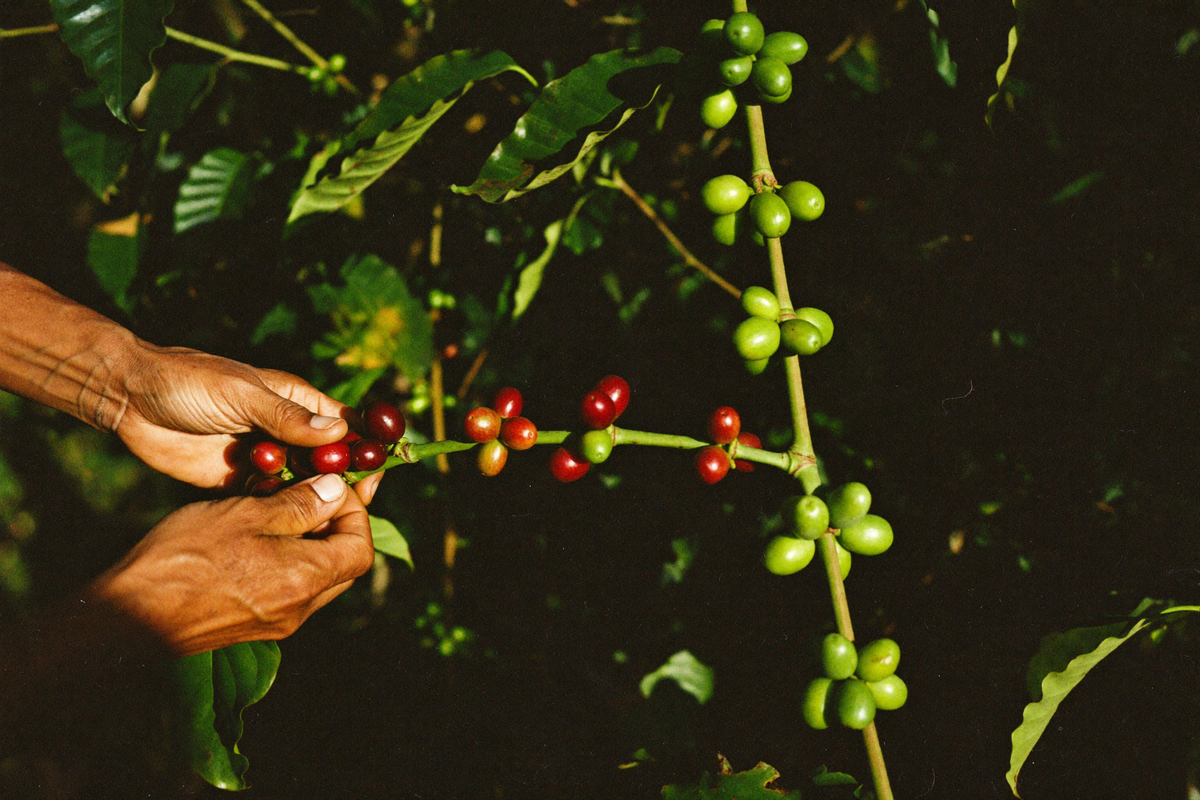
Coffee is an annual fruit crop. Flowering follows heavy rain, the cherry takes up to nine months to ripen, and harvest, drying, milling, export paperwork and an ocean crossing add months on top of that. Your origin is gone because the tree is not carrying fruit, and nothing in the supply chain can be hurried into producing some.
The gap between that and how coffee is sold is the whole subject. Roasted coffee is retailed like a manufactured good, in stock or out of stock, restockable on request. Green coffee arrives once a year in a boat.
The nine months, and the three years before them
Flowering is triggered by rain, which is the first thing that makes coffee awkward to plan around. Blossom appears after a prolonged period of rainfall, and James Hoffmann's World Atlas of Coffee puts the ripening that follows at up to nine months on the branch. That single fact is why coffee has vintages in the way wine does, and why a farmer who sees the price double cannot respond to it. Hoffmann gives the other half of the timing problem too: a newly planted tree needs roughly three years before it fruits properly, so the response to this year's price arrives in the cup around three years late, if it arrives at all.
Then the harvest itself refuses to cooperate. Cherries on the same branch do not ripen at the same time. Hoffmann is direct about what this costs: picking only the ripe fruit means going through the same trees several times over weeks, paying for each pass, while strip picking or machine harvesting takes everything at once and delivers a mix of ripe, unripe and overripe. That difference is most of the price gap between commodity coffee and good coffee, and it is a labour cost, not a marketing one.
Hoffmann also records the view that governs everything downstream: the cup is as good as it will ever be at the moment of picking. Everything after that is preservation. Careful drying, careful milling, good bags, a cool warehouse and a fast crossing all protect what is there. None of them add anything.
The calendar, in real dates
Origins do not share a year. Each producing country runs a marketing year set to its own harvest, and the USDA's 2026 Coffee Annual reports lay them out plainly.
| Origin | Marketing year | 2026/27 forecast, thousand 60kg bags |
|---|---|---|
| Brazil | July to June | 71,900 |
| Vietnam | October to September | 32,500 |
| Indonesia | April to March | 11,380 |
| Uganda | October to September | 7,160 |
Read down that column and the answer to "why is it not available" stops being abstract. As of late July 2026, Brazil's 2026/27 year had just started and was partly observed. Vietnam's and Uganda's had not started at all and were entirely forecast. Four origins, four different points in their own cycles, all on the same shelf.
The harvest itself is not an event either, it is a season with a progress figure. The International Coffee Organization's June 2026 market report had Brazil's 2026 harvest at 39 percent complete on 17 June. Commodity market reporting carried by Barchart had it at 64 percent on 15 July, running behind both the previous year's 77 percent and the five-year average of 70 percent for that date. A late harvest is not a shortage. It is the same coffee, arriving later, into a market that has already sold forward.
Further back still: the crop that Brazil harvested through mid-2026 was set by rainfall during the September to October 2025 flowering. Timely rain then is why the 2026/27 arabica forecast rebounded. In Vietnam, Global Coffee Report's field reporting from the Central Highlands described a double hit on the 2024/25 crop, drought during the February to April flowering followed by flooding late in the season. In Indonesia, heavy mid-2025 rain disrupted flowering in southern Sumatra and Java, and the robusta forecast fell. The weather that decides what is on your shelf happened one to two years before you got there.
What changes in the sack while you wait
Green coffee is not inert while it waits for a boat and a roaster, and this is the part that explains why the same origin tastes different in March than it did in October.
Kenneth Davids sets out the arc in Home Coffee Roasting. Give a dense, high-altitude green from Central America, Colombia or East Africa a dark room, low humidity, a temperature short of cold and air moving through it, and two or three years will barely register on it. The movement it does make has a direction. Through the first year the flavour rounds and the sugar comes forward. After that the body thickens while acidity and brightness drain away. So the same lot reads brighter and lighter in its first year after harvest, and heavier and quieter once it is past that.
Lower-grown coffees move faster and less kindly. Davids uses Brazilian Santos as the example: six months past harvest the acidity can already be going, and by the end of the first year the cup often carries the dull, damp-sacking note cuppers file under baggy. Anything that lands with a lot of water still in it, which includes a good many Sumatras and Sulawesis, tends the same way and picks up mustiness in storage. Plenty of people like the result. It is a taste, and the honest thing is to call it one rather than a defect or a virtue.
Store the same greens hot and humid instead of cool and ventilated and the timescale collapses. Coffee can fade or go baggy within months of harvest. Which means "how old is this crop" and "how was it kept" are two questions, and only the first one ever gets printed.
The consequence nobody mentions: the roast has to move
Here is the mechanism that turns all of this into something you can taste, and it is the reason seasonality is a roasting problem and not only a buying one.
Green coffee changes how it takes heat as it ages. Davids is specific: a bean under a year old off high ground is dense and still holds water, and it works through a roast slowly. A bean a year or more past processing gets there somewhat faster. His own oven guidance sets a different starting temperature for new-crop than for past-crop coffee, because the same profile applied to both will not land in the same place.
So a roaster working through one lot from arrival to the last sack has to keep adjusting, or the cup drifts. The bag you loved in month two and the bag that disappointed you in month ten can be the same coffee, roasted the same way, by someone who did not move with it. That is worth knowing before you blame the farm, the harvest or your own palate. If the same coffee has started tasting flat and heavy rather than bright, the sour-or-bitter diagnostic will tell you whether to reach for the grinder or accept that the lot has aged.
Blends exist partly to absorb all of this. Jessica Easto puts the same point from the drinker's side in How to Taste Coffee: seasonality is why single origins come and go from a menu, and year-round consistency is why blends exist at all. The trade is exactly what you would expect. A blend can hold a flavour profile steady across the calendar by changing its components. A single origin cannot, which is precisely why it has more to say.
What this will not do
Understanding the calendar will not get you the coffee. There is no version of knowing this that produces a bag of last year's Yirgacheffe in the month it is not there. The knowledge is diagnostic, not procurement.
It will not tell you how old the coffee in front of you is, either. Almost no retail bag prints a harvest year, and the roast date that a good bag does print says nothing about when the cherry came off the tree. A coffee roasted last Tuesday can be from a crop that landed fourteen months ago. Those are two independent clocks and the pack usually shows you one. Roast freshness is its own separate problem with its own separate timing, which is why a bag roasted two days ago is not ready yet.
And it will not make seasonal coffee better than year-round coffee in any general sense. A well-kept past-crop lot roasted by somebody paying attention beats a fresh-crop lot handled carelessly, every time. Age is a variable, not a verdict.
What to actually do about it
Buy the origin when it lands, not when you remember it. Roasters announce arrivals because the arrival is the event, and the first two or three months of a lot are when the brightness that made you like it is most available.
If a particular coffee matters to you, buy more of it while it is there and freeze the surplus in sealed portions on the day it arrives. That holds the roasted coffee. It does nothing for the green, but the green is not your problem to solve, and the method matters enough that we wrote it out step by step in freezing coffee works if you portion it first.
Then, once a year, do the thing that makes the whole calendar legible. Buy the same origin from the same roaster twelve months apart and taste them side by side. You will hear a lot of talk about vintage in coffee and almost none of it comes with evidence attached. Two cups on a table is the evidence, and it is the reason tasting in pairs teaches you what a single cup cannot.
We work from Kampala, which puts us on the growing side of this calendar rather than the retail side. Uganda's marketing year runs October to September, and roughly 6.0 million of a forecast 7.2 million bags for 2026/27 are robusta, exported as green bean. From here, the seasons are not an interesting fact about coffee. They are the shape of the year, and they are the reason the bag on a shelf in Berlin or Chicago is the end of a story that started with rain.