Before the reassurance, one question, because the answer to it flips the advice completely.
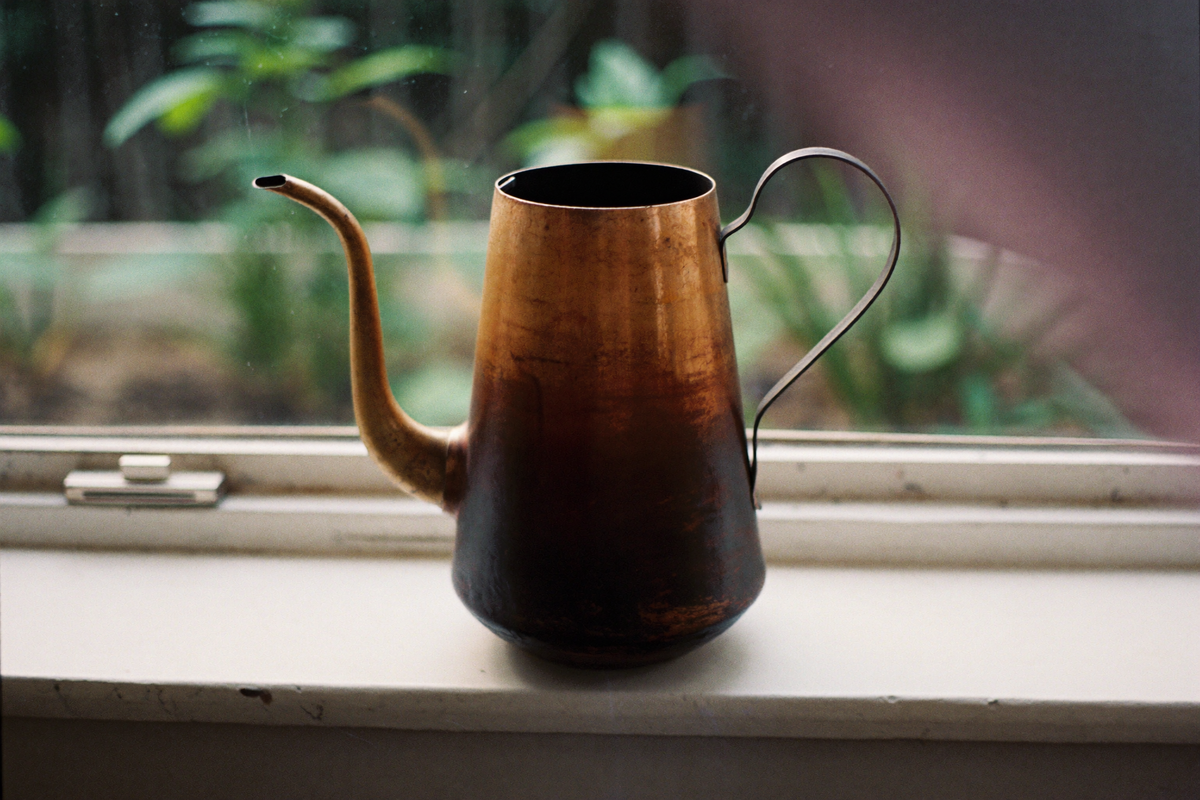
Is the inside of your cezve a different colour from the outside?
If the interior is silvery, grey, dull or mottled while the exterior is orange, you have a lined vessel and the rest of this article is for you. Your lining is doing exactly what tin does and you should stop worrying about it.
If the inside is the same warm orange as the outside, all the way down, you may have an unlined decorative piece. Stop brewing in it and go read what the lining is actually for. Nothing below applies to you, and the reassuring version of this advice is the last thing you need.
We are opening this way because both readers arrive here having searched the same words, having seen the same change, and the comforting answer is only correct for one of them.
Assuming you are lined: the darkening is normal
A tinned interior does not stay bright. It goes grey. Then it goes patchy grey, with darker blooms and lighter areas that map onto nothing in particular and change over months.
That is a surface change on the tin, and it is what the metal does. It is not tarnish that has been left too long, it is not a residue of old coffee, it is not a sign that the vessel was cheaply made, and it is not evidence you have been cleaning it wrong.
Nearly every account of the traditional cezve says the same thing in the same slightly weary tone: the lining darkens with use, and it should not be scoured off. The instruction gets repeated that often because the mistake gets made that often.
Why you assumed it was dirt
You had no way to know. Almost nobody in a market where cezves are a novelty has previously owned an object with a tin interior, so there is no stored sense of what a normal one looks like at three years old.
What you did have was a strong resemblance. Grey, mottled and dull is what a neglected metal surface looks like. It resembles tarnish on silver, limescale in a kettle, staining in a teapot. Every one of those is something you are supposed to clean. So the resemblance did the classifying.
And the entire visual culture around copper is about shine. Copper is sold, photographed and displayed polished. That is the whole aesthetic promise of the material, and it establishes an expectation that a dull surface is a failed one, which happens to be true of the exterior and false of the interior.
Why nobody warned you
Because the warning is slightly inconvenient to sell.
Look at how these objects are photographed. Bright exterior, and where the interior is visible at all, it is a clean new tinning, silvery and even. That photograph is accurate on the day the vessel is made and misleading about every subsequent day of its life.
A care card reading the inside will go grey and mottled, this is correct, do not scrub it is cheap to print and mildly deflating to read at the moment of purchase. So it usually is not printed. The result is a category where the normal ageing of the object is a surprise to nearly every first-time owner.
We do not think this is deception, mostly. Most sellers in the chain have never used one daily, do not know the interior goes grey, and are reproducing the supplier's photographs. But the effect on you is the same as if it were deliberate, and it is worth naming the mechanism so you stop assuming the fault was yours.
The reason to do nothing, even if you are unsure
Suppose you are not fully convinced. The grey looks wrong to you and you are weighing whether to give it a proper clean.
Compare the two mistakes, because they are not remotely the same size.
If you leave a lining alone and it turns out to be genuinely worn, you have lost very little. Lining wear is gradual and visible. Relining exists as a service. Another month of noticing before you act does not meaningfully change the outcome.
If you take an abrasive to a healthy lining, you remove lining. Immediately, permanently, and in the one place it matters. Tin is soft. A steel wool pad or a scouring sponge will take it off faster than you expect, and there is no version of that you can undo at home. You will have converted a vessel that was fine into a bare copper one, in pursuit of an appearance that was never a problem.
So the asymmetry decides it. Under uncertainty, do nothing, because the cost of wrongly doing nothing is small and recoverable while the cost of wrongly doing something is total. This holds at almost any level of confidence, which is what makes it a rule rather than a judgement call.
Doing nothing is not the lazy answer here. It is the correct answer, and the confident-looking action is the destructive one.
The one thing that is not normal
There is a single exception, and it is easy to see once you know to look.
Orange. Copper is an unmistakable colour and it does not appear in a healthy tinned interior. If patches of warm orange metal are showing through the grey, particularly on the base where a spoon scrapes and the heat is highest, that is the lining worn through rather than discoloured.
Grey and mottled: fine, expected, leave it. Orange showing through: stop brewing in it.
That is the whole diagnostic, and you can run it in ten seconds in daylight. Not under a warm kitchen bulb, which makes everything look slightly copper. Take it to a window.
Restorers who reline copper vessels generally act at around a square inch of exposed metal, some saying a coin-sized patch. We are passing that on as their working practice rather than as a standard, because no official body publishes a threshold and we would rather say where the gap is than pretend there is a number.
Relining is a real trade. It is not expensive relative to a good cezve and it is the ordinary end of a lining's life rather than the end of the object's. A vessel that has been relined once is not a compromised object, it is a maintained one.
How to clean it, then
Not with anything abrasive. That is most of the instruction.
Warm water, a soft cloth or sponge, and mild dish soap if you want it. Dry it properly rather than leaving it to air dry, mostly to keep water marks off the exterior. That is genuinely all the interior needs, and coffee does not build up in a way that requires anything stronger.
Two things to avoid beyond abrasives. Do not put it in a dishwasher, where the combination of heat, harsh detergent and long exposure is hard on both the lining and the exterior. And do not heat it empty, which is the other common way linings die. Tin melts at a far lower temperature than copper, so an empty vessel left over a flame can damage the lining from the inside without anything looking dramatic from the outside.
If you want the exterior bright, polish the exterior. The two surfaces have different jobs and there is no reason to treat them the same way.
What we cannot tell you
We cannot tell you whether the specific grey in your specific vessel is ordinary tin ageing or something particular to how yours was made. We have not seen it, and there is no photograph-based diagnosis worth much here.
We also are not going to tell you that tin is safe, which is the sentence you would expect a shop to write at this point. When we went looking for an official-body source for it, we found cookware retailers, restoration workshops and a tin manufacturer, all of whom have an interest. We are not repeating a trade claim as a safety finding.
The sourced fact is narrower and does the same work. Food regulation prohibits copper from contacting anything below pH 6, and coffee measures around 4.85 to 5.10. The lining's job is to keep the coffee off the copper. That makes your only real question whether copper is exposed, which is exactly the orange test above, and it needs no claim about tin at all.
The short version
The grey is the object ageing, not the object failing. The instinct to fix it is the actual threat to it. Check for orange in daylight, and if there is none, put the scouring pad down and make coffee.
And if you have read this far only to realise that your vessel is orange all the way through, that is worth knowing today rather than in five years, and it is the reason we put the question at the top instead of the bottom.