The short answer to whether the metal changes your coffee is no, and the useful answer is that it changes something else entirely.
Copper does not improve the flavour of coffee. It improves your control over the heat, and control is what produces the flavour. Those sound like the same claim and they are not, and the difference is worth about fifteen hundred words because it tells you exactly when copper is worth paying for and when it is decorative.
The number, and what it actually means
Thermal conductivity measures how readily a material passes heat through itself. Roughly, in watts per metre-kelvin:
| Material | Approximate conductivity |
|---|---|
| Copper | 400 |
| Aluminium | 235 |
| Carbon steel | 50 |
| Stainless steel | 16 |
Copper moves heat roughly twenty-five times as readily as stainless steel. That is not a marginal advantage, it is a different category of behaviour, and it produces two effects that matter at a stove.
Evenness. A high-conductivity vessel spreads heat sideways almost as fast as it takes it in, so a small flame under one part of the base warms the whole base rather than producing a hot spot. A low-conductivity vessel largely heats where the flame is.
Responsiveness. The same property works in reverse. When you take a copper vessel off the heat, it stops driving heat into the liquid almost immediately, because it holds relatively little heat energy in reserve and gives it up quickly. Stainless carries on.
That second effect is the one people underrate, and it is the one that matters for coffee.
Where responsiveness earns its money
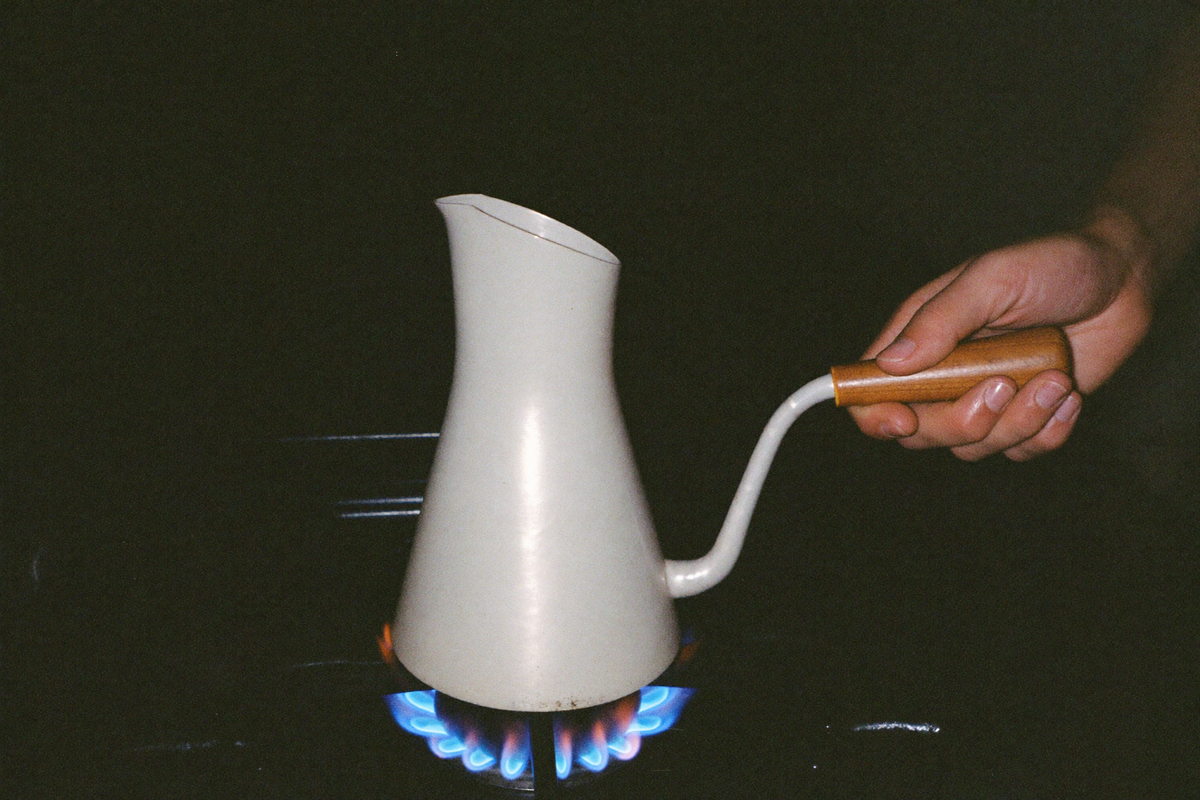
Consider what happens in a cezve. You are watching a foam climb a narrowing neck and you have a window of a second or two to lift it before it goes over.
With a responsive vessel, lifting it off the flame ends the process. The signal you are reading is current, and your action takes effect when you take it.
With a sluggish one, the base is still holding heat when you lift, and it keeps delivering that heat into the coffee for several seconds afterwards. The foam continues climbing after you have done the right thing. So you learn to lift early, by an amount you have to discover through failures, and you are effectively steering an object with a lag.
This is the whole case for copper in coffee, and it is a case about a specific brewing situation rather than about metals in general. Anywhere you are making a fast judgement against a visible signal at the stove, conductivity is doing real work. Anywhere you are not, it is doing very little.
Where it earns nothing at all
Which brings us to the part a shop selling copper is not supposed to say.
In a vessel that holds coffee rather than heats it, conductivity is either irrelevant or an active disadvantage. A serving pot is trying to keep coffee at temperature, and a material that passes heat readily passes it outward into the room just as readily. High conductivity is precisely the wrong property for holding anything hot. That is why insulated vessels are built around a vacuum gap, which is the absence of a conductive path, rather than around a clever metal.
The 1922 trade literature reached the same split. Ukers, ranking metals by how little coffee attacked them, put copper well down the list and said that whatever you brewed in, the vessel coffee actually stood in should be earthenware or glass.
So the honest architecture is a division of labour. Copper where the heat is moving. Ceramic or glass where the coffee waits. Not a hierarchy of materials, an assignment of jobs.
If you are looking at a copper object whose function is to hold rather than to heat, you are looking at something being sold on the appearance of the metal. That is a legitimate reason to buy an object. It is just not a thermal one, and you should know which purchase you are making.
What copper does not do
A copper vessel will not extract your coffee differently, will not add a flavour of its own, and will not soften acidity or round out the body, whatever is claimed for it by the people selling the metal.
The claim that turns up most often is that copper somehow improves the water or the extraction. We have not seen a controlled comparison supporting it, and the mechanism usually offered quietly requires the coffee to be in contact with the copper, which is the one thing a properly lined vessel is built to prevent. If your copper vessel is correctly lined, the coffee never touches copper at all, so any flavour story that depends on that contact is describing a vessel you should not be drinking from.
That is a neat test, actually. Any claim about copper improving the coffee is either wrong or describes an unlined vessel. There is no version where it is both true and safe.
Aluminium, honestly
Aluminium conducts well, at roughly 235, comfortably more than half of copper and vastly more than steel. It is cheap and light.
A moka pot is aluminium for exactly this reason and it works. Anyone telling you the aluminium moka pot is thermally inadequate is arguing against about a century of contented use.
So if responsiveness is what you are buying, aluminium delivers most of it for a fraction of the price. What copper adds is the top of the conductivity range, considerably more thermal mass in a heavier vessel, and an appearance people build kitchens around. Those are real, and only one of them is thermal.
We would rather you knew that before you paid for copper, and if the honest answer is that you want the object because it is beautiful, that is a perfectly good reason that does not need a physics justification bolted onto it.
The practical version
Buy copper for a vessel you heat and watch. That is where twenty-five times the conductivity of steel turns into an actual difference in what ends up in the cup, because it turns into control at the moment control matters.
Do not buy copper to keep coffee hot. It is the wrong tool and the physics runs against you.
And treat any claim that the metal itself improves the coffee as a reason to check what the vessel is lined with, because the claim only makes sense in a vessel you should not be using.