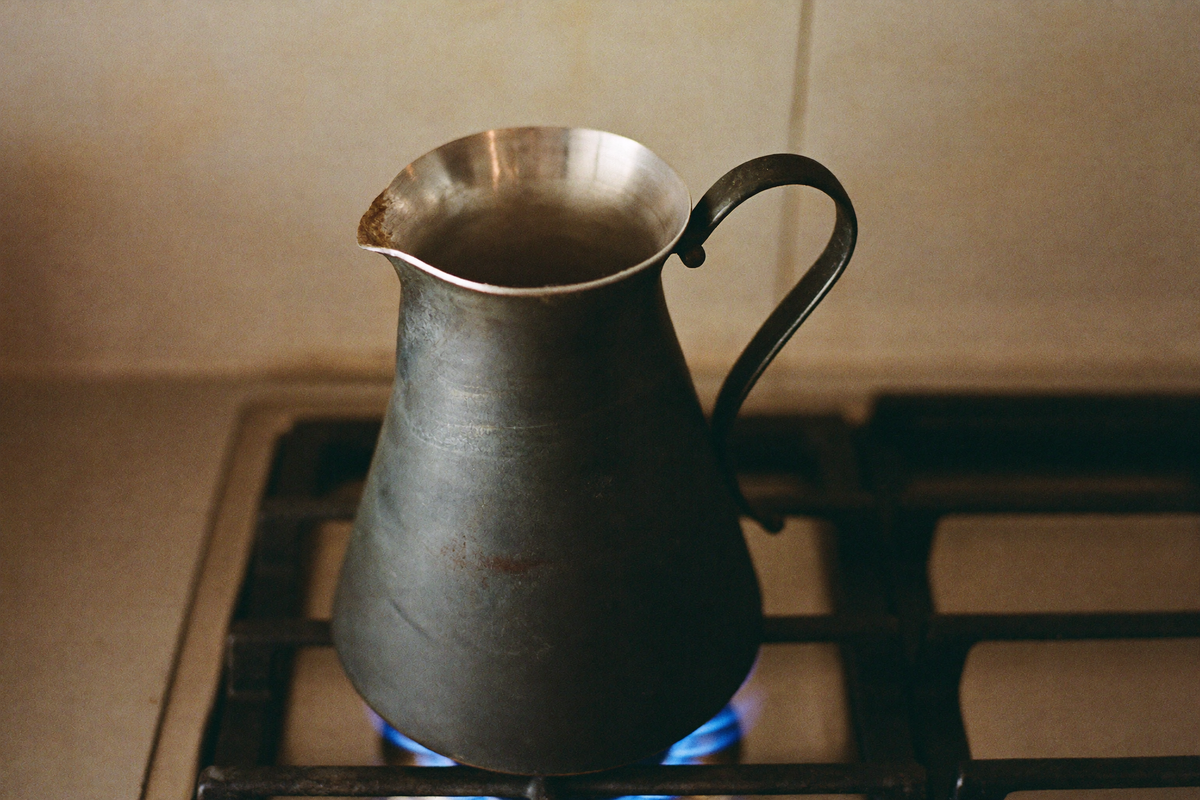
A cezve is two metals doing two jobs, and the division of labour is old enough that nobody involved in settling it had access to a chemistry lab.
Copper on the outside because it moves heat faster than almost anything else. Tin on the inside because the coffee has to sit somewhere that is not copper.
What makes the object interesting is not that answer, which is short, but the third question underneath it: why tin specifically? Silver conducts better. Stainless is tougher. Tin is soft, dull and melts at a temperature a hot pan can reach. On paper it is a poor choice, and it won anyway.
The heat problem the shape creates
Look at what the vessel has to do. A cezve is narrow at the neck and wide at the base, with a long handle, and it is used for a brew where the entire decision happens in about two seconds.
You heat the coffee slowly. A foam builds and climbs the narrowing neck. You pull it off the heat at the moment it rises, sometimes twice, sometimes three times depending on whose grandmother taught you. Take it off late and the foam collapses and boils over. Take it off early and you have not developed it.
That is a control problem, and control is a function of how fast the metal responds. A vessel that lags means the coffee keeps climbing after you have lifted it. A vessel that responds instantly means the moment you remove the heat, the heating stops.
The shape and the metal are one design rather than two decisions. The narrow neck exists to make the foam legible, a visible signal rising through a constriction where a small change in volume produces a large change in height. The wide base exists to take heat from a small flame across the whole of the liquid. And the copper exists so that the signal you are reading is current rather than a couple of seconds stale.
Copper is a poor place for coffee to sit
The other half is a constraint rather than a benefit.
Coffee is acidic, measuring around pH 4.85 to 5.10 in peer-reviewed measurements of hot brew. United States food regulation prohibits copper from contacting anything below pH 6, in the most serious of its three enforcement categories, with a single exception carved out for beer brewing.
So the material that solves the heating problem creates a contact problem, and the object cannot exist unless something separates the two. The lining is not a refinement of the design. It is the condition on which the design is allowed to work at all.
This is not a modern discovery dressed up as tradition. In 1922, William Ukers ranked the metals by how little coffee attacked them, put silver, aluminium, Monel and tin near the top, placed copper well down, and said plainly that whatever you brewed in, the vessel the coffee actually stood in should be earthenware or glass. The trade knew. It simply expressed the finding as a materials ranking rather than a regulation.
Copper where the heat is, something else where the coffee waits. That sentence organises the entire history of coffee vessels, and it also happens to organise a sensible cupboard.
So why tin, of all things
Here is the part that gets left out, and it is the most interesting thing about the object.
Tin's headline weakness is its melting point. It liquefies at a far lower temperature than copper, which is why heating a cezve empty is one of the few ways to ruin one, and why tinned vessels come with warnings that stainless ones do not.
That weakness is the entire reason tin became the traditional lining.
A metal that melts easily can be applied easily. Tinning a copper vessel does not require a factory, a furnace or an industrial process. It requires a hot vessel, a stick of tin, a flux, a cloth, and someone who knows what they are doing. It can be done in a workshop on a street, with the vessel in one hand.
Which means it can also be redone. A worn cezve goes back to a tinsmith and comes home with a new interior. The object does not have a lifespan defined by its lining, because the lining is a consumable that a local trade can replace indefinitely.
Compare the alternatives on that criterion rather than on hardness. Stainless steel is more durable and cannot be applied by hand over a flame, so a stainless-lined vessel is a factory product and a worn one is scrap. Silver works beautifully and costs what silver costs. Nickel is workable but was not available to a fifteenth-century workshop in the way tin was.
Tin won because it is repairable at village scale, and durability is a much less important property than repairability when a skilled repairer lives on your street. The property that makes tin fragile in your kitchen is the same property that made it the only sensible answer for most of the object's history.
What this means for buying one
Three things follow from the design that are worth carrying into a purchase.
The two-metal construction is the normal state, not an upgrade. A cezve advertised as solid copper, with nothing said about the interior, is describing half an object. The interior is the half that determines whether you can drink from it.
A relined vessel is a maintained one, not a damaged one. Because the lining is a consumable, wear is expected rather than shameful, and the trade that replaces it still exists. A cezve that has been retinned once has had ordinary maintenance, and treating it as second-hand goods misunderstands how the object was designed to be owned.
Stainless linings are a real modern option with a different tradeoff. They last far longer and they are not repairable in the same way, so you are choosing between an object that lasts a long time and then stops, and an object that wears steadily and can be renewed forever. Neither is the correct answer. They are different theories of ownership, and the tinned one is the older and more interesting theory.
The thing we will not claim
We are not going to tell you that tin makes the coffee taste better, or that copper does. We have not seen a controlled comparison that would support either, and the claims that circulate about metals improving flavour tend to come from people selling the metal.
What the copper demonstrably does is move heat quickly, which gives you control at the one moment in this brew where control is the whole game. That is a mechanical benefit and it is enough. It does not need a flavour story stapled to it.
The honest summary of the object: a fast-conducting shell wrapped around a soft renewable barrier, shaped to make a two-second decision visible, and designed in an era when the person who could fix it lived nearby. Almost nothing about it is decorative, which is probably why it still looks right.