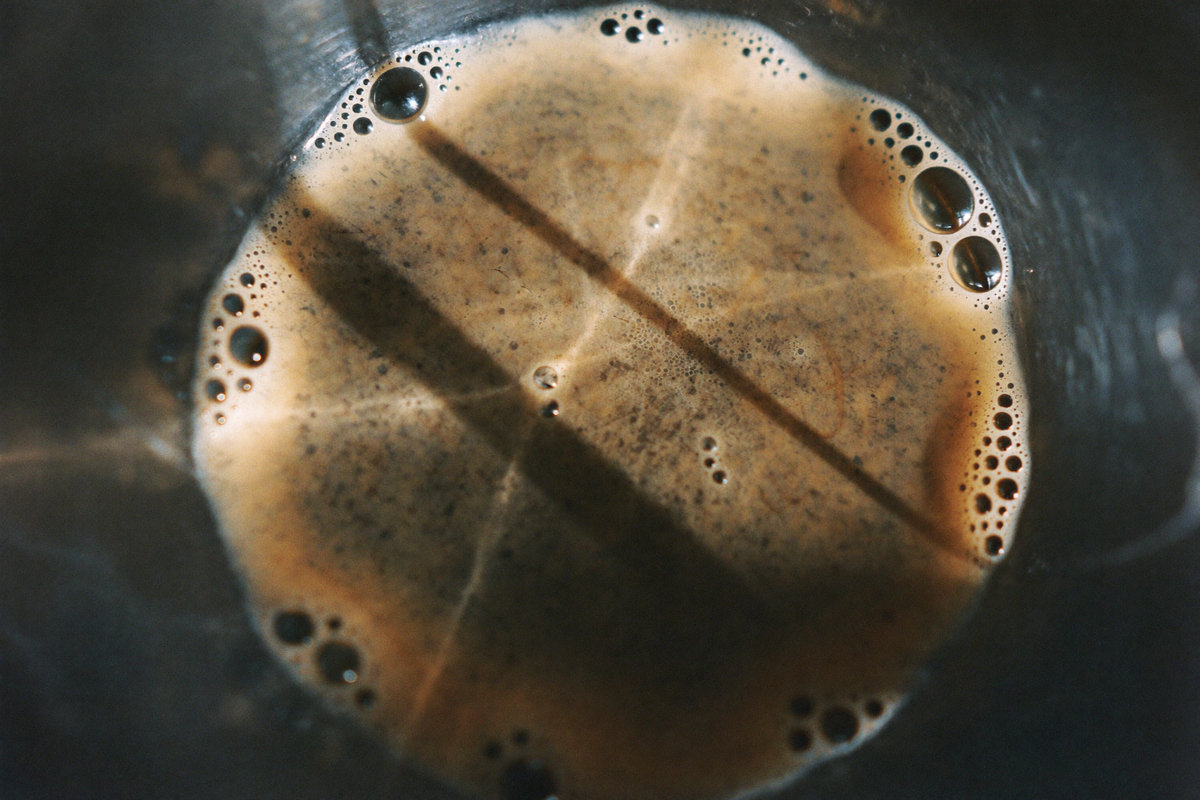
Pour a little water on fresh grounds and the bed swells, domes and hisses. Most people have been told this is a step you perform to make the coffee better. It is more useful than that, and slightly less magical.
The bloom is coffee telling you how old it is. The swelling is carbon dioxide leaving the grounds, and how much of it there is, is a direct read on how recently the beans were roasted. Treating it as a technique means you do it and move on. Treating it as a diagnostic means you look at it, and what you see changes what you do next.
What is actually happening
Roasting generates carbon dioxide inside the bean, and the bean releases it slowly for weeks afterwards. Grinding opens the structure and the release accelerates. Add water and the remaining gas comes out all at once, pushing up through the bed and forming the dome.
That gas is a problem while it lasts. It occupies space the water wants, and it pushes water away from the grounds it is meant to be dissolving. Wetting the bed and pausing lets the bulk of it escape before the main pour, so the rest of the brew happens in more even contact.
Moldvaer's instruction is to wet the grounds and wait 30 to 45 seconds before continuing. Longer blooms became fashionable after that was written, and the difference between 45 seconds and 60 is small compared with the difference between blooming and not.
Reading it
Here is the part that turns a step into information.
A vigorous, high dome that holds for most of a minute means very fresh coffee. Days rather than weeks off the roast. It is nice to look at, and it is also a warning: on espresso, coffee this gassy produces uneven flow, visible bubbles and a slightly metallic edge, which is the too-fresh problem.
A modest rise that settles within about thirty seconds is the middle of the window. This is what you want and it needs no action.
A flat surface that barely wets, with no rise at all, means the gas has gone. The coffee is stale. It will not be undrinkable, and it will be dull in a way that no grind adjustment recovers, because flatness is not an extraction fault.
This is a freshness test that costs nothing, needs no equipment, and works in any brewer. It is more reliable than the roast date on the bag, because it measures the bean in front of you rather than a claim made about it weeks ago in another building.
What it does not tell you
It does not tell you the coffee is good. Freshness is a floor, not a ceiling. A stale bag of excellent coffee and a fresh bag of poor coffee will bloom exactly as their ages predict.
It does not work on decaf reliably. Decaffeination alters the bean structure and the degassing behaviour with it, so a weaker bloom on decaf is not the same signal.
It does not apply to immersion brewing in the same way. In a French press the grounds and water sit together for four minutes regardless, so the gas has time to leave during the brew. You can still watch the crust form and read freshness off it, but the pause is not doing the same work, and a formal bloom step is optional.
And it is not the reason your coffee is sour. Blooming improves evenness. It does not move extraction far enough to fix a balance problem, and reaching for a longer bloom to correct sourness is a way of avoiding the grind adjustment that would actually work.
The part people get wrong
Two errors, both common.
Using too much water. The bloom wants roughly twice the weight of the coffee, so about 30 grams of water on a 15 gram dose. Enough to wet everything, not enough to start drawing down. Pour more and you are not blooming, you are brewing slowly.
Blooming stale coffee out of habit. If the bed does not rise, waiting 45 seconds achieves nothing except letting the brewer cool. There is no gas to release. Skip it and pour.
There is a third, subtler one. A bloom that looks impressive in a video is often coffee that is too fresh to brew well, and the visual has become an aspiration in its own right. The dome is a readout, not a score.
What to do with the reading
If the bloom is flat, buy less coffee more often, and check that the bag has a roast date rather than a best-before date two years out. If it is violent, leave the bag another few days before judging the coffee, especially for espresso.
If it sits in the middle, do nothing at all. That is what a working diagnostic mostly tells you, and a test that only ever says "fine" would not be worth running. This one earns its place by catching the two ends.
The habit that makes this useful is the same one that makes every other adjustment legible: change one thing, taste, write it down. A note that says "flat bloom, dull cup, bag opened three weeks ago" is worth more than any recipe, because next time you will recognise it before you brew.