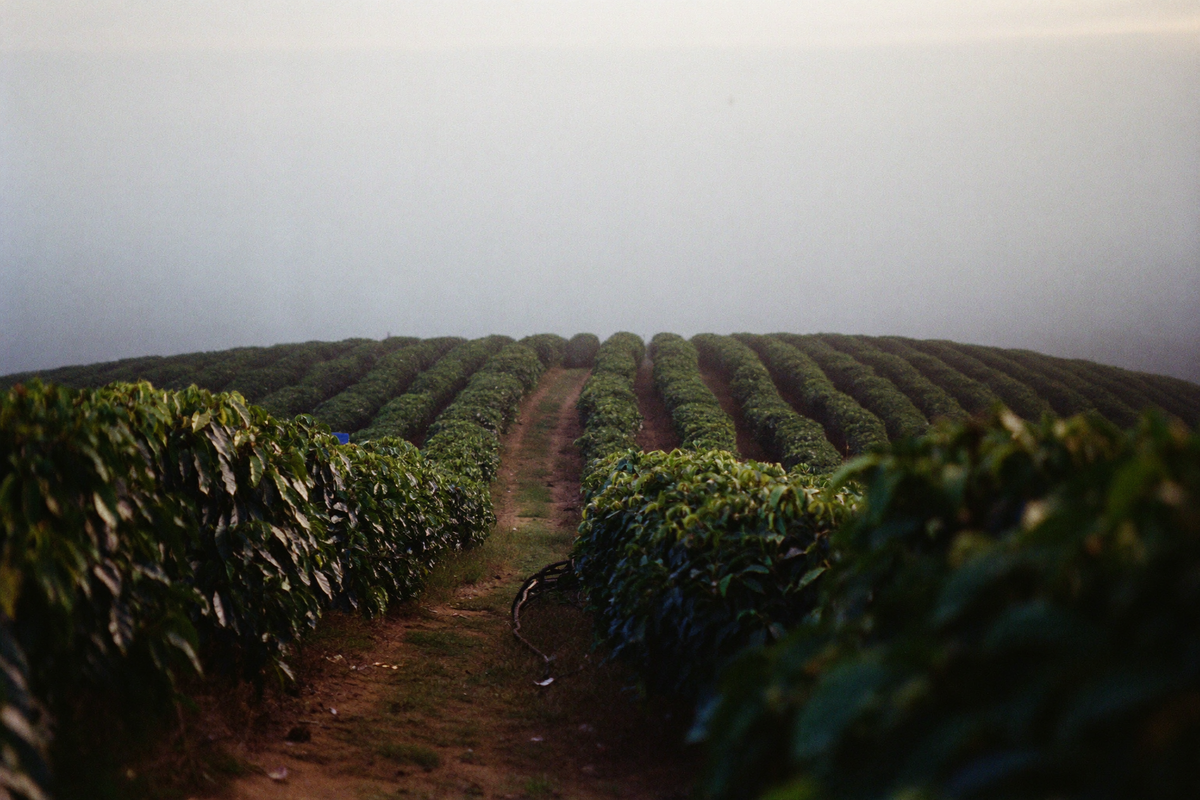
You have almost certainly seen the number: half the land suitable for coffee will be gone by 2050. It appears in newspapers, on café chalkboards, in sustainability reports and on the back of coffee bags.
It comes from a real study, and almost every version you have read misstates what it measured. The correct version is less apocalyptic and considerably more interesting, and it points at a specific problem that nobody writing the headline seems to have noticed.
What the study actually says
The figure traces to work published in PLOS ONE in 2015. It projected that the globally suitable area for arabica would fall from 7.2% to 3.6% under a mid-range emissions scenario, for the period 2040 to 2069.
Halving. So far the headline holds.
The denominator is the tropical land belt, not coffee farms. The study is measuring the share of a broad band of the earth's surface that is climatically suitable for arabica, and finding that share roughly halves. It is not measuring existing coffee-growing land, and it is not forecasting that half of current production disappears.
Those are very different claims, and the number has been laundered from the first into the second for a decade.
A separate 2022 study reached a similar-sounding halving, with an important qualifier: it applied to the highly suitable class only. Land in the marginally suitable category fell by just 5 to 13% over the same horizon.
What the research does agree on
Strip away the headline and there is a finding the literature broadly agrees on, and it is the one worth building a decade of decisions around.
Coffee is moving uphill by roughly 300 to 500 metres.
Not vanishing. Migrating. Arabica wants cool nights and a fairly narrow temperature band, and as the climate warms, the elevation at which those conditions occur rises. Land that was too cold becomes suitable. Land at the bottom of the current range stops being so.
That reframes the entire problem. It is not primarily a question of whether coffee survives. It is a question of where the suitable land will be, who owns it, and what is currently standing on it.
The collision nobody has connected
Here is the part we have not seen anyone put together, and it is the most consequential thing in this article.
The land coffee is migrating toward is uphill. Uphill, in most coffee-growing regions, is forest.
The 2015 paper flags this directly: newly suitable areas overlap with forested land.
Meanwhile the European Union has adopted a regulation that prohibits placing coffee on the EU market if it was grown on land deforested after the end of 2020. It applies to large and medium operators from 30 December 2026, to micro and small operators from 30 June 2027, and to soluble coffee from 30 December 2027.
Put those two facts side by side. The adaptation that the climate science implies is the one the regulation forbids.
A grower whose land is warming out of the suitable band has an obvious agronomic answer: move up the hill. If moving up the hill means clearing forest, that coffee cannot be sold into the European market. The science says migrate; the law says not there.
This is not a criticism of the regulation, which exists for good reasons and addresses a genuine driver of deforestation. It is an observation that two policies designed in isolation now interact, and that the people caught between them are smallholders with fractional-hectare plots and no capacity to buy land somewhere else.
What we could not find out
Two gaps we think are worth stating rather than filling.
No documented case of smallholders actually being excluded from EU coffee supply chains. The regulation has not applied yet. Every exclusion figure currently circulating is a projection, and several are presented as though they were observations. We are not going to add to that.
No evidence that compliance premiums are reaching the farm gate. Somebody is paying for plot-level geolocation and due diligence. We could not find research showing that anybody is paying the farmer for it.
There is also a trap worth flagging. Headlines from July 2025 reported that the European Parliament "rejected" the regulation's country benchmarking. That objection was non-binding, and the act stands. Any piece relying on that reporting is describing something that did not happen.
What this will not tell you
It will not tell you your coffee is about to disappear. Production is shifting, not ending, and on the timescale that matters to a person buying beans this month the effect is on price and origin availability rather than supply.
It will not tell you which origins are safest. Vulnerability is intensely local, driven by specific elevation profiles, and the country-level generalisations in circulation are too coarse to act on.
And we should be honest about a gap that matters to us particularly: we could not source good observed data for Kenya, and the Uganda figures we found are secondary rather than primary. For a business run from Kampala, in a coffee-producing country, that is the wrong way round, and it is on our list to fix properly rather than fill with regional averages.
How to state it responsibly
If you want to use the number, this is the version that survives scrutiny:
Modelling published in 2015 projected that the share of the tropical land belt climatically suitable for arabica could roughly halve by the middle of this century under a mid-range emissions scenario. Later work found a comparable decline for highly suitable land specifically, with marginal land far less affected. The finding common to this research is not disappearance but migration: growing zones shifting upslope by roughly 300 to 500 metres.
Longer than the headline. Considerably harder to argue with.
And it leaves you with the genuinely difficult question rather than the dramatic one: not whether there will be coffee, but who will be growing it, at what altitude, and whether they will be allowed to sell it.