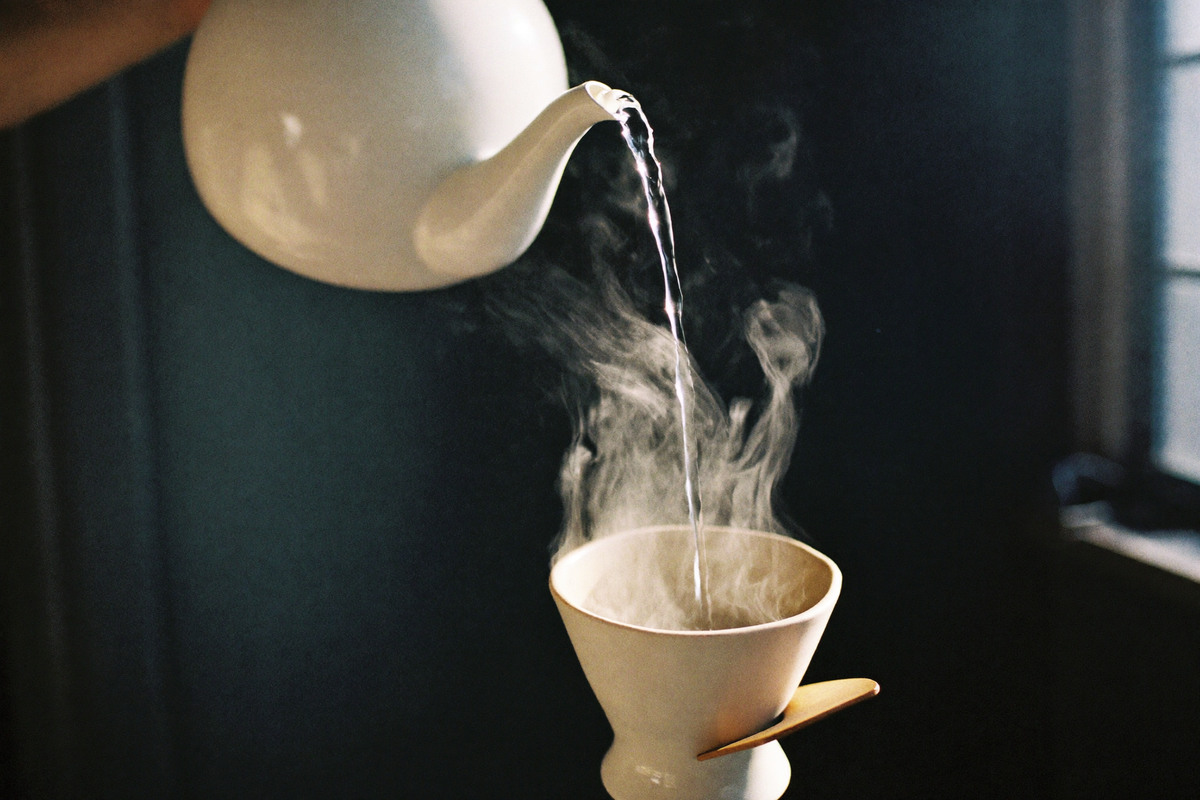
Tea drinkers are taught that different leaves want different temperatures, and they adjust without thinking about it. Coffee drinkers are mostly taught nothing, so the kettle boils, clicks off, and the water goes straight in. That single habit is responsible for a large share of home coffee that tastes harsh.
Brew between about 90 and 96 degrees Celsius, which is 195 to 205 Fahrenheit. That is the range the Specialty Coffee Association uses in its brewing standard, and it sits meaningfully below boiling. Water at a true 100 degrees pulls compounds out of the grounds that you do not want, and it does it fast.
What temperature is actually controlling
Water is a solvent, and how aggressive a solvent it is depends on how hot it is. The pleasant things in coffee dissolve early and readily. The acids come first, then the sugars and the compounds that give body, and last come the heavier, drier, more bitter molecules that were never meant to be in the cup.
Too cool, and you stop before the middle of that sequence. The cup tastes sour and thin, and people usually describe it as weak even when they used plenty of coffee.
Too hot, and you race past the end of it. You get the bitter, ashy, mouth-drying finish that people blame on dark roasts or cheap beans, when it was the kettle.
The window exists because it is where the solvent is strong enough to finish the job and not so strong that it keeps going.
You probably do not need a thermometer
A kettle taken off the boil and left alone drops through the useful range on its own. In a typical kitchen, a litre of freshly boiled water sits somewhere near the top of the range after about thirty seconds and near the bottom of it after a couple of minutes, though the exact numbers depend on your kettle, the room, and how much water is in it.
So the free version of this advice is: boil, wait, pour. Thirty seconds to a minute is enough for most setups.
Two situations change the maths. Pouring boiling water into a cold ceramic or glass brewer loses a lot of heat instantly to the vessel, which is the argument for rinsing your brewer with hot water first. And very dark roasts are more soluble than light ones, so they tolerate the cooler end of the range better and punish the hotter end harder.
What temperature control will not fix
It will not rescue a bad grind. If your grinder produces a wide spread of particle sizes, some of that coffee will over-extract and some will under-extract in the same brew, at any temperature. You will taste sour and bitter at once, and no kettle setting resolves that contradiction.
It will not fix stale coffee, and it will not fix the wrong ratio. Temperature is the third variable to get right, not the first. If you are still measuring with a scoop, fix that first, because it moves the cup further.
It also will not make a dramatic difference to a French press, where the long contact time and coarse grind flatten out much of the effect. The people who benefit most are those brewing quickly and finely: pour-over, and anything where water and coffee meet for under four minutes.
The honest recommendation
Do not buy a variable-temperature kettle to solve this. Boil, wait thirty to sixty seconds, pour. That costs nothing and captures most of the benefit.
Buy a temperature-controlled kettle only if you have already fixed grind and ratio, brew pour-over most mornings, and want to remove the last variable. Good ones cost roughly $95 to $180 as of August 2026, and the honest case for them is repeatability and a gooseneck spout you can aim, not the temperature readout itself. Plenty of people who own one would get the same cup from a plain kettle and a thirty-second pause.
We sell the vessel the coffee ends up in, and vessel temperature matters for a different reason: a cold cup pulls heat out of a correctly brewed coffee within seconds of pouring. That is a real effect, it is cheap to fix, and it is covered separately. It does not change the kettle advice above, which stays the same whether you buy anything from us or not.