Some coffee questions are about mechanism. This one is about vocabulary, and it is worth answering plainly because the two words appear on competing product listings as though they described competing objects.
They are the same device. Siphon, syphon, vacuum pot and vac pot are four names for one brewer, and no manufacturer means anything different by them. If you are comparing a "siphon" against a "vacuum brewer", you are comparing two of the same category, and you should be looking at build quality and heat source instead.
Where the two names came from
The device dates to the 1830s and was popular across Europe and later Japan long before specialty coffee existed. Different markets latched onto different halves of how it works.
"Vacuum" describes the finish. As the lower chamber cools, the pressure inside it drops, and the partial vacuum draws the brewed coffee back down through a filter. That is the part people watch.
"Siphon" describes the start, or rather it describes it slightly inaccurately. Vapour pressure pushes water up into the upper chamber. That is not really siphoning in the strict fluid-dynamics sense, but the word stuck, particularly in Japan and in English-language specialty coffee.
Both names survived. Neither is more correct in ordinary use.
How it actually brews
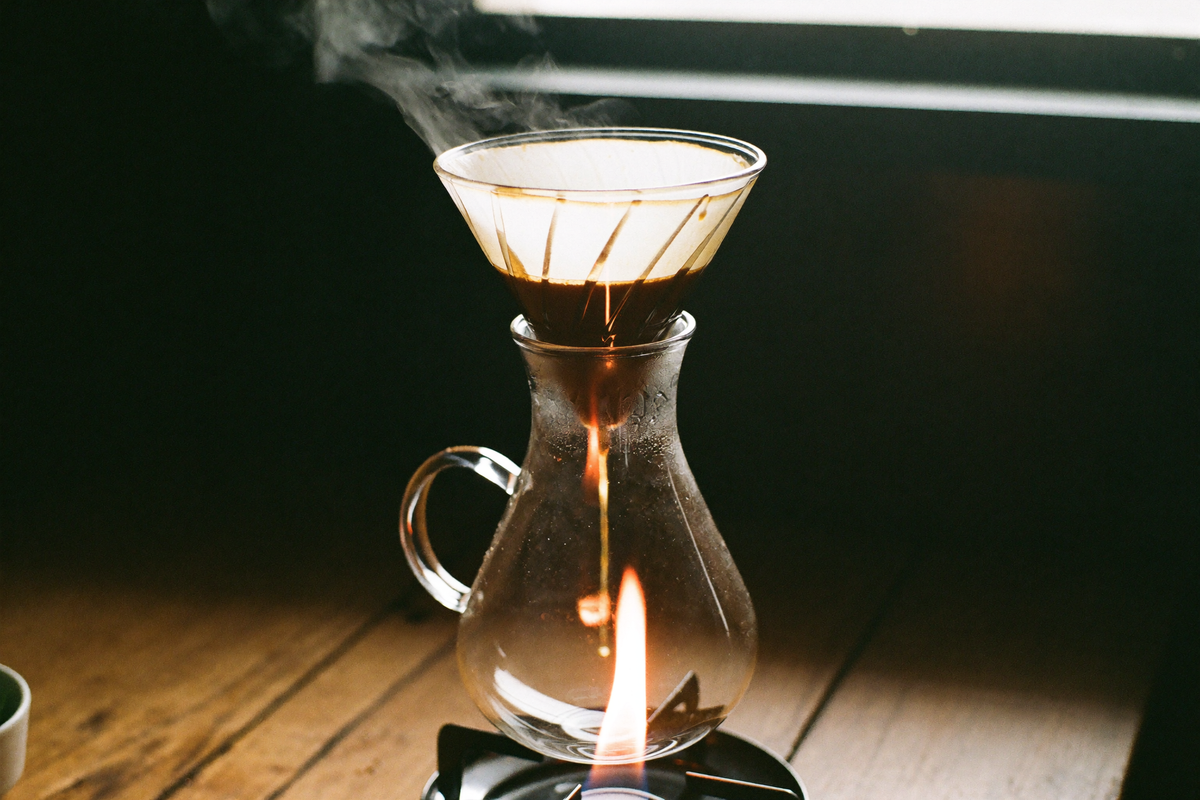
Water in the lower globe is heated. As it warms, vapour pressure forces the liquid up a tube into the upper chamber, where the coffee is waiting. The two sit together for a controlled time, usually about a minute to ninety seconds, with the brewer often stirred once or twice.
Then the heat is removed. The lower chamber cools, pressure falls, and the coffee is drawn back down through a filter, which may be cloth, paper or metal.
Two things about this are genuinely distinctive. Brewing happens as full immersion, like a French press, so every particle is in contact with water for the same length of time. But the coffee is then filtered on the way out, so you get immersion evenness with filtered clarity. That combination is hard to get any other way, and it is the real argument for the device.
The other distinctive thing is temperature. The brew sits above a heat source, so it holds temperature through the whole immersion rather than falling steadily, as a pour-over does.
What a siphon will not do
It will not be convenient. It is glass, it has several parts, the filter needs rinsing or wetting and then cleaning, and the whole thing wants your attention for the entire brew. Nobody makes a siphon coffee while doing something else.
It will not survive rough handling. Glass over a heat source, taken apart wet and hot, breaks. Replacement globes are available for the common models and you will eventually need one.
It will not survive a dishwasher, and cloth filters need to be kept wet in the fridge between uses or they go rancid, which is a genuine ongoing chore that people quietly abandon.
And it will not make a better cup than a good pour-over in a way most drinkers can reliably identify. The clarity-with-body character is real, and it is a difference more than it is an upgrade.
The honest recommendation
Buy a siphon because you want to do this, not because you expect the coffee to be better. It is the most theatrical brewer in common use and that is a legitimate reason to own one, particularly if you like making coffee in front of other people. It is one of the few brewing methods that genuinely holds a room.
Expect to pay roughly $70 to $150 as of August 2026 for a well-made three-cup with a proper stand, plus a heat source. A butane burner is traditional and finicky. A halogen beam heater is far easier to control, costs more than the brewer itself, and is what most people who keep using a siphon end up buying.
If what you actually want is clean, bright, filtered coffee with a bit of body, a good pour-over gets you most of the way for a fraction of the money and none of the maintenance. We would rather say that now than sell you the more interesting object.