A rosetta on the surface of a flat white is the most widely used proxy for café quality in the world. People choose where to buy coffee based on it, photograph it, and treat it as evidence that the person behind the machine knows what they are doing. It is evidence of exactly one thing, and it is not the coffee.
Latte art certifies that the milk was correctly textured, that the crema was intact enough to lift, and that the barista's hand was steady. It certifies nothing about extraction. You can pour a flawless swan on top of a sour, badly extracted, stale-bean shot, and the photograph will be indistinguishable from one poured on an excellent shot. The pattern forms in the milk. The quality lives underneath it.
Why the pattern proves what it proves
Pouring art requires three things to be true, and each one is a genuine skill.
The milk has to be right. Air can only be usefully introduced while the milk is still cold. Once the base of the pitcher reaches roughly body temperature, any further bubbles you whip in will not integrate, and you get a coarse foam that sits as a separate layer instead of a single glossy fluid. Get this wrong and no pattern is possible, because there is nothing to pour with.
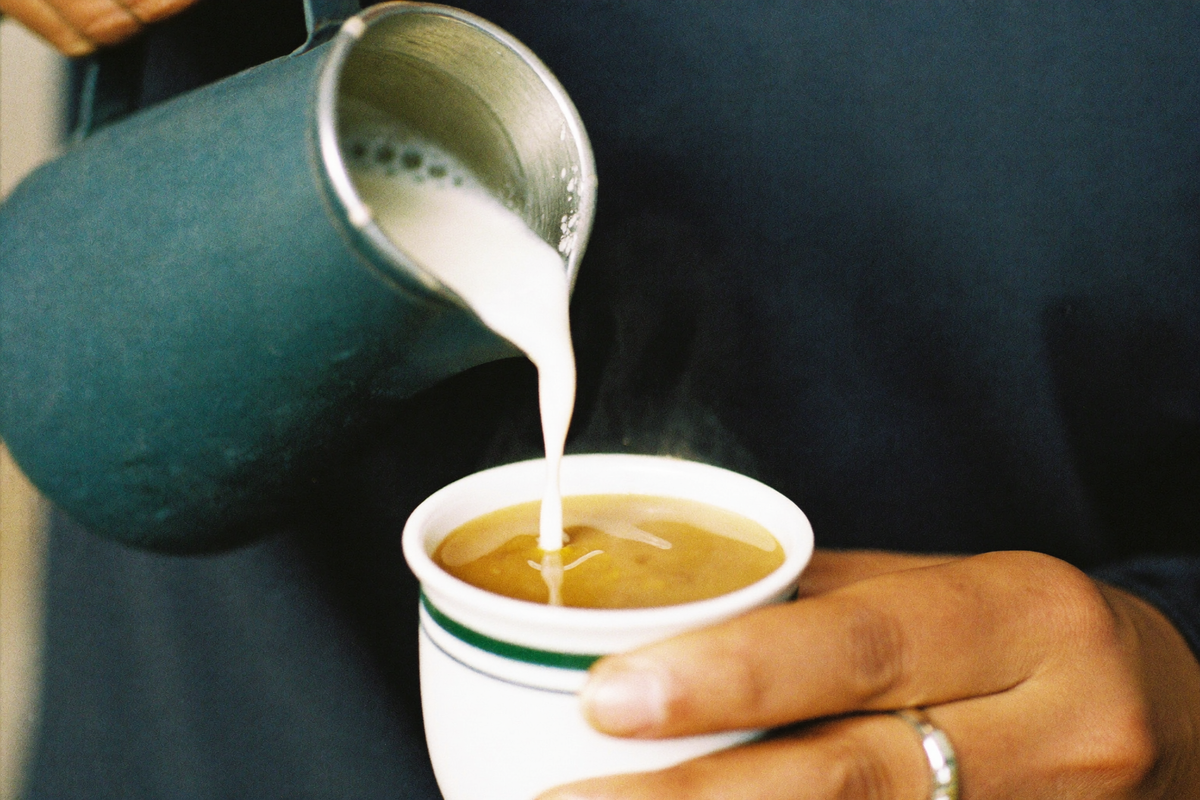
The crema has to survive. The pour starts high, five to eight centimetres above the surface, aimed at the centre. Height lets the milk dive underneath the crema and lift it, stretching it into a usable canvas. Then, once the cup is roughly two-thirds full, the pitcher drops close to the surface, and only then does white foam surface and hold a shape. Too high throughout and you get a beige cup with no design. Too close from the start and the crema drowns.
The hand has to be steady. The stream has to keep re-entering the same opening it made in the surface. Wander, and the pattern breaks up.
All three are real competences. None of them is extraction.
What it cannot see
Extraction time. Grind calibration. Whether the beans were roasted three days ago or three months ago. Whether the water is so heavy with bicarbonate that it has flattened every trace of acidity. Whether the group head has been cleaned this month. Whether the machine holds temperature.
Any of those can be badly wrong while the art is perfect, and the drink will look exactly the same in a photograph.
The awkward part: art changes the drink
This is the finding that surprised us most, and it comes from inside the same reference book that teaches the technique.
A cappuccino built to specification leaves a ring of bare crema visible at the rim. The reason is deliberate: it makes the first mouthful coffee-forward rather than milk-forward. That first sip is meant to taste of espresso.
Every full-surface latte art design destroys that ring. The industry adopted a presentation convention that overrides a stated taste principle described a few pages earlier in the same book, and as far as we can tell almost nobody has noticed.
Whether you mind depends on what you wanted. If you like a milk-forward first sip, full-surface art is an improvement. But the choice was made on your behalf, for visual reasons, and it is worth knowing that it was a choice.
It goes further at the decorative end. Etching, colouring and three-dimensional foam sculpture take minutes to build, during which a drink specified at 60 to 65 degrees falls well out of range and the foam coarsens. And several of the most spectacular designs in circulation contain no coffee at all: they use coloured milk as the dark field instead of crema. That is legitimate as craft and as performance. It is not a better drink, and it should not be sold as one.
Why cafés mandate it anyway, and why they are right to
Here is the part that redeems the whole practice.
At least one multi-site café chain required latte art on every single milk drink leaving the bar. Not for delight. You cannot pour a clean pattern on a badly textured milk or a collapsed crema, which means the requirement makes drink quality visible to a manager from across the room.
It is quality control disguised as decoration. Any craft process benefits from a visible, non-negotiable output signal that cannot be faked, and this is an unusually good one. It just certifies the half of the drink it can see.
The rosetta stopped being a signal a decade ago
Dhan Tamang observed in 2016 that it seemed every barista was putting a rosetta on a flat white. That was ten years ago. A rosetta is now a floor, not a differentiator, and any advice telling you to look for latte art as a sign of a good café is repeating guidance that stopped working before most current cafés opened.
What this will not do
Knowing this will not help you find better coffee. It removes a proxy without replacing it, and there is no equally quick visual substitute. The honest answer is that you find out by drinking it.
It also is not a reason to be dismissive of the skill. Texturing milk to a glossy, uniform microfoam is genuinely hard, it takes months to learn, and it makes a real difference to how the drink feels in your mouth. That is worth respecting on its own terms rather than as a stand-in for something else.
If you want to pour at home
Three things matter more than the pitcher you buy.
Stop adding air at body temperature. Your hand on the base of the pitcher is the instrument. When it stops feeling cool, stop introducing air and submerge the tip.
Stop steaming when the base is just too hot to hold. That is roughly 60 to 65 degrees, which is also where milk tastes sweetest. Past about 70 the proteins denature further and you get a cooked, faintly eggy flavour that cannot be undone.
Keep swirling until the moment you pour. Milk and foam separate on standing. A dry foam island floating in the pitcher means the drink has already failed.
On equipment: a pitcher should taper toward the top and be filled no more than half, so the milk has room to expand and spin. Learn on more milk than the drink needs, because a larger volume heats slowly enough to let you feel what is happening.
And buy a thin-walled pitcher, not an insulated one. The whole technique depends on reading temperature through the metal with your hand. An insulated or very thick-based pitcher destroys that feedback loop, which is the opposite of how pitchers are usually marketed. We would rather sell you the one that teaches you faster.