Nearly every care guide for copper treats the object as one surface. That is the mistake, and it is the reason so many well-intentioned owners damage the part that matters while maintaining the part that does not.
A lined copper vessel has two surfaces with opposite requirements. The outside is appearance and it is durable. The inside is function and it is soft. Care instructions that do not separate them are actively harmful, because the standard advice for the exterior, which is polish it, is the single worst thing you can do to the interior.
Everything below is organised around that split.
The inside: protect, do not clean
The interior lining is the reason the vessel is usable at all. Food regulation prohibits copper from contacting anything below pH 6, and coffee sits around 4.85 to 5.10, so the lining is the only thing standing between the drink and the metal.
It is also soft, particularly if it is tin. So the governing principle is not cleanliness, it is preservation.
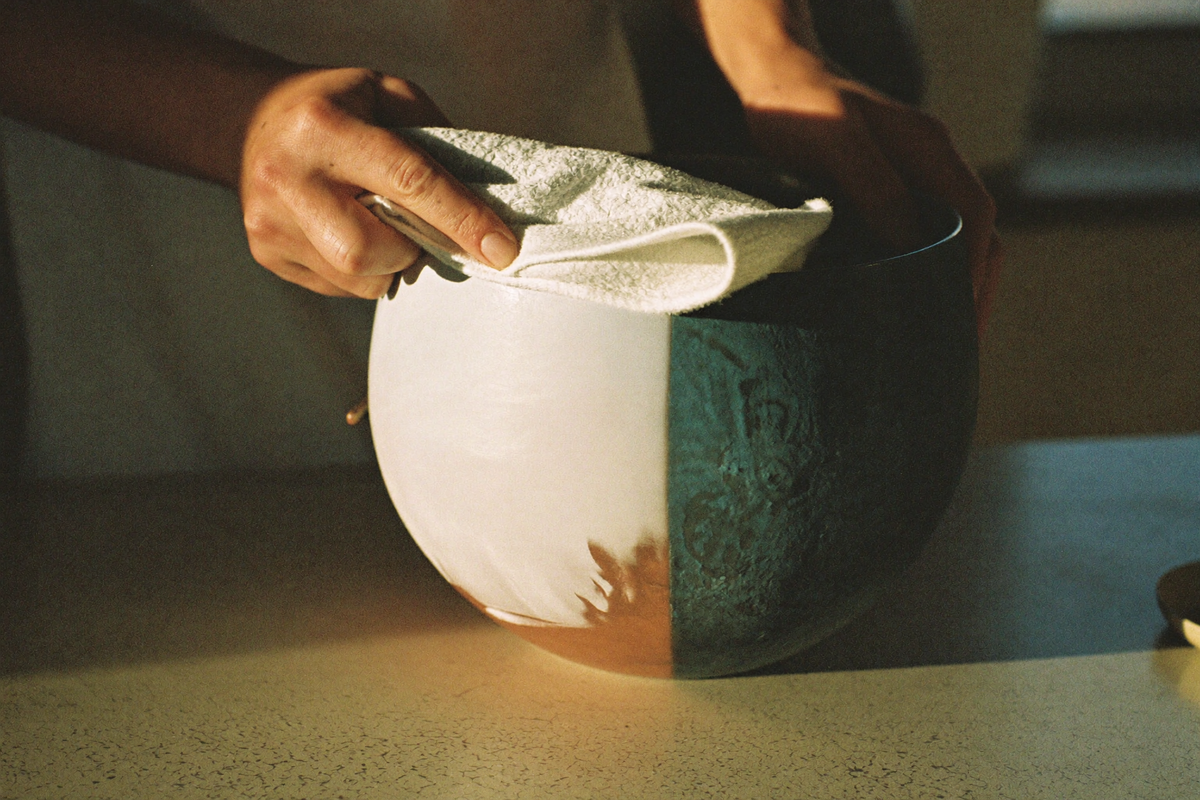
Wash it with warm water, a soft cloth or sponge, and mild dish soap if you want it. Dry it with a towel rather than leaving it to sit wet. That is the complete instruction. Coffee does not build up in a way that requires anything more aggressive, and there is no residue worth removing at the cost of lining.
Four things to avoid, in rough order of how much damage they do.
No abrasives, ever. Steel wool, scouring pads, powdered cleansers, the rough side of a sponge. Tin comes off faster than people expect and it does not come back at home.
No dishwasher. Long exposure to heat and harsh detergent is hard on the lining and unkind to the exterior.
Never heat it empty. Tin melts at a far lower temperature than copper, so an empty vessel over a flame can damage the lining while the outside still looks perfect. This is one of the commonest ways a good cezve dies.
No metal utensils where you can avoid it. A spoon scraping the base is exactly where linings wear through first.
If the interior has gone grey, mottled or blotchy, that is tin ageing and it is normal. Leave it. The thing to look for instead is orange, meaning copper visible through the lining, which is the actual failure and the point at which the vessel needs relining rather than cleaning.
The outside: an entirely different object
The exterior is bare copper, it is not in contact with anything you drink, and it is far harder to damage. Here the constraints relax almost completely.
Copper darkens. That is oxidation and it is normal. Whether you reverse it is a preference, not a maintenance duty, and the vessel works identically either way.
If you want it bright, the traditional method costs nothing: an acid and a mild abrasive. Half a lemon dipped in salt, or a paste of vinegar and salt, rubbed on and then rinsed and dried thoroughly. Commercial copper polishes work and are faster. Both are fine on the exterior.
Rinse and dry properly afterwards, especially where a polish or an acid paste can creep over the rim toward the interior. That is the one place the exterior routine can hurt the interior, and it is easy to avoid by being deliberate about the rim rather than casual.
If you would rather let it age, let it age. More on that decision in our piece on patina, which is genuinely a matter of taste rather than of care.
Storage, which nobody mentions
Copper tarnishes fastest in humidity and in contact with sulphur compounds.
Store it dry and store it with air around it. Sealed in a plastic bag, a vessel that was not perfectly dry will tarnish considerably faster than one on an open shelf. Do not store a cezve with coffee residue in it, and do not stack copper inside copper for long periods, where trapped moisture and abrasion both compound.
None of this is urgent. It is the difference between polishing twice a year and polishing every month, on an object whose appearance is a preference anyway.
Relining, which is ordinary
When the lining wears through, the vessel gets relined. This is a real and continuing trade.
Restorers generally act at around a square inch of exposed copper, some saying a coin-sized patch. We pass that on as their working practice rather than as a standard, because no official body publishes a threshold and we would rather point at the gap than invent a number.
A relined vessel is a maintained object, not a compromised one. Tin linings were always consumable, and the reason tin became traditional at all is that it can be reapplied by hand with simple tools. An object designed to be renewed indefinitely is not diminished by being renewed.
Stainless-lined copper behaves differently: much longer-lived, and not repairable in the same way, so when it eventually fails it fails permanently. Neither is better. They are different theories of how long an object should last and what happens at the end.
What we will not tell you
We will not tell you that a particular polish is safe for interiors, that a home remedy is fine near the lining, or that tin itself is safe. We looked for an official-body source for that last one and found only cookware sellers, restorers and a tin manufacturer, every one of them an interested party. We are not going to convert a trade claim into a safety statement by repeating it with confidence.
The sourced version does the same job and asks less of your trust. The prohibition in the regulation is on copper contact. The lining exists to prevent that contact. So the only question that matters is whether copper is exposed to your coffee, which you can answer yourself by looking for orange in daylight.
The whole routine, briefly
| Surface | What it needs | What ruins it |
|---|---|---|
| Interior lining | Warm water, soft cloth, dry it | Abrasives, dishwasher, empty heating, metal utensils |
| Exterior copper | Nothing, or acid-and-salt if you like it bright | Very little, honestly |
Wash the inside gently and never scrub it. Polish the outside or do not, as you prefer. Store it dry. Check for orange once in a while. Reline when you see it.
That is a genuinely low-maintenance object being described as a demanding one by people who did not separate the two surfaces.