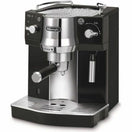
The espresso machine is the only purchase in coffee that people justify with a spreadsheet. Nobody builds a business case for a French press. But a four-figure machine gets one, usually starting with the daily café spend multiplied by 365, and the spreadsheet is where the trouble starts.
Home espresso will not save you money in any way that matters, and the arithmetic is not the reason to do it or not do it. The real question is whether you will still be doing the daily work in eighteen months, because that is what actually determines whether the machine was a good purchase. There is a cheap way to find out before you commit, and most people skip it.
The arithmetic, settled quickly
Let us do the spreadsheet properly and then set it aside.
Say you buy two café drinks a day. A mid-range home setup as of 27 July 2026 runs roughly $500 for the machine and at least $200 for a grinder capable of feeding it, so call it $700 before anything else. On paper that is a few months of café spend and the payback looks obvious.
Then the consumables arrive. Beans, at a rate you will find surprising once you are pulling shots daily and dialling in a new bag every couple of weeks. Milk you throw away, because good microfoam means steaming to order and discarding the surplus rather than re-steaming it. Water treatment, because scale destroys boilers and most manufacturers treat hard-water damage as a warranty exclusion. Descaler, cleaning detergent, replacement gaskets, filter baskets. And the shots you dump while learning, which in the first month is most of them.
None of that is ruinous. All of it is invisible in the version of the calculation people actually do, because the café price silently included every one of those costs plus the labour.
The honest summary: it probably does come out ahead eventually, on a horizon long enough that the machine may need servicing before you get there, and only if you keep using it. That last clause is doing all the work in the sentence, and it is the one the spreadsheet cannot model.
What you are actually buying
Here is the part the savings framing hides. A café's advantage over your kitchen is not the machine. It is a paid person compensating for physics all day.
A working barista adjusts the grind repeatedly through a shift, against changes in air temperature, humidity, the temperature of the burrs themselves, whether the air conditioning is running, and how many people are standing in the room. They pull and taste a shot at the start of every shift and roughly hourly after that, discarding each one. That is not fussiness. It is the labour that produces consistency, and it is priced into your $5.
At home, nobody does this. You will not do it. You should not do it. Which means your espresso will be excellent on a good day and puzzling on a bad one, and you frequently will not know which variable moved. That is not a failure of your equipment. It is the predictable result of removing the person whose whole job was absorbing that variance.
Espresso is the one brew method where the café's advantage is structural rather than merely practised. For filter coffee, a home setup genuinely closes the gap. For espresso it does not, and any honest guide should say so before you spend.
The three thresholds that actually matter
If you do go ahead, three things separate a machine that can make good espresso from one that cannot. Everything else is refinement.
Pressure, and the number on the box is not it. Espresso extracts at roughly 9 bar. Machines advertising 15 or 18 bar are quoting pump capability, not brew pressure, and rely on a relief valve to shed the difference. Above about 10 bar you compact the coffee bed and flow drops rather than improves. A higher number on the box is a specification presented as a benefit.
Pressurised versus unpressurised baskets. Cheap machines ship dual-wall baskets with a single small hole that creates artificial back-pressure. They produce a thick foam that looks like crema regardless of how badly the coffee was ground, which is precisely the problem: the machine appears to work while masking the extraction entirely. This is why beginner machines seem fine and the coffee still tastes flat. The moment you switch to a single-wall basket you will need a grinder that can actually hold a fine setting, which is the real reason grinder-first is not optional here.
Thermal stability, and the warm-up nobody waits for. A domestic machine needs twenty to thirty minutes from cold before its brew temperature is stable, with the portafilter locked in so the group head heats too. The ready light indicates water temperature, not machine temperature. This is the single most common reason the first coffee of the morning is the worst one of the day, and it is free to fix by turning the machine on before you shower.
What a home espresso setup will not do
It will not replace your café. It will not be consistent in the way a café is consistent, because consistency there is a person's job. It will not be faster than a pour-over on a weekday morning, once you count warm-up, dialling in, and cleaning the group.
It will not make you money.
And it will not tell you, before you buy it, whether you are the kind of person who will still be doing this in a year. That is the actual risk, and it is not a financial one. The failure mode for home espresso is almost never "I tried it and disliked the coffee." It is a machine on the counter that you feel faintly bad about, used less each month, kept because getting rid of it would mean admitting the money is gone. That is a normal human response to a large irreversible purchase, and it is worth designing around rather than pretending you are immune to.
How to find out cheaply
The uncertainty is about your own future behaviour, and there is a way to test it that costs a fraction of resolving it by buying more machine.
Buy a manual lever first. A Cafelat Robot is roughly $375 as of 27 July 2026, and a Flair 58 roughly $529 as of the same date. Both are routinely described by reviewers as producing shots competitive with machines several times their price, and neither has a pump, a boiler, or a warm-up cycle to wait through. You supply the pressure with your arm.
That is not a compromise version of the experience. It is the experience with the convenience removed, which makes it a near-perfect test of the only thing you actually need to know. You will find out within a month whether you enjoy the daily ritual of grinding, dosing, distributing, and pulling, or whether you were buying the idea of it.
Then pre-commit the decision now, in writing, before you are emotionally invested:
If I am still pulling shots four mornings a week after eight weeks, buy the pump machine. If not, I have saved myself well over a thousand dollars and learned something true.
Either outcome is a win. That is the point of testing rather than deciding.
The case for doing it anyway
Everything above is an argument against the savings framing, and none of it is an argument against the machine.
If you want the thing itself, buy the thing. A lever machine on a counter is an object somebody designed and you chose, and the two minutes it asks for every morning is the product rather than the cost. Half of what this shop sells exists on exactly that premise, and we would be dishonest to pretend otherwise while listing objects whose entire justification is that you want to look at them.
Just buy it for that reason, out loud, rather than through a spreadsheet that was never really the point. A purchase justified honestly on pleasure survives contact with a disappointing Tuesday. One justified on savings does not.
The setup
If you are going ahead, this is the order as of 27 July 2026:
- The grinder, first and non-negotiable. From about $200 for something that will hold a fine espresso setting. Below this, nothing downstream works.
- A scale to 0.1 g. A multi-site café chain that spent five figures on its espresso machines used an ordinary sub-$50 kitchen scale. Any brand selling you a $250 coffee scale is selling you an identity, and we will say that even while stocking one.
- A manual lever as the test, roughly $375. Or skip straight to the machine if you already know yourself.
- Water treatment, before the machine and not after. Scale is what kills boilers, and it is a maintenance question long before it is a flavour one.
- A pump machine, once the trigger fires.
- A cup with enough wall to hold the heat, preheated, because a 25 ml drink poured into a cold vessel loses a startling share of its temperature before it reaches you.
Six things. The first five we do not sell. The sixth we do, and it is the smallest decision on the list.