Here is a fact that took us by surprise, and it is sitting in plain sight in the federal regulation.
The FDA permits six times more leachable lead in a dinner plate than in a coffee mug. The limits are 3.0 for flat tableware and 0.5 for mugs, in milligrams per litre. And in the Food Code's own table, the description column for that strictest category reads, in full: Coffee Mugs.
The regulation was written with this exact object in mind. Once you see why, you know most of what there is to know about ceramics and lead.
The actual numbers
FDA Food Code 2022, section 4-101.13, with identical figures in the FDA's enforcement guidance for pottery (Compliance Policy Guide 545.450, November 2005):
| Category | What the code lists | Maximum lead |
|---|---|---|
| Beverage mugs, cups, pitchers | Coffee mugs | 0.5 mg/L |
| Large hollowware, excluding pitchers | Bowls over 1.1 litres | 1.0 |
| Small hollowware, excluding cups and mugs | Bowls under 1.1 litres | 2.0 |
| Flat tableware | Plates, saucers | 3.0 |
The ranking looks backwards until you read the definitions, which is where the reasoning lives.
The enforcement guide defines cups and mugs as vessels "commonly used for consumption of beverages, for example, coffee or tea at above room temperature." It defines pitchers, which share the same strict 0.5 limit, by their use with "acidic beverages."
Heat and acid are the two things that pull lead out of a glaze. A dinner plate holds food that is cooling, briefly, on a surface. A coffee mug holds a hot acidic liquid, for fifteen minutes at a time, several times a day, for as long as you own it. The regulator sorted the categories by exposure rather than by size or shape, and the coffee mug came out at the top of the risk ranking. So it got the tightest number.
The stricter test nobody mentions
The number is only half of it. Mugs are also judged more harshly.
For flat tableware, the standard is the average of six units. For cups and mugs, it is any one of six units. A set of plates can have one bad piece pulled up by five good ones. A set of mugs cannot. One failure out of six is a failure.
The test itself is a 24-hour soak in 4% acetic acid, under ASTM method C738. That is roughly the strength of household vinegar, which is a far more aggressive solvent than coffee. The test is deliberately harsher than real use, because a limit that only held under gentle conditions would not be worth setting.
The hole in the bottom
If you have ever picked up a decorative bowl and found an inexplicable hole bored through the base, this is the explanation, and almost nobody writes it down.
Under 21 CFR 109.16(b), quoted directly in the FDA's pottery guidance, ceramicware is treated as unsuitable for food, and therefore exempt from the lead limits, if it either carries a permanent warning fired onto the base (in letters at least 3.2 mm tall, alongside a stick-on label saying something like "Not for Food Use. May Poison Food"), or if a hole is bored through the food-contact surface.
The hole is a regulatory exit. It makes the object physically unable to hold liquid, so it stops being foodware and the limits no longer apply.
Which means a hole drilled in the bottom of an otherwise lovely piece is a signal worth reading. Somebody decided that object should not hold anything you drink. It is not a manufacturing defect and it is not a drainage feature. Treat it as the warning it is.
What this does not mean
It does not mean your mugs are dangerous. Commercial dinnerware sold through ordinary retail channels in regulated markets is tested against these limits, and the limits are enforceable.
It does not mean lead glazes are common. They are far rarer than they were, and most contemporary studio potters work with glazes that contain no lead at all.
And it does not mean we can tell you whether the specific mug in your cupboard is fine. We cannot. Nobody writing an article can. What we can tell you is which mugs sit outside the system that would have caught a problem, which is a more useful thing to know than a reassurance we are not in a position to give.
Where the risk actually concentrates
Four categories fall outside routine testing, and they are worth naming plainly.
Traditional and imported handmade pottery, particularly older pieces from workshops using inherited glaze recipes. The FDA has issued guidance specifically about imported traditional pottery, which tells you where the agency has found problems.
Antique and vintage ware. Lead glazes were ordinary once. A mug from a flea market predates the regulation it would now have to satisfy.
Decorative pieces used as drinkware. The commonest way a compliant object becomes a problem is that somebody drinks from something never intended for it. This is the reason the bored hole exists.
Craft-fair and self-taught studio pieces, where the maker mixes their own glazes. Most are perfectly fine, and the good ones will tell you exactly what is in a glaze if you ask, because they know their own recipe. The concern is not craft pottery. It is craft pottery bought from someone who cannot answer the question.
The common thread is that none of these passed through a channel where anyone tested anything. That is the risk factor, not the material and not the age on its own.
What to actually do
Ask makers what is in the glaze. A working potter knows their glaze chemistry and will answer straightforwardly. Hesitation is itself informative.
Look for the phrase "food safe" and then treat it as the beginning of a conversation. It is not a regulated term. It usually reflects a genuine belief and sometimes reflects an assumption nobody tested.
Be wary of bright orange, red and yellow glazes on older or informally made pieces. Historically those colours were the hardest to achieve without lead or cadmium, so they are where the older recipes concentrated. On modern commercial ware this is not a useful signal.
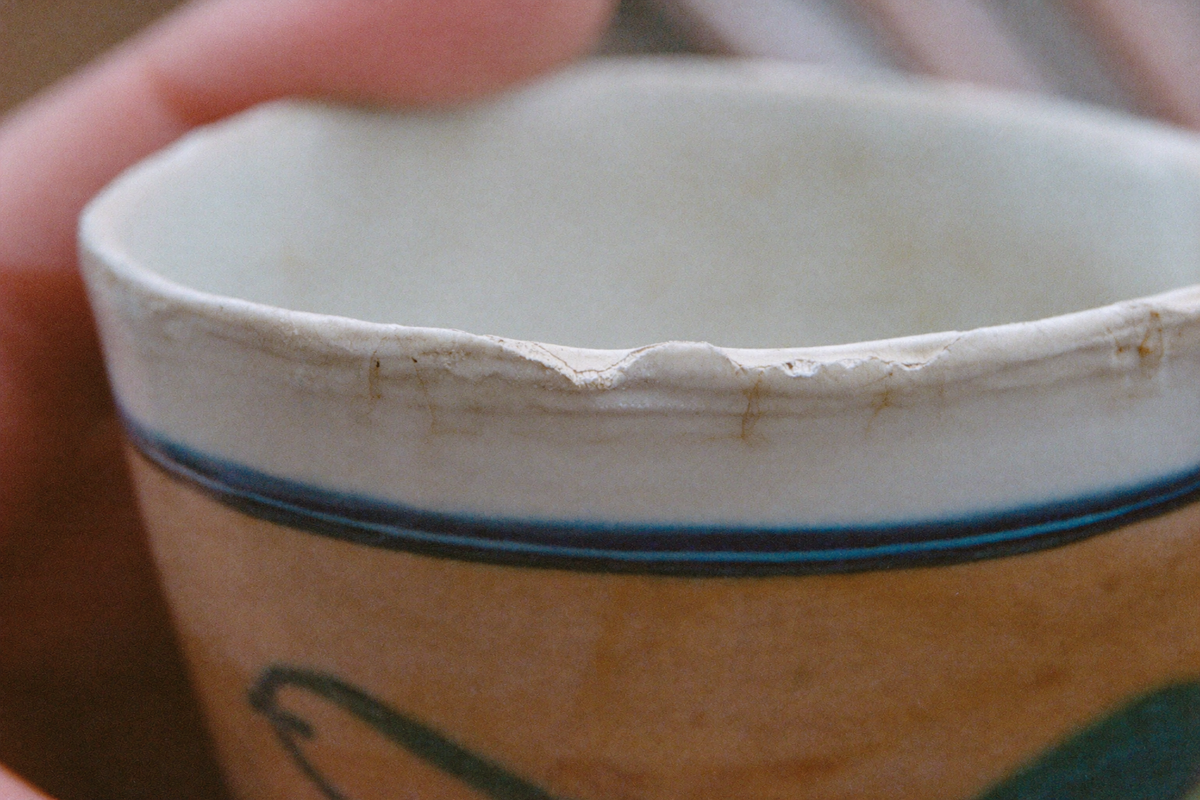
Retire anything visibly deteriorating. A glaze that has gone chalky, dusty or crazed with a fine network of cracks has a compromised surface, and the intact surface is what holds the glaze chemistry in place. This is the one signal you can read yourself, on any piece, without asking anyone.
And if a decorative piece has a hole in the base, believe it.
Home lead test kits exist and are cheap. They are a reasonable screening tool, but a negative result from a swab is weaker evidence than a 24-hour acetic acid extraction in a laboratory, and it should not be treated as clearance for a piece you have real doubts about.
The uncomfortable part
We sell ceramics. So notice that everything above pushes toward buying from channels that test, which is a category we are asking you to trust us to be in.
The claim we are willing to make, and the only one we will make, is a procedural one. We ask our ceramic suppliers for their compliance testing, and where a maker cannot produce it, we say so on the product page rather than leaving the space blank. A hand-thrown mug from a small workshop is a genuinely different proposition from a factory line with a testing regime, and the honest thing is to tell you which one you are looking at and let you decide, rather than photographing both the same way and hoping the question does not come up.
The short version: your ordinary mug from an ordinary shop is inside a system built specifically around it, and that system already treats coffee mugs as the highest-exposure ceramic object in the house. The pieces to think about are the ones that never went through that system at all.