The last inch of a cafetière is usually undrinkable, and most people have quietly accepted this as the price of the method. It is not. The sludge is a procedural problem, and the fix costs nothing but a spoon and about two extra minutes of standing around.
Skim the foam and floating grounds off before you plunge, push the plunger down only to the surface rather than to the bottom, and let it rest two minutes before pouring. The plunger is a gate, not a piston. Using it as a piston is what puts the mud in your cup.
Why the standard method produces sludge
A cafetière separates coffee from water with a metal mesh, and metal mesh is a coarse filter. It passes oils and it passes fines, which is exactly why press coffee has the body it does. Those fines are not a defect of the method, they are the method.
The problem is where they end up. During the steep, the fines gradually settle. Left alone they form a layer on the bottom and stay there. Drive a plunger down through the brew and you do two unhelpful things at once: you stir that settled layer back into suspension, and you force liquid through the bed under pressure, pushing fine particles out through the mesh that were sitting harmlessly below it.
So the last inch is muddy because the plunge put the mud there thirty seconds before you poured.
The method
1. Stir once after pouring the water. This is about saturation, not agitation. Every particle needs wetting at roughly the same moment, otherwise some grounds start extracting late and you get an uneven cup. A consistent, deliberate stir is a brewing parameter, not a flourish.
2. At four minutes, stir the crust. A raft of grounds and foam forms on the surface. Break it with two or three strokes and most of it sinks. This is the stir nearly everyone skips, and it is the one that determines how much material is left floating.
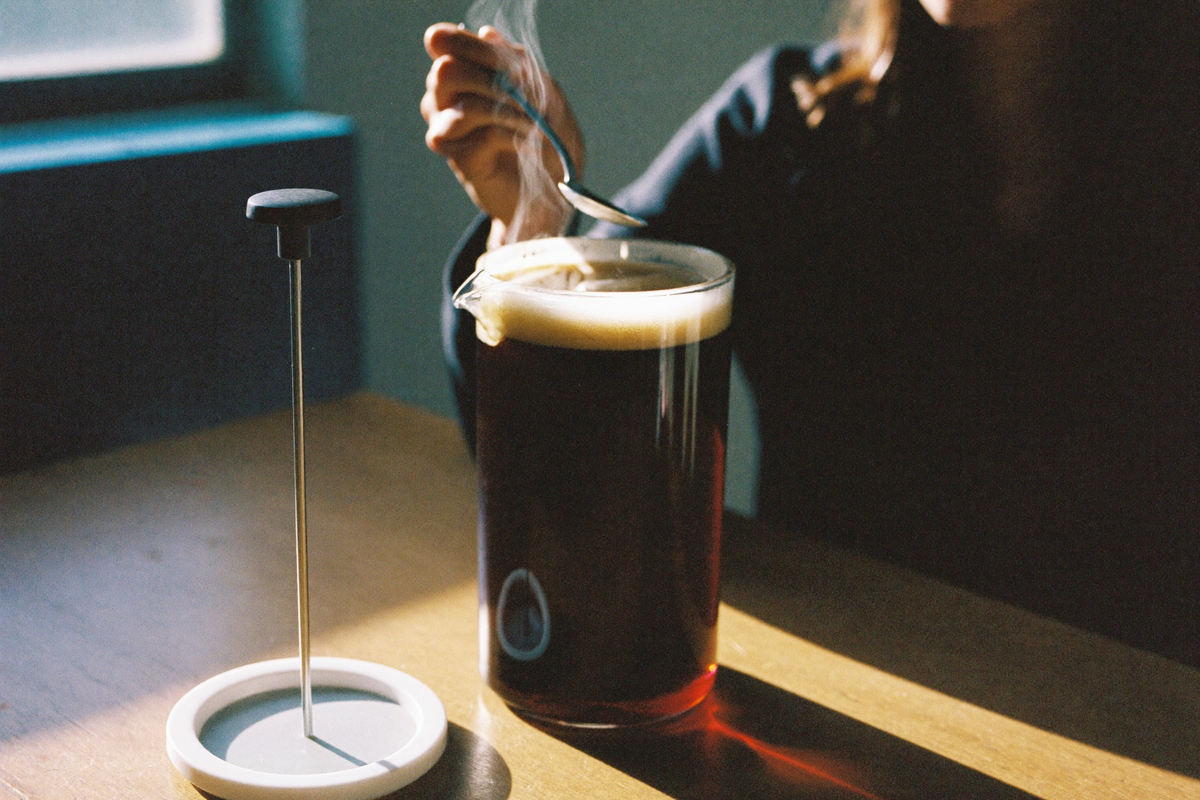
3. Skim. Take a spoon and lift off the foam and whatever is still floating. It looks fussy and it takes about fifteen seconds. This is where the bitterest, driest material is concentrated.
4. Push the plunger to the surface only. Just below the waterline is enough. You are holding the raft down and giving yourself a clean pour, not pressing anything through.
5. Wait two minutes. Nothing happens that you can see, and this is the step that does the real work. The fines settle out of suspension and stay settled because nothing has disturbed them.
6. Pour steadily and stop early. Leave the last centimetre in the pot. That centimetre is where everything you just separated is now living, and it has done its job by being there.
Why it works
Every step is about the same thing: let gravity do the separating, and do not undo it.
The mesh was never going to remove fines, so the strategy is not to filter them out but to leave them behind. Settling is slow, gentle and free, and it produces a cleaner cup than any amount of pressing because pressing works against it.
The two minutes matter more than any other single change. Coffee poured immediately after plunging is a suspension. The same coffee poured two minutes later has had time to become a liquid with a sediment layer under it.
How you know it worked
Look in the bottom of your cup when you have finished, not in the pot. A correctly poured press cup leaves a faint film at most. If there is a visible layer of grit, you either plunged too far or poured too deep.
The second check is temperature, and it is the honest cost of the method. Waiting two minutes means the coffee is cooler when it reaches you. Preheating the pot and the cup buys most of that back.
What this will not do
It will not turn a cafetière into a filter brewer. Press coffee is meant to carry oils and body, and the whole reason to own one is that heavier mouthfeel. If you want a genuinely clean cup with no sediment at all, you want paper, and no technique with a metal mesh will get you there.
It will not fix a grind that is too fine, either. A cafetière wants medium-coarse to coarse. Grind it at pour-over fineness and you will generate far more fines than settling can deal with, and you will over-extract at the same time. Sludge that survives this method is usually a grinder telling you something.
And it will not help if you leave the coffee sitting in the pot. Extraction continues after brewing, so a press left on the table for twenty minutes gets progressively harsher whatever you did at minute four. Decant what you are not drinking straight away.
The short version
Stir, wait, stir again, skim, plunge to the surface, wait two minutes, pour and stop early.
Six steps, one spoon, no purchase. It is the largest single improvement available to anyone who already owns a cafetière, and most people have owned one for years without being told.