Our company has copper in its name. So it is worth being direct about the thing we had to learn before we could responsibly sell a single copper object.
Brewed coffee is acidic enough that United States food regulation prohibits copper from touching it. Not discourages. Prohibits, in the same enforcement class as cooking temperatures.
That sounds like it should end the conversation, and it does not, because the tradition worked this out centuries before the regulation existed. The answer has always been a lining. What follows is what the rule actually says, why coffee falls inside it, and the specific question you should ask before you buy any copper coffee object from anyone, us included.
The rule, quoted rather than paraphrased
The FDA Food Code is the model regulation that most American state and local health authorities adopt, usually close to verbatim. Chapter 4 governs equipment and utensils. Section 4-101.14 reads:
Copper and copper alloys such as brass may not be used in contact with a food that has a pH below 6 such as vinegar, fruit juice, or wine [...]
Three details in that section change how you should read it.
"May not" is not soft language here. The Food Code defines its own vocabulary in the preface, and the entry is one line: "May not" means absolute prohibition. That is the document telling you how to read its own verbs, so there is no interpretive room to treat this as a recommendation.
It is marked with a P. The Food Code sorts every provision into three categories of importance. A Priority item is defined as one "whose application contributes directly to the elimination, prevention or reduction to an acceptable level, hazards associated with foodborne illness or injury and there is no other provision that more directly controls the hazard." Below that sit Priority foundation items, which merely support Priority items, and Core items, which cover general sanitation and maintenance. The copper section carries the P. It is in the top category, and the definition is explicit that nothing else in the Code controls this hazard more directly.
And there is exactly one exception, which is not ours. Copper may contact ingredients below pH 6 in the prefermentation and fermentation steps of beer brewing. That is the entire carve-out. There is no exception for short contact times, none for coffee, and none for objects sold as decorative that people use anyway. The narrowness is deliberate. When a regulator writes one exception that specific, they have considered the category and declined to widen it.
The same text has been adopted at state level. Virginia's administrative code carries it word for word, adding only an allowance for apple butter and molasses during processing.
Coffee is not a borderline case
The obvious question is whether coffee is actually acidic enough to fall inside a pH 6 line. People have strong intuitions here, usually shaped by whichever brand last sold them a low-acid roast.
A 2018 study in Scientific Reports by Rao and Fuller measured pH across light roasts from Brazil, Ethiopia, Colombia, Myanmar and Mexico, brewed both hot and cold. Hot brew came in between pH 4.85 and 5.10. The Ethiopian Ardi was the most acidic at 4.85. The Brazilian was the least acidic at 5.10. Cold brew landed in a comparable range, with the two methods together spanning 4.85 to 5.13.
So the least acidic coffee in a peer-reviewed sample of five origins still sat nearly a full pH point below the regulatory line, and the pH scale is logarithmic, which makes that gap larger than it looks.
There is no roast level, origin, grind or brewing method that gets coffee over pH 6. This is not a marginal case where a careful buyer might reasonably conclude the rule was not written with them in mind. Coffee is comfortably, unambiguously inside the prohibition, and the ordinary variation between coffees is not remotely large enough to matter.
Which means the whole safety question collapses into one thing.
The lining is not a finish
If coffee cannot touch copper, then on any copper vessel intended for coffee, the interior surface is doing all the work. It is not decoration and it is not a quality upgrade. It is the entire mechanism by which the object is permitted to exist.
The tradition understood this. A Turkish cezve is copper on the outside and tinned on the inside, and it has been made that way for a very long time, for reasons that predate any food code. The copper is there because it moves heat quickly and evenly, which matters enormously in a vessel where you are watching for a foam to rise and pulling it off the heat within a second or two of the right moment. The tin is there because the coffee has to sit somewhere that is not copper.
Copper where the heat is, something else where the coffee waits. That principle turns up independently in the trade literature. In 1922, William Ukers ranked the metals by how little they were attacked by coffee, put silver, aluminium, Monel and tin at the top, placed copper well down the list, and stated plainly that whatever you brewed in, the vessel coffee actually stood in should be earthenware or glass. The 1922 industry position and the modern regulatory position are the same position.
One thing we will not tell you: that tin is affirmatively safe. We looked for an official-body source saying so and found only cookware retailers, restoration workshops and a tinplate manufacturer, all of whom sell tin. We are not going to launder a trade claim into a safety claim by repeating it confidently.
What we can tell you is the sourced version, which is more useful anyway. The prohibition is on copper. A lining's job is to keep the coffee off the copper. That makes the operative question "is any copper exposed to the drink," which is a question you can actually answer by looking, rather than "is tin good," which you cannot.
The part that makes this hard to buy
Here is the uncomfortable structural fact, and it applies to the whole category rather than to any particular seller.
A lined copper cezve and an unlined decorative one are indistinguishable in a product photograph. Both are copper outside. Both are shot from the same angle. If anything the unlined one photographs better, because bright bare copper reads as cleaner and newer than a dull grey tin interior, which many buyers mistake for tarnish or damage.
Lining costs money. Skipping it costs nothing and is invisible at the point of sale. And a listing that simply says nothing about the interior is currently free to write, carries no penalty, and outsells nothing.
That is a market where the cheaper, worse option is systematically favoured, not because anyone is lying, but because the honest seller has no cheap way to prove they are the honest one. Most of the importers reselling these objects are acting in good faith and have never asked their own supplier the question, because nobody asked them.
So the absence of a claim about the lining is not neutral information. It is the most common state of affairs, and it is the state you cannot distinguish from a problem.
It also expires
Even a properly lined vessel is not safe as a permanent attribute. It is safe as a current state.
Tin is soft. It is worn away by abrasion from spoons and scouring pads, and it can be damaged by heating an empty vessel, since tin melts at a far lower temperature than copper. A cezve that was entirely compliant on the day it shipped can develop exposed copper in year four with nobody having done anything obviously wrong.
So the question is not "is this object safe" but "is it still safe," and the answer changes over time.
Restorers who reline copper cookware converge on a rough working trigger of about a square inch of visible copper, some saying a patch roughly the size of a coin. We are passing that on as restorers' practice rather than as a standard, because no official body publishes a threshold, and we would rather label the gap than paper over it.
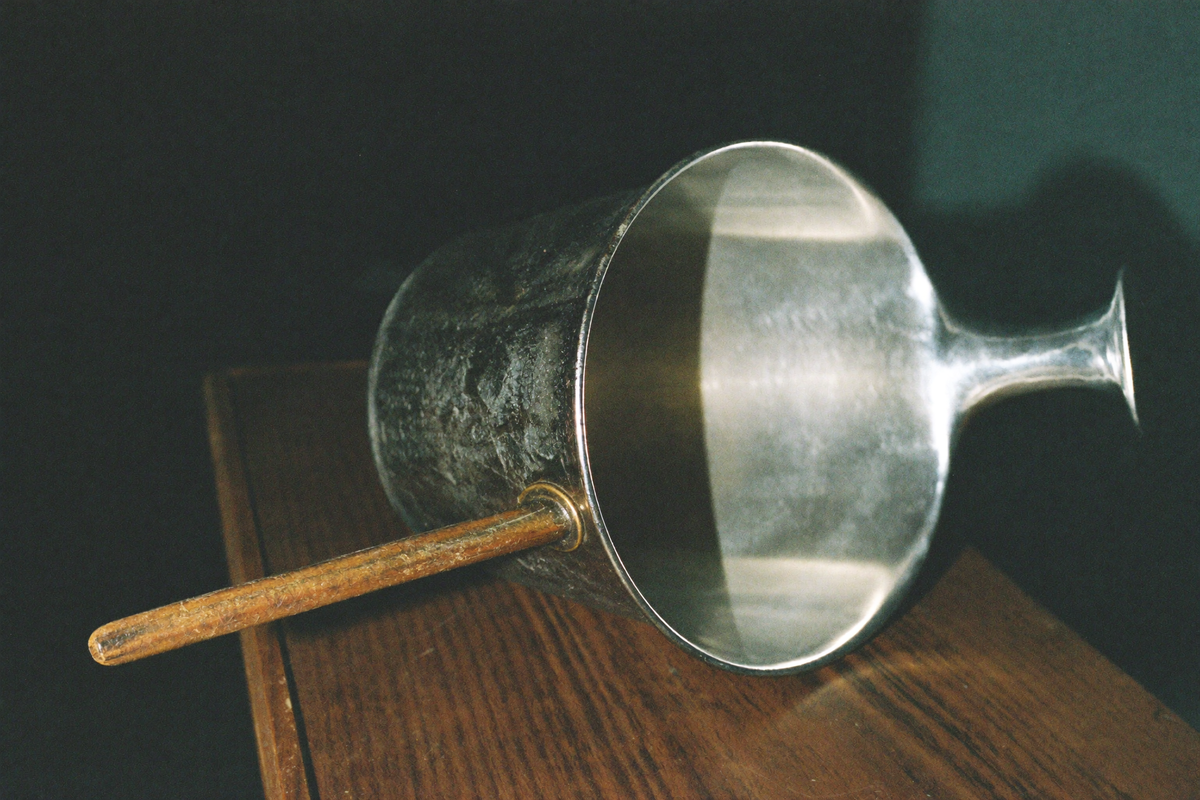
The practical version is simpler. Look inside your vessel in good light. You are looking for the colour of copper, which is unmistakable and orange, appearing in the interior surface. You are not looking for darkening, which is a different thing entirely and is covered below.
Darkening is not damage
The single most common reason people ruin a cezve is that the tin interior goes grey and blotchy, they assume it is tarnish or filth, and they attack it with a scouring pad.
Tin darkens. That is what tin does. It is a normal surface change and it does not mean the lining has failed. Scrubbing it hard with an abrasive removes lining, which is the one thing that actually matters, in pursuit of an appearance that was never a problem.
The distinction to hold onto is between a grey or mottled tin surface, which is fine and expected, and orange copper showing through, which is the thing to act on. If you can see copper, stop brewing in it until it is relined.
What to ask before you buy
If you take one thing from this, take a question rather than a conclusion.
Ask the seller, in writing: what is the interior of this vessel lined with, and can you confirm the supplier's answer rather than your own assumption?
A good answer names a material. Tin, stainless steel and nickel are the linings you will encounter. A good answer also distinguishes what the seller was told from what the seller has verified, because those are genuinely different, and a seller who makes that distinction unprompted is telling you something reliable about how they operate.
A bad answer talks about the copper. If the reply describes the quality of the copper, the thickness of the gauge, the hand-hammering or the heritage of the workshop, and never states what is on the inside, you have not received an answer. That evasion is usually not deception. It is frequently a seller who does not know and has not asked.
And treat "food safe" on its own as an unanswered question. It is an unregulated phrase in this context and it is compatible with the seller having simply assumed.
The same test applies to us. If you ask us this and we give you a vague answer, we have failed and you should buy elsewhere.
What we will not do
We are not going to tell you that you have been poisoning yourself, and we are not going to tell you that you are fine.
We do not know how much copper any particular unlined vessel releases into any particular cup of coffee. Nobody has published that measurement for coffee specifically, and it would depend on the vessel, the contact time, the temperature and the coffee. For scale, the EPA's action level for copper in drinking water sits at 1.3 mg per litre, set against acute gastrointestinal effects. That number is a benchmark for how regulators think about the magnitudes involved. It is not a prediction about your cezve, and we are not going to dress it up as one.
The rule is enough to act on without any of that. A Priority-class prohibition exists, coffee falls inside it, the lining is the reason the object is permitted, and you can check the lining yourself. That chain of reasoning holds up entirely on documents anyone can look up, and it needs no claim about what happens inside a human body.
The part where this comes back on us
Everything above teaches you to interrogate a seller. Read it again and notice who is being asked to do the work.
You are the party with the least information, the least leverage and no ability to inspect anything before it arrives. We are the party that talks to suppliers. A store that publishes a careful guide to asking hard questions, and then lists copper objects without answering those questions itself, has performed conscientiousness while transferring the actual duty onto the person least equipped to carry it.
So the commitment, plainly. We publish the lining material on every copper object we list, on the product page, before it goes on sale. Where our supplier will not put the answer in writing, we do not stock the object. Not a smaller order, not a cautious footnote. We do not list it.
That will cost us. Some genuinely beautiful workshop pieces come through channels where nobody can tell you what is inside, and a rule like this means walking away from objects we would like to sell. We would rather absorb that than write an article like this one and quietly not apply it to ourselves.
The honest summary of the whole category is short. Copper is a superb material for moving heat and a prohibited one for holding coffee, the tradition resolved that contradiction with a lining long before anyone regulated it, and the only real question on any copper coffee object is whether that lining is there, whether you can find out, and whether it is still intact.
If the seller cannot tell you, that is your answer.